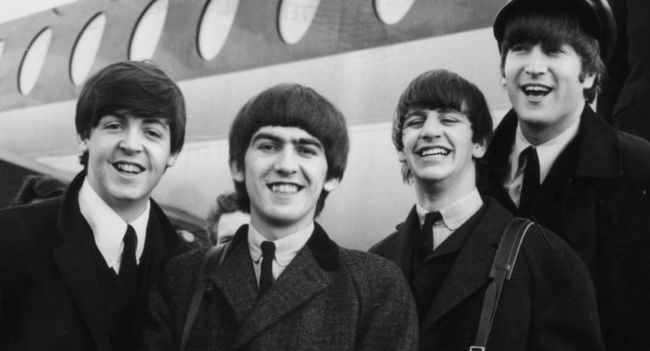

In celebration of its 60th anniversary on August 5, Paste will be publishing essays about The Beatles’ Revolver.
In 2007, Terry, my father-in-law, showed Rachel, my wife, a movie called Across the Universe. At the time of its release, Rachel was nine and already a fan of musicals, an infatuation that would continue to the present day. Terry, who would one day tell me that John Lennon is a better writer than William Shakespeare, figured now was an opportune moment to educate his daughter about a band he loved called the Beatles. Here was a jukebox musical film about one of the most beloved bands in the popular music canon, one about a group he loved and one he believed his daughter would also love. He guessed right. She loved (and still loves) Across the Universe, and she loved (and still loves) the Beatles.
Fast forward to July 2025, and Rachel and I are sitting on our couch, trying to pick a movie to watch. She asks me if I’ve heard of Across the Universe, and I tell her I haven’t. I love the Beatles now, but I didn’t grow up with them the way Rachel did. My mom raised me on an exclusive diet of classic college and alt-rock: The Cure, The Smiths, Smashing Pumpkins, Pixies, Nirvana, Sonic Youth, the various countercultural artifacts of her teenagedom and early twenties. My dad, meanwhile, just wasn’t much of a Beatles fan. The most exposure I received to Beatlemania as a child was through A.) 2009’s The Beatles: Rock Band on Xbox 360, B.) Covering “While My Guitar Gently Weeps” in my middle-school “band” and embarrassingly dropping a drumstick mid-twirl in front of a crowd of parents, and C.) My best friend, who had his first makeout session at a Paul McCartney concert when he was thirteen, and his dad pretended not to notice from two seats over.

I would witness a Paul McCartney set of my own in 2018 at Austin City Limits, the first large-scale music festival Rachel and I attended together. Of course, Macca was one of her most anticipated performances. I studied up months before the show, listening to the White Album in full for the first time and acquainting myself with the hits. Many of them I knew through cultural osmosis, and others were completely new to me. I know I’m a walking anomaly—a music critic who’s also a late-bloomer Beatles fan—but I am one nonetheless. Around the time of 2021’s Get Back, the excellent and incredulously candid Peter Jackson docuseries, I’d listened to most of their discography. But it wouldn’t be until last summer that I’d unearth a new layer within their music.
Let me say here that I’m not the biggest fan of musicals, and I find most jukebox musical movies to be cheesier than a Pizza Hut stuffed crust. But, as someone who has now seen a decent amount of musicals, I’ve come to recognize that the cheese is part of the intrinsic charm. Musical theater fans typically know that the shows are corny, and the cast and crew lean into it. It’s not for me, but I’ve learned to respect it as an artform. I’m typically game to watch any movie, especially if I haven’t seen it before. Rachel had told me how important Across the Universe is to her, so I was excited to watch something that occupied a significant part of my spouse’s upbringing.
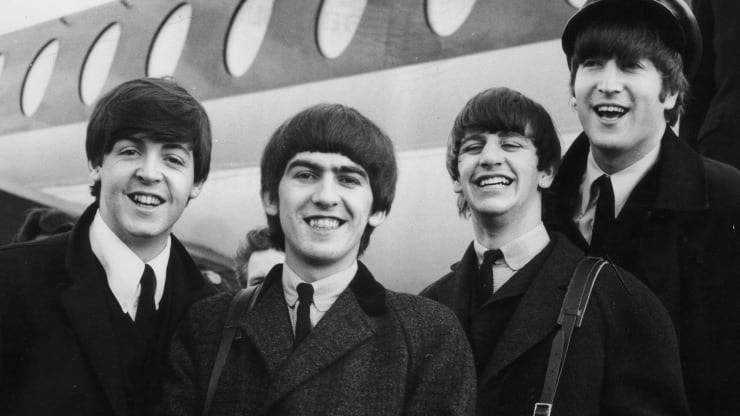
As I’ve become a bigger Beatles fan over the years, Rachel and I have bonded over their music, approaching it from completely disparate angles. She’s the one who’d grown up with them, and I’m the one who’d grown to love them. So when she showed me Across the Universe, I figured that, if there were a jukebox musical I could get into, maybe it would be this one. I enjoyed it upon my initial viewing, but what I’ve come to appreciate about it in the year since is how it showcases one of the most magnetic elements of the Beatles: the multiplicity of their music.
In one of the film’s most pivotal scenes, the character Max attempts to avoid getting drafted for the Vietnam War. The song that plays here, “I Want You (She’s So Heavy),” is, on its face, obviously not about the Vietnam War. John Lennon wrote it as a song about the totalizing, engrossing romance he felt for Yoko Ono. But in the film, a frankly eerie poster of Uncle Sam sings the song to Max about how he wants him to join the military. Even though Across the Universe has no songs from Revolver, this scene makes me think of that album, especially for the ways the Beatles developed their songwriting here, harnessing that ethos of multiplicity to make songs about one specific thing that are also about everything. One that has grown on me in the time since watching the film is Revolver’s penultimate track, “Got to Get You into My Life.”
You wouldn’t be at fault for thinking McCartney penned the tune for a certain paramour, one who “didn’t run” and “didn’t lie,” one who knew Macca wanted to hold them. There’s a visceral yearning to his delivery, and the horn section (the first time the band had ever used one) amplifies the romantic grandeur. The Beatles already had a bevy of love songs to their name by this point in their career; they were universal heartthrobs who’d inspired one of the original stan armies. But this time, Macca wasn’t writing to a hypothetical woman, nor was he singing to you, the listener. He was singing about weed.
Listening with that knowledge in mind, the signs are much clearer. “I was alone, I took a ride / I didn’t know what I would find there,” goes its opening line. After hitching said ride, Macca admittedly develops a THC dependency that requires him to partake in his favorite new substance “every single day of my life.” In 1997, he openly admitted that the song was about his discovery of pot. It’s a discovery Macca owes to Bob Dylan, who, as the legend goes, introduced him and his bandmates to it in a New York hotel room in 1964. “‘Got to Get You into My Life’ was one I wrote when I had first been introduced to pot,” Macca recalled in Barry Miles’ book Paul McCartney: Many Years from Now. It’s “really a song about that, it’s not to a person,” he added for further clarification. In a 2015 interview with British tabloid The Mirror, he explained that he no longer smoked weed, instead opting for “a glass of red wine or a nice margarita.”
Personally, I’m not that into weed. I could probably count on two hands the total number of times I’ve smoked marijuana in my twenty-nine years of life, but there’s something about Paul McCartney’s subtle stoner anthem that resonates with me on another level. Namely, it lies in how he wields malleability, how it’s buoyed by songwriting so excellent and mutable that it became an influential hallmark for decades to come. Calling the Beatles an influential band feels both redundant and like a vast understatement, but “Got to Get You into My Life” partly demonstrates that influence in media res. What is a relatively simple song about mind-altering chemicals became an example of the shifting and dynamic possibilities that lie dormant in music itself. Its directness is paradoxically pliable. McCartney eschewed puzzling ambiguity but, in that same process, managed to convince his audience he’d written an earnest love song about another person, only to reveal its true muse three decades later.
One of the things that I’ve come to appreciate the most about the Beatles is their savvy pop craftsmanship, how they uphold songwriting as a vital and continuously evolving process, how they make the act of expression feel like an art form we’re all constantly honing. That expression is what ultimately grants us our underlying humanity and agency, which is a worthwhile endeavor: a craft whose aim is making ourselves heard amid the din of daily existence. And to think that Sir Paul McCartney made me think about all of this with a little song about weed.
But what I admire even more than any of that is the way the Beatles exemplify music’s potential as a bonding agent. They begat a community unto themselves, and those communities have multiplied and sprouted in the intervening years. I’d even say that Rachel and I have built a small community of two around our shared Beatles fandom, as silly as a two-person community might sound on paper. When we’re in the car together, I’ll often throw on a monster playlist I’ve made that consists of a bunch of music I know both of us like. There’s Big Indie like Fleet Foxes and the National; modern pop auteurs like Chappell Roan and Olivia Rodrigo; new music from Kevin Morby and old music from Aretha Franklin. But the Beatles take up more than 3.5 hours’ worth of music on that playlist, so their songs make frequent appearances on our drives. We’ll both sing along quietly, our voices blending into the background together. She’s been singing their songs for far longer than I have, but we’re both singing all the same. It’s moments like these when I think how glad I am that I got the Beatles into my life.