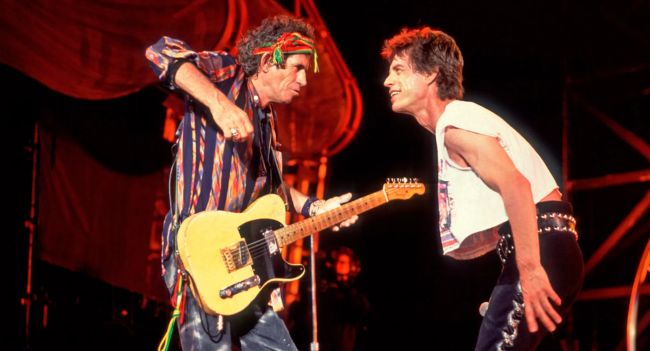
The Beatles and The Rolling Stones may have started out looking like a group of mates getting together to play a few tunes, but as the years passed, the relationship between Mick Jagger and Keith Richards became far more complicated.
Before they even started playing music, Jagger and Richards had known each other since childhood. Both men lived just a few streets away from each other, and they caught up later in life when they met at a train station and discovered a mutual love for American blues. After Jagger got a call from Brian Jones to play for one of the newest bands on the London club scene, he motioned that Richards should come into the picture as well, and from there, The Rolling Stones were formed.
Despite being very much Jones’s band, both Jagger and Richards became the inseparable duo that took the group to major heights, writing iconic material like Sticky Fingers and Let It Bleed. While the good times easily carried them through the 1970s, their relationship became a bit rockier when the MTV era kicked in, and the landscape of popular music changed.
As the band adapted to the changing times, Richards increasingly came to see Jagger as overbearing, patronisingly referring to the frontman as ‘His Majesty’. In his autobiography, Life, Richards admitted their relationship had been strained for decades. By the 1980s, with the Stones entering a new phase of their career, Jagger also seemed less dependent on the band, something his collaboration with David Bowie only reinforced.
Richards’ attitude towards Jagger grew so hostile that he finally declared his grievances through his songwriting. On 1980’s Emotional Rescue, Richards takes the lead vocal on the song ‘All About You’, talking about a person with an inflated ego who needs all the attention for themselves. While he was going through a separation from Anita Pallenberg at this time, it’s hard not to see some of these lines being aimed at Jagger, especially since Richards took to nicknaming him ‘Bitchy Brenda’ during rehearsals.

The clearest example of the band not gelling properly, though, arrived on their 1986 album Dirty Work, one of their most disappointing releases to date. Although the group were convinced that this was the new sound they were looking for, Ronnie Wood didn’t mince words when discussing potential reasons why it flopped. After its dismal reception, Wood said that the band included a handful of his songs on the record was proof that Jagger and Richards were no longer functioning.
When Keef did show up on the record, though, most of what he had to say wasn’t kind. On the song ‘Had It With You’, it’s hard not to look at this as Jagger and Richards singing to themselves. Each line is full of backhanded compliments towards the other, with Jagger calling this character a “dirty fucker” and Richards adding the line “singing for your supper”.
Throughout all of the animosity, both Jagger and Richards always came back to each other for security. The band’s importance supersedes any individual member, and the ‘Glimmer Twins’ have always compared themselves to a dysfunctional rock and roll marriage.
When asked about his relationship with Richards for The Daily Mail, Jagger compared them to brothers because of their shared experiences. He said, “If you work with someone that long, it makes a lot of bonds, a lot of memories, and things you relate to from your past. You have reference points that you can evoke. You have relationships with everyone in the band and with people in the periphery, so it’s a large group. But it isn’t a family”.
In the same interview, Richards was slightly less candid about his relationship with Jagger: “Everybody’s still here, which is obviously an important ingredient,” he said. “With any band that has been around, even for a few years, not everybody always likes everybody. But maybe you need that conversation to continue, and music is the one way you can do that. It’s stronger than the other things that get in the way”.
That said, Richards didn’t start to mellow out on his opinion of Jagger either. Although Jagger still goes out on the road on solo tours and releases material outside of the Stones, Richards isn’t the biggest fan, and once incorrectly called Jagger’s album, “Dogshit in the Doorway” rather than Goddess in the Doorway.
Despite the bad blood over the years, Richards knows that the best way to communicate with Jagger isn’t through words but through music. When talking about the relationship that they’ve built over the years, Richards has been open about how music always brings them back. He once noted, “My main means of communication is through music. Call it a gentleman’s agreement or something like that. It’s unspoken, but I notice that many of the barriers or whatever you want to call them tend to disappear once we start working”.
That has always been the strange contradiction at the heart of the Rolling Stones. Jagger and Richards have spent decades taking aim at one another in interviews, biographies and, occasionally, even in song, yet the moment they begin writing together, the friction seems to become part of the creative process rather than an obstacle to it. Plenty of great songwriting partnerships have ended because the personalities became too difficult to manage. The ‘Glimmer Twins’ somehow turned that tension into fuel, which perhaps explains why they’ve outlasted so many of their contemporaries.
The drama may work out great for the headlines, but the main connection between Jagger and Richards is plugging in their guitars and loving the sound they pull out of each other. Given the band’s history with rock and roll, it makes sense that the band would have their fair share of hiccups over the years.
These songs were based on the blues from the beginning, and every song they’ve put out has been about the sour side of the heart. The blues might build up resentment among the best of friends, but it can also be the music that leads you back home.