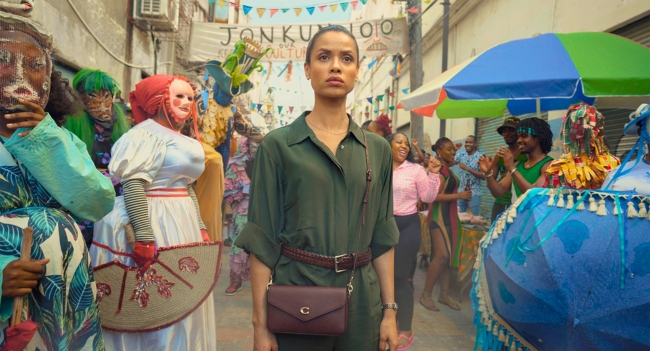
Possession is the latest genre-bending thriller to be landing on Sky and Now. Here, Stylist sat down with Gugu Mbatha-Raw, Bel Powley and creator Karla Crome to dig into the real-world history behind the show.
Thrillers have dominated our TV screens this year. Whether it’s Widow’s Bay, Furious, Lucky or I Will Find You, plenty of titles have been keeping viewers hooked from the minute they’ve pressed play. And in some cases, they also offer a way to explore more difficult, real-world themes – something that Possession, Sky’s latest supernatural thriller, offers in spades.
The five-part series centres on Claudia (Gugu Mbatha-Raw), an ambitious mixed-race lawyer who travels to Jamaica to help a wealthy white aristocrat challenge his father’s will, which has left everything to a local man, Cudjoe East (Sheldon Shepherd).
Moving between the present day and the 1760s, the story takes an unsettling turn when Claudia uncovers a disturbing link between a plantation’s brutal past and the injustices that continue to shape the present.
The initial idea for the show was brought to its creator, Karla Crome (Something Very Bad Is Going to Happen), who couldn’t stop thinking about it. “[I was immediately taken with the concept of] an eyewitness to slavery who lived to the present day and was then involved in an inheritance dispute over his own reparations,” she tells Stylist.
“The two initial decisions we made were that we would see two dual timeframes: in the 1700s and the present day. So we could literally see how the past affected the present, the metaphorical and actual legacies of slavery from those colonial times into the present day.”
“I also wanted to centre this mixed-race experience as someone who was culturally British but has Jamaican heritage, which is similar to my own experience.”
One of the show’s most significant themes is reparative justice and the ways in which the legacy of colonialism continues to shape British society, regardless of our individual cultural heritage.
“There were facts that we came across in our research, which I really wanted to embed in the script because I found them so surprising,” says Crome.
“One being that the British taxpayer only finished paying back money that was given to slave owners to compensate them for the loss of slaves – and that only ended in 2015. So my taxes went to paying off these families, which is shocking and upsetting and really surprising.”

Credit: Nile Saulter/Sky
Working alongside the show’s director, Jamaican filmmaker Storm Saulter, Crome also collaborated with cultural adviser and Kumina practitioner Dr Stines, who was integral to weaving the rich history of Caribbean folklore into the plot.
“We don’t know much about obeah [loosely: a folk religion combining traditional African rites with aspects from other religions, practised especially in the Caribbean] because it was illegal; it was suppressed, and it was feared because it gave people their peoplehood and their sense of self, which slave owners would try to sever,” says Crome.
With Dr Stines’s guidance, Crome drew on a mixture of stories passed down through generations and her own imagination when writing the supernatural elements of the series.
It was Crome’s vivid script that drew the show’s leading actor, Gugu Mbatha-Raw (Fuze), to the role of Claudia.
“The dialogue pinged off the page, and I felt like Claudia was a really interesting character because she starts off reserved and ambitious, but somehow disconnected,” she says. “I loved that she goes on this massive journey. As an actor, that’s always really juicy to get your teeth into – to feel like your character has changed and has this big arc.”
Another factor that drew her to the project was her co-star, Bel Powley (Everything I Know About Love), who plays the isolated and unforgiving character of Charlotte Connaught. “This is my first time ever playing an antagonist, which is why I wanted to do it because it would be a huge challenge,” Powley says.
You can’t look away because is so suspenseful

Credit: Des Willie/Sky
“The challenge [was] finding the emotional hook to someone, but without absolving the horrible things that they do. What I found interesting with Charlotte is the kind of duality that exists between her, where she can be really frightening but also be really vulnerable. And this idea that personal trauma can coexist with structural power and how that can be abused.”
Powley worked with costume designer Suzanne Cave to further showcase Charlotte’s character arc. “As Charlotte’s power grows, the corsetry gets tighter and the panniers get bigger, which is actually so helpful for [getting into] character – you move in a different way. And then obviously the fabrics get heavier. It’s more velvets and dark reds, and it ends with a fabulous magenta.”
When it comes to the show’s more serious themes, its supernatural and horror elements are often used to bring them to the surface – something that, as a viewer, had me watching from behind my hands at times.
“I was a bit intimidated to approach horror,” says Mbatha-Raw. “It’s not necessarily something that I’m naturally drawn to. But when we spoke about it, I thought, actually, it’s really bold and it makes you uncomfortable, but so does the history of slavery. It’s uncomfortable, it’s difficult, it’s scary. And I think it’s a really good genre for exploring those kinds of issues because it goes to the taboo areas, it goes to the scary places in the psyche.”
“I think for something that’s especially historic where you think, ‘Oh, is this political? Does this belong to history?’ It grabs your attention and you can’t look away because is so suspenseful.”
As Powley says: “The history becomes the horror.” Possession confronts a past that has too often been omitted from our screens – and tells a story that promises to stay with viewers long after the final credits roll.
All episodes of Possession are available from 6 August on Sky and streaming service Now.