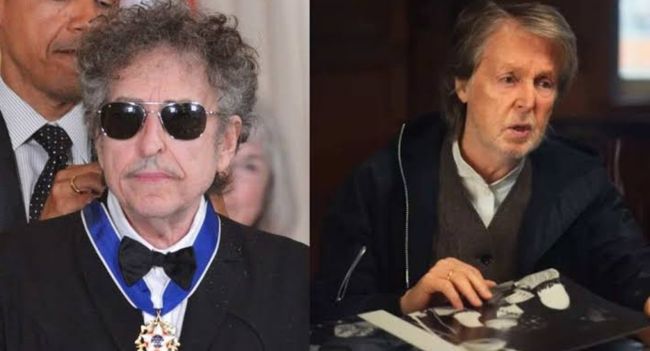
The influence of the writer William S Burroughs presided over the 1960s like a North Star, and he once fittingly wrote, “Artists to my mind are the real architects of change, and not the political legislators who implement change after the fact.”

In postlapsarian times like the present, where politics seemingly answers to no one, Burroughs’ statement seems to have a glossy-eyed naivety to it. However, when you look back at the 20th century with a retrospective glance, the mythology and iconography is, indeed, dominated by the designs and ideologies of the great artists. The chief architects being Bob Dylan and The Beatles.
Their brand of pop might have been delivered with a limited vocabulary when it comes to the grand scheme of music, but with four chords and the truth, they were amplified beyond anything ever heard before. In a very literal sense, Bob Dylan and The Beatles may, in fact, represent the two most significant artists since cavemen started scribbling on walls. The facts back it up.
Amadeus Mozart was never actually heard by anyone outside of a few thousand Viennese elite, the works of Leonardo da Vinci still mean nothing to the man on the street who can’t afford to visit the Louvre, but at a time when the human population was booming alongside the means to distribute art en masse, the original vagabond and the Fab Four sent pop culture whirling towards a profound future.
To validate this in the cynical modern age, you only have to look at the figures behind what Paul McCartney and his mates achieved. The Beatles sold around 600 million albums in their time. When they released their debut single, the world’s population was 3.1 billion, which means that 20% of the world’s population at the point of their pomp had technically bought one of their records.
While that stat cooks the books a little, given that the population has skyrocketed since then and much of their sales have come from more recent times, even that sustained success is a symbol of the way they have transcended the usual boundaries of art and permeated society at large. If anything, they’re bigger than ever.
Without Dylan, they would never have reached such a pinnacle. By McCartney’s own admission, he was their “idol“, and his poetry “brought a new kind of intelligence to pop songwriting“, as David Bowie once put it. The Beatles took a leaf out of his book and a toke on his joint the night they met at the Delmonico Hotel in 1964. Suddenly, McCartney discovered ”the meaning of life”. It was an encounter that spun the Beatles’ discography out in a more progressive direction. Given the commercial clutch they had already built up, culture followed their lead.
It was a lead that brought depth, political bite, liberation and the avant-garde closer to the dramatically shifted centre of art. As the philosopher Mark Fisher once said, “The Beatles basically trained people to expect things to get more and more experimental the more popular they got.”
Most of all, in a manner that is both obvious in retrospect but largely disregarded, the Fab Four’s revolution was about having a good time. With the Vietnam War waging, to some extent, The Beatles tragically reminded the masses of the young brothers and sons being shipped off to die in their droves overseas, and those they were killing many miles away.
This alone poignantly highlighted the need for the exultancy that their music provided. Exultation was essential to stay sane in such a climate. In many ways, above everything else, this was the core tenet of the so-called hippy movement: Turn on, tune in, drop out.
Defining this was a song that Hunter S Thompson called “the hippy national anthem“, Bob Dylan’s 1965 classic ‘Mr Tambourine Man’. Fittingly, this is also McCartney’s favourite. “I know it’s corny, but I heard him do it at the Albert Hall [May 9, 1965],“ he recently told Mojo, “And I was aching for him to do it and knowing Dylan I thought he might not do it. Just to be awkward, just to be perverse.“
In fact, even more recently, McCartney has doubled down on this critique. However, that fateful night in ’65, Dylan didn’t ‘let him down’. Though, plenty of other people present thought he had sold them short. They – much like McCartney with his grovelling over Dylan’s recent setlists – were wrong.
“It was the infamous show where all the folkies thought he’d sold out. How crap is that?“ Thankfully, for the sake of the future of music, McCartney wasn’t one of the few shouting “Judas“ back then and saw an ionised break from tradition as the start of a progressive future rather than an insult to the past. “It was fantastic. First half is folky, and then the second half was electric with The Band – it was the all-time concert.“
McCartney comically continued, “Then of course, somebody starts going, ‘He’s deserted the folk world!’ Yeah, no wonder, look at you mate. So he did it there, the first time I’d ever heard it live. A really good song, very much of the period. Totally nailed that year. I was lucky to be there.”
Perhaps the most revealing thing about McCartney’s admiration is that he wasn’t simply saying that ‘Mr Tambourine Man’ was a great song, with his ”nailed that year” celebration he’s saying that it sounded like 1965 itself. And it proves meaningful that he still says that now, half a century on from the fabled concert when he first heard the song.
Because in many ways, with Rubber Soul and ‘Satisfaction’ making their mark in a truly emotive yet mainstream manner in ’65, Dylan’s anthem stood out as definitive for the cause. What made ‘Mr Tambourine Man’ so radical was that it offered no grand political programme. Its rebellion was simply the refusal to go home and nothing more.
In many ways, ’65 was a year that fought for fun. Had Rudyard Kipling written his famous poem in the furnace of the frenzy of that epoch, it may well have sounded like this: If you can keep your head by getting out of your gaud, when all about you are soberly losing theirs and blaming it on the youth, the Earth and everything in it will be liberated by peace and love, and – which is more – you’ll be a hippy, my flower child! Before that notion became, as Hunter S Thompson would put it, ”hugely-advertised”, Dylan defined it at its most pure with a masterwork.
‘Mr Tambourine Man’ is about juicing life down to the pith. Those evenings when you stay out to watch the blessed sunrise simply by virtue of not wanting to go home. The rare nights that happen in your youth, where energy and jubilation seem to stick to you like the wrapper to a warm toffee, and when the rising sun finally casts a shade of weariness, you wander to some sofa to the tune of ‘Daylight come, and me want to go home’, arm-in-arm with a comrade proverbially picketing against the shackles of stilted adulthood.
This is what The Beatles stood for with their revolution, and in a concert hall in 1965, McCartney saw himself, like millions of others for years to come, in the humble folk song – recognising that somewhere in the whirlwind of poetry was a tale of the rare nights he lived for.