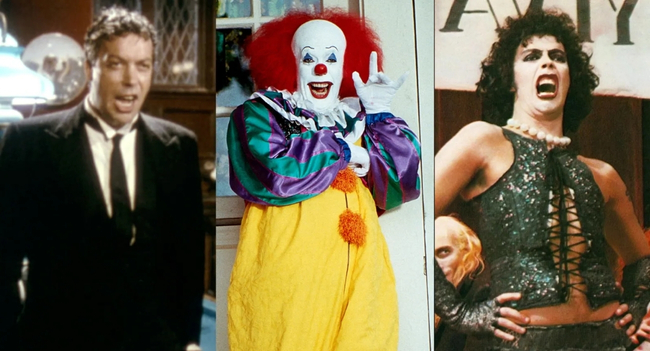
From the corseted doctor of Transylvania to one of cinema’s most terrifying clowns, these nine performances helped make Tim Curry a true pop-culture icon.
Had Tim Curry played only Dr. Frank-N-Furter, the lingerie-clad scientist from Transylvania who helped transform The Rocky Horror Picture Show into the ultimate midnight movie, his place in film history would already have been secure.
But Curry, who died at the age of 80, built a career that was far more varied than that single iconic role suggests. Over the decades, the British actor played English kings, evil clowns, pirates, butlers and William Shakespeare. He also appeared as a smooth-talking New York radio DJ and became an extraordinarily prolific voice actor, continuing that work even after suffering a seriously debilitating stroke in 2012.
Curry approached his career with a spirit of curiosity and possibility. In his 2025 memoir, Vagabond, he wrote, “Much like a painter might consider what to do with a blank canvas, or a gardener with a blank space in the backyard, a vagabond looks upon the world as a field of potential and possibility,” adding that beauty could be created as well as discovered, and that adventure awaited anyone willing to pursue it.
That outlook was evident in his performances. Curry brought imagination, mischief and a subversive sense of play to roles that could be wildly different from one another. From Frank-N-Furter to Pennywise, these are nine of his most unforgettable movie performances.
The Rocky Horror Picture Show (1975)

20th Century Fox
“How do you do?”
Five decades after its theatrical debut, The Rocky Horror Picture Show remains one of the longest-running theatrical releases in film history. Its story of a sexually repressed young couple encountering a bizarre collection of kink-loving outsiders in a mysterious mansion has endured, but Tim Curry’s Dr. Frank-N-Furter remains the production’s defining presence.
His entrance is unforgettable. First come those white, bedazzled platform heels. Then a shrieking guitar riff announces the arrival of the flamboyant scientist from the planet Transsexual.
Curry’s performance as the “sweet transvestite” became the film’s beating heart and instantly established him as an actor capable of turning contradiction into charisma. Rocky Horror was also his film debut, setting the tone for the unpredictable career that followed.
“I can’t imagine a better role to enable me to embrace my contradictions and see them through,” Curry wrote in his memoir. “I learned not to limit myself — artistically, professionally, sexually or mentally.”
Frank-N-Furter, of course, has lived far beyond the movie itself.
Times Square (1980)

Associated Film / Everett Collection
In Allan Moyle’s early-Eighties cult film, Curry plays Johnny LaGuardia, a late-night radio DJ who becomes an unlikely ally to two teenage runaways played by Trini Alvarado and Robin Johnson.
LaGuardia first hears from one of the girls through a letter signed “Zombie Girl.” As he realizes that she is one of the runaways authorities are searching for, he encourages the pair to form a punk band, the Sleez Sisters, and continue pushing back against the establishment.
The character fits comfortably into the mischievous, anti-authoritarian territory Curry often inhabited. Yet the performance also reveals a more compassionate side. In one response to an angry teenager’s letter, LaGuardia acknowledges the fear and desperation that can accompany feeling completely alone.
“Maybe you’re all alone… that’s a pretty scary place to be. You may have to jump off into the darkness. How desperate they feel, those moments before you jump — but you gotta do it.”
It is an unexpectedly tender moment in a role built around rebellion.
Annie (1982)

© Columbia Pictures / Everett Collection
As Rooster Hannigan, the scheming conman in Annie, Curry embraced a comic Depression-era New York accent and a distinctly restless physicality.
Rooster is the brother of orphanage owner Aggy Hannigan, played by Carol Burnett. Along with his girlfriend, Lily St. Regis, played by Bernadette Peters, he devises a plan to pose as Annie’s parents in an attempt to claim the $50,000 reward offered by the Warbucks family for information about Annie’s biological parents.
Curry drew inspiration for Rooster’s mannerisms from an unlikely source. He recalled in his memoir that he borrowed the fidgety movements of a stagehand he had observed while working on a Broadway production.
Because Annie is a comic musical and Rooster is its villain, his eventual fate is hardly a surprise. Curry nevertheless gives the character plenty of swagger, particularly during the bawdy musical number “Easy Street,” where his legwork is almost as entertaining as the song itself.
The part also helped broaden Curry’s film career, leading to more roles in children’s movies that would become an important part of his later work.
Clue (1985)

© Paramount / Everett Collection
Six strangers arrive at a mansion. A murder takes place. Everyone becomes a suspect.
That basic setup gives Clue its whodunit framework, but the 1985 comedy would lose much of its manic energy without Tim Curry as Wadsworth, the butler employed by the mysterious Mr. Boddy.
Curry attacks the role with such precision that even his reactions become comic set pieces. The eye rolls, startled expressions and perfectly delivered consonants provide an entire layer of entertainment beneath the movie’s already frantic plot.
The extended re-enactment sequence, in particular, showcases just how much Curry can do with a character who is ostensibly there to serve drinks and provide information.
The butler did it after all. And Curry made the whole thing a spectacularly good time.
Legend (1985)

© Universal / Everett Collection
Ridley Scott did not initially envision Tim Curry as Darkness, the demonic villain of his fairy tale starring Tom Cruise. Scott later said he had considered Peter O’Toole for the part, but abandoned the idea because the Lawrence of Arabia star was “so skinny and so pale.”
The casting idea changed when Scott revisited The Rocky Horror Picture Show. He had been considering one of the film’s actresses for the role of the swamp sorceress Meg Mucklebones when he caught sight of Curry and immediately recognized his Darkness.
“Oh my god, this is Darkness,” Scott thought.
The character required pounds of prosthetic makeup, but the elaborate transformation could not conceal how much Curry was enjoying himself. He plays Darkness with an irresistible devilish charm, throwing himself completely into the character’s theatrical wickedness.
For all the movie’s elaborate fantasy imagery, Curry is its standout performer by a considerable distance.
It (1990)

© Warner Bros. / Everett Collection
Tim Curry may not have done much to win over people with a fear of clowns, but his Pennywise remains one of the most frightening clown performances ever put on screen.
The 1990 adaptation of Stephen King’s sprawling novel about children confronting a supernatural entity has since been eclipsed by later versions with more advanced visual effects. Yet Curry’s original Pennywise remains deeply unsettling.
In many ways, the limitations of the production only make his performance more effective. Curry does not need elaborate effects to make Pennywise frightening. A fixed, murderous stare and an unnervingly broad grin are enough to make the clown feel genuinely dangerous.
As Pennywise, Curry becomes the Losers Club’s most terrifying nightmare, giving the story’s darkest moments a presence that lingers long after the scene ends.
“You’ll float, too…”
FernGully: The Last Rain Forest (1992)

Long before voice acting became one of the most recognizable parts of Curry’s career, he brought his rich baritone to FernGully: The Last Rain Forest, an animated musical about a teenage logger and a group of mystical fairies trying to save the last rainforest.
Curry voices Hexxus, the embodiment of ecological destruction. The role gives him plenty of room to combine menace with the campy humor that had become one of his trademarks.
There are moments when his familiar Frank-N-Furter persona seems to peek through. Listen, for example, to the pause he gives the line “I do believe we are destined to be soul… mates!” and it is hard not to hear an echo of his most famous character.
For an entire generation, Hexxus became one of Curry’s defining performances. He clearly enjoyed the work, and it marked the beginning of a period in which his distinctive voice would become a regular presence across animated films and television.
Home Alone 2: Lost in New York (1992)

© 20th Century Fox / Everett Collection
In Home Alone 2: Lost in New York, Curry plays Mr. Hector, the concierge at the Plaza Hotel who becomes suspicious of Kevin McCallister after the resourceful 10-year-old checks in using his father’s credit card.
Curry spends much of the movie circling the hotel and keeping tabs on Kevin, maintaining a broad, almost permanently fixed grin while pursuing his suspicions.
Behind the scenes, Curry found it difficult to relate to Macaulay Culkin. Still, he wrote in his memoir that he personally liked the young actor and had considerable sympathy for the pressures faced by child performers.
“By the early 1990s, young Macaulay had achieved widespread celebrity status and was recognized everywhere. I find that strange as an adult, so I can’t imagine what it must have been like to process it as a kid.”
Curry later returned to the Home Alone 2 world in another capacity, narrating an audiobook of the movie’s novelization after the film was released.
Muppet Treasure Island (1996)

Disney / Everett Collection
As Long John Silver in Muppet Treasure Island, Curry gets the kind of role that seems almost tailor-made for him: a flamboyant, slippery cook who turns pirate and brings a generous dose of theatrical villainy to Robert Louis Stevenson’s familiar adventure.
His targets include young Jim Hawkins, played by Kevin Bishop, as well as a collection of Muppet characters Stevenson never created, including Kermit, Fozzie Bear and Miss Piggy.
Curry had already played the Pirate King in The Pirates of Penzance on Broadway, so a swaggering pirate was hardly unfamiliar territory. He slips naturally into the part, combining showmanship with comic menace and giving his musical number “A Professional Pirate” plenty of Penzance-style flair, complete with an Irish accent.
Curry later called the movie his favorite.
“It’s my favorite movie,” he told The New York Times in February. “I loved doing it, and I hope it plays forever.”
Across these nine films, Curry demonstrated the remarkable range that made him so enduring. Whether he was playing a seductive scientist, a sympathetic radio host, a cartoon villain, a suspicious hotel concierge or a flamboyant pirate, he brought the same willingness to embrace theatricality, humor and unpredictability. That versatility is what allowed Tim Curry to move so effortlessly from cult icon to mainstream character actor and, eventually, one of the most recognizable voices in animation.