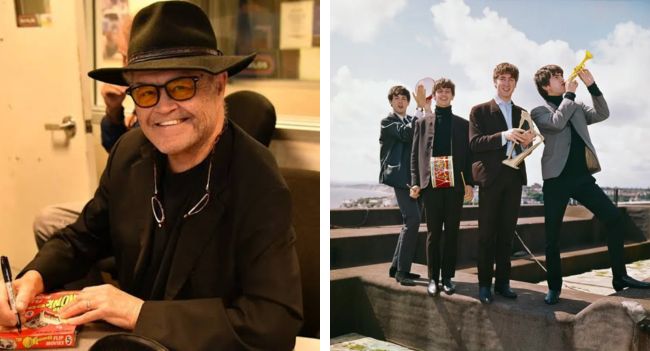
Micky Dolenz Celebrates 25 Years of ‘Breakfast With the Beatles’ — And Recalls Going From Watching the Fab Four on TV to Hanging Out With John Lennon
Micky Dolenz helped mark a major milestone for one of Los Angeles radio’s most enduring Beatles traditions — while reflecting on the strange path that took him from watching the Fab Four on a parking-lot television to sitting alongside John Lennon at Abbey Road.
The last surviving original member of The Monkees joined host Chris Carter at 95.5 KLOS in Burbank on Sunday as Breakfast With the Beatles celebrated Carter’s 25th anniversary behind the microphone.
For Dolenz, 81, the occasion carried an obvious connection.
The Monkees were originally built around a television series about a fictional band chasing the kind of success The Beatles had already made look revolutionary.
“It was a television show about a band,” Dolenz said. “They lived in a Malibu beach house and wanted to be The Beatles.”
“On the television show we never made it.”
Dolenz first saw The Beatles on a TV in a parking lot
Long before The Monkees became stars in their own right, Dolenz remembered seeing The Beatles on television in an unusually memorable setting.
He said he was at Bob’s Big Boy in Los Angeles when someone had a television set in the parking lot, complete with rabbit-ear antennas.
“There was a guy who had a TV in the parking lot with rabbit ears,” Dolenz recalled.
At that point, The Beatles were still simply a phenomenon he was watching from afar.
Only a few years later, his life would look very different.
From watching The Beatles to Abbey Road

Within roughly three years, Dolenz found himself in London spending time with John Lennon during recording sessions for Sgt. Pepper’s Lonely Hearts Club Band.
The sudden change in circumstances is something he still seems to find difficult to fully comprehend.
“It’s bizarre, I feel blessed,” Dolenz said.
By then, The Monkees had become a major cultural force of their own.
The NBC television series, which ran from 1966 to 1968, starred Dolenz alongside Davy Jones, Michael Nesmith and Peter Tork.
The show helped trigger Monkeemania across the United States and turned all four performers into pop-culture stars.
The Monkees became hitmakers in their own right

The group went on to score three No. 1 singles on the Billboard Hot 100.
“Last Train to Clarksville,” “I’m a Believer” and “Daydream Believer” all reached the top of the chart.
What had begun as a television concept inspired by Beatlemania quickly became something much larger.
The Monkees were no longer simply playing characters trying to become a successful band.
They had actually become one.
Dolenz is now the only surviving member of the original lineup.

He joined Carter’s anniversary celebration while preparing for his upcoming Micky Dolenz: 60 Years of The Monkees tour, which begins in Phoenix before reaching Los Angeles on Sept. 12.
Chris Carter marks 25 years behind the microphone
While Dolenz provided one of the afternoon’s strongest links to Beatles history, the celebration itself centered on Chris Carter.
Carter took over Breakfast With the Beatles in 2001 following the death of the program’s creator and longtime host, Deirdre O’Donoghue.
For the past 25 years, Southern California listeners have spent Sunday mornings hearing Carter play everything from the group’s biggest hits to rarities, outtakes and solo recordings.
The program is billed by KLOS as “America’s longest running Beatles show.”
For many longtime listeners, however, its importance goes well beyond a playlist.
“It’s like going to church,” listener Alex Macias said.
One listener has documented 894 shows by hand

Macias, known to the audience as “Oxnard Alex,” was among those in the studio for the anniversary.
He has kept a spiral notebook containing a handwritten record of the songs played on the program.
By the time of the celebration, he had documented 894 shows.
The habit began during a difficult period in his life.
“I started writing down the songs when I was going through a hard time,” Macias explained, “and it helped me get out of it.”
His collection has since become its own personal archive of the program’s history.
Carter’s first week nearly became his last

Carter’s tenure on the show began at an especially difficult moment.
He took over in 2001 just days before the Sept. 11 terrorist attacks.
In the aftermath, Carter said radio executives provided him with a list of songs that should temporarily be avoided.
One of them was John Lennon’s “Imagine.”
Carter immediately disagreed.
“I immediately rebelled and played it every hour,” he recalled.
“My first week could have been my last.”
Instead, it became the beginning of a quarter-century run.
Carter credits Deirdre O’Donoghue for everything that followed
Despite spending 25 years as the voice most closely associated with the program today, Carter was careful to honor the woman who created it.
“If it weren’t for Deirdre, we wouldn’t be here,” he said.
O’Donoghue hosted Breakfast With the Beatles until her death in 2001.
Carter took over later that year and gradually built his own history with the artists whose music formed the heart of the show.
That included interviews with Paul McCartney and Ringo Starr, as well as George Harrison.
Carter’s interview with Harrison for Capitol Records ultimately became Harrison’s last.
A Sunday tradition built around more than hits
Part of the program’s longevity has come from its depth.
Listeners do not simply hear familiar Beatles singles every week.
Carter mixes well-known tracks with deep cuts, rarities, outtakes and solo material from John Lennon, Paul McCartney, George Harrison and Ringo Starr.
The show also regularly features guests with direct connections to the group, along with trivia and stories from Beatles history.
That format has helped turn it into a Sunday ritual for generations of Southern California listeners.
Dolenz was a fitting guest for the anniversary
Few guests could have been more appropriate than Micky Dolenz.
His own career was tied to Beatlemania from the beginning.
The Monkees’ television premise openly borrowed from the cultural explosion created by The Beatles, yet Dolenz eventually found himself moving within the same musical world as the band he had once watched on a small television outside a hamburger restaurant.
From trying to imitate The Beatles on television to spending time with Lennon at Abbey Road, his career became one of the stranger side stories of 1960s pop history.
Six decades later, he was back in a radio studio helping celebrate another institution built around that same music.
Carter ended the show the same way he always does
After three hours filled with John, Paul, George, Ringo and a little Micky Dolenz, Carter closed his anniversary broadcast with the sign-off longtime listeners know well.
“It’s been a pleasure playing the Beatles for ya.”
The final words then belonged to The Beatles themselves, with “The End” playing out the show.
When it was over, Carter removed his headphones and smiled.
“Another one down,” he said.
Then, after 25 years of Sunday mornings, he added one more simple message.
“Thank you for having me for 25 years.”