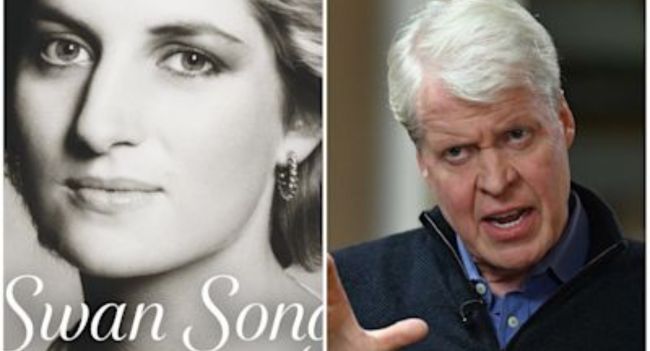
EARL SPENCER DEFENDS BOMBSHELL KING CHARLES CLAIM — ‘IT HAD TO BE IN’ AS HE EXPLAINS WHY DIANA ALLEGATION APPEARS IN NEW BOOK

Earl Spencer has broken his silence on one of the most explosive claims in his new memoir, insisting he stands by what he wrote about King Charles and revealing why the controversial passage “had to be in” the book.
The 62-year-old appeared on ITV’s Lorraine on Wednesday morning to discuss Swan Song, his new book about his late sister Diana, Princess of Wales.
Released on Tuesday, the memoir contains several deeply personal accounts of Diana’s life, including her unhappy marriage to Charles and the events surrounding her death in August 1997.

One of the most striking passages concerns an alleged conversation between Spencer and Charles during the early period of mourning following Diana’s death at the age of 36.
Spencer claims the then-Prince Charles told him that people would “forget” Diana “soon enough” — a remark he says was directly connected to the speech he later delivered at her funeral.
Asked by Lorraine whether he stood by everything he had written about the now-King, Spencer was unequivocal.
“Yes,” he replied.
The Earl was also keen to stress that he had not written the memoir as an attack on Charles.
“So I would like to explain I wasn’t setting out to do a hit piece on the King at all,” he said. “The bits that have been included in the book are totally in context.”
Spencer then explained why he believed the controversial claim was essential to the wider story he was telling about Diana.

He pointed to the closing words of the eulogy he delivered for his sister.
“So that clip you played of me getting through the end of the eulogy,” he said. “I end with this thing, uh, that the final thought I give is that Diana will never be extinguished from our minds.”
According to Spencer, those words were deliberately significant.
“That was a direct counter to the King saying we’ll forget her soon enough,” he explained.
“So it had to be in because the strand through the book is how did this eulogy come about? I use that as a device to look at Diana’s life.
“Yeah. So if I didn’t put in the reason, you wouldn’t have the consequence.”
The claim appears in one of the book’s most emotionally charged sections.
Spencer recalls receiving a stream of calls after Diana’s death and describes an encounter with Charles as he crossed the landing upstairs.
While Spencer says other callers were “stunned” and struggled to express their condolences, he describes Charles’ demeanour very differently.
He wrote that Charles “sounded giddily elated” and compared the impression he had at the time to “a lottery winner”.
The account has since become one of the most controversial passages in Swan Song, particularly because it concerns the period immediately following Diana’s death.
Spencer’s appearance on Lorraine made clear that he is not withdrawing the claim.
Instead, he maintains that the passage belongs within the wider narrative of how he remembered Diana, how he came to write her eulogy and why its final message carried such significance.
With Swan Song now published, Spencer’s explanation adds another layer to an already intense debate over his recollections of the late Princess of Wales and the royal family.