Ethan Hawke Leads a Tense Depression-Era Thriller in The Weight
In the depths of the Great Depression, freedom comes with a price: a dangerous journey through the wilderness carrying hundreds of pounds of gold. That is the grim bargain at the center of The Weight, a rugged thriller led by Ethan Hawke and set in 1933 Oregon.
The film draws its premise from a real piece of Depression-era history. In April 1933, President Franklin D. Roosevelt signed an executive order prohibiting the hoarding of gold and requiring Americans to turn in excess quantities to a Federal Reserve Bank by May. The policy itself is largely background material in The Weight, but it provides the foundation for the film’s illicit gold-smuggling operation.
Directed by Padraic McKinley and written by Matthew Chapman, Matthew Booi and Shelby Gaines, the film follows a group of work-camp prisoners recruited for a dangerous, unofficial mission. At the center of it all is Samuel Murphy, played by Hawke, a single father desperate to get back to his young daughter.
A Father Pushed to the Edge
Murphy is struggling to survive four years into the Great Depression. He is intelligent, capable and fundamentally honest, but those qualities do little to protect him or his daughter Penny (Avy Berry) from the harsh circumstances around them.
Their troubles escalate after they return from church one day to discover that they have been evicted from their apartment. While searching for another place to live, Murphy and Penny encounter a group of toughs who confront them. Murphy fights back in self-defense, only to discover that one of the men he struck is a police officer.
That changes everything.
Murphy is sent to a work camp, leaving Penny at risk of becoming a ward of the state if he cannot get home in time. The situation gives him a powerful reason to take the extraordinary risk that follows.
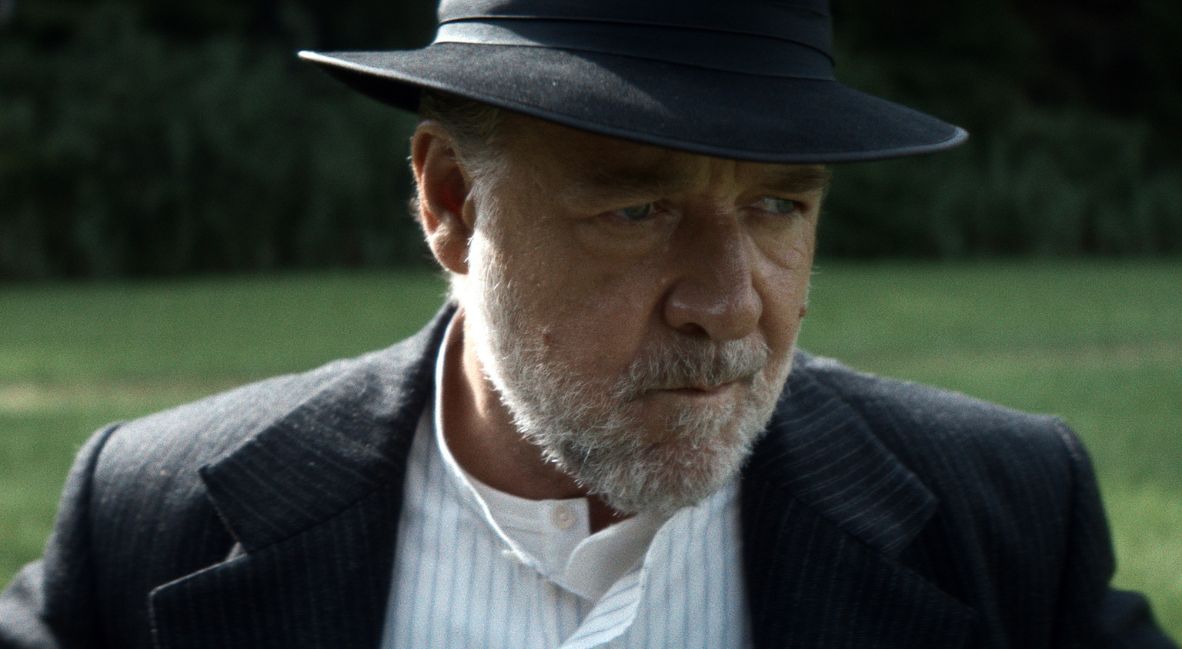
At the camp, Murphy initially tries to keep his head down. His intelligence and practical instincts, however, quickly make him stand out. Warden Clancy, played by Russell Crowe, notices that Murphy is someone who can solve problems.
Clancy is not portrayed as a cartoonishly brutal prison warden. He can even appear personable at times, occasionally granting the workers a day off. But he remains the man with absolute power over the camp, making it difficult to determine whether his promises can be trusted.
When Clancy offers Murphy a deal, the choice becomes clear. If Murphy helps complete a secret gold-smuggling operation, Clancy says he will sign the papers necessary to secure Murphy’s release.
For Murphy, the possibility of returning to Penny is worth the danger.
A Gold Shipment Through the Wilderness
Murphy assembles a team of prisoners that includes Singh (Avi Nash), Olson (Lucas Lynggaard Tønnesen) and Rankin (Austin Amelio). Their job is to transport heavy gold bars from one location to another through the wet, unforgiving Oregon wilderness.
The Oregon landscape was actually filmed in Bavaria, Germany, but the setting is presented as a remote American wilderness. The forest becomes one of the film’s most important obstacles, turning what might sound like a straightforward smuggling job into a physically punishing survival test.
The group also includes several suspicious and difficult men working for the people behind the operation, as well as Anna (Julia Jones), a Native American woman who joins the journey.
Trust is in short supply from the beginning.
Everyone has a reason to question everyone else, and Murphy has to keep the group moving while carrying a valuable cargo that makes every encounter potentially dangerous. The journey forces them to deal with a series of increasingly difficult obstacles.
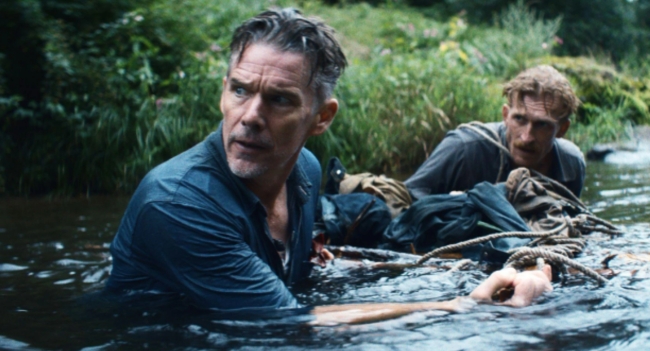
One of the most nerve-racking sequences involves a damaged rope bridge and the problem of getting the heavy gold across it. The solution requires the men to throw and catch the bars in a tense maneuver that leaves little room for error.
They also have to cross a river while attempting to conceal their trail. At any point, the mission could unravel because of the environment, the people around them or the weight they are carrying.
Then another unpredictable threat appears: a giggling lone vagrant who is searching for something to eat and begins wondering what is inside all those suspiciously heavy bags.
Ethan Hawke Gives Murphy a Quiet Strength
Hawke is particularly well suited to the film’s stripped-down style. Murphy is not a traditional action hero who relies primarily on physical strength. His greatest advantage is his ability to think his way out of difficult situations.
Hawke plays him with a weary, restrained quality. His rough voice and weathered appearance reinforce the sense of a man who has already endured more than his share but still has something worth fighting for.
His denim work clothes also fit naturally into the film’s Depression-era setting. The overall look is practical rather than glamorous, helping the character feel like an ordinary working man caught in extraordinary circumstances.
That grounded quality is important to the film. Murphy survives as much through judgment and resourcefulness as he does through brute force.

Russell Crowe Brings a Different Kind of Menace
Crowe’s Clancy is similarly restrained. Rather than turning the warden into an obvious monster, the film gives him enough charm to make his intentions difficult to read.
That ambiguity adds another layer of tension to Murphy’s decision. The promise of freedom comes from the very man who controls his confinement, so even a deal that could reunite him with Penny carries an obvious risk.
Crowe and Hawke give the film much of its dramatic weight, while Julia Jones, Austin Amelio, Avi Nash and Lucas Lynggaard Tønnesen round out the central group.

Old-Fashioned Thriller, Modern Release
McKinley, making his feature directorial debut, keeps the film moving at a confident pace. The action is built around physical challenges rather than elaborate spectacle, with the wilderness providing much of the danger.
The result has the feel of an old-fashioned adventure movie: direct, rough around the edges and focused on characters trying to survive a series of increasingly difficult situations.
The film has been compared by critics to the kind of sturdy, character-driven thrillers associated with earlier decades of American filmmaking. Its straightforward approach also gives it the feel of what might traditionally be called a “dad movie”: a muscular, uncomplicated adventure built around survival, loyalty and getting the job done.
That description does not necessarily limit the film. In this case, The Weight embraces the appeal of a solid, physical thriller that does not need elaborate mythology or spectacle to establish its stakes.
Other reviews have similarly highlighted the film’s old-school sensibility, physical action and Hawke’s central performance, while noting that the movie’s deliberately traditional approach may not work equally well for every viewer.
A Gritty Journey With Real Physical Stakes
The film’s strongest sequences come when the characters are forced to physically confront the landscape and the weight of their cargo. The rope bridge, river crossings and other obstacles make the gold itself feel like a burden rather than simply a prize.
That is fitting for a story in which nearly every character is carrying some kind of burden. Murphy carries the responsibility of getting back to his daughter. The prisoners carry the hope of freedom. The men behind the operation carry their own ambitions and suspicions.
The film’s title therefore works on more than one level, even as its most literal meaning remains the simplest: these men are struggling to move a heavy load through dangerous country.
Critics have also noted the film’s emphasis on physical action and its evocation of older survival thrillers.
For viewers looking for a tense, traditional adventure centered on Ethan Hawke’s performance, The Weight offers a gritty Depression-era story with a clear emotional objective at its center: one father’s attempt to earn his freedom and get back to his daughter.
The Weight is a Vertical release and opened in theaters on September 18, 2026. The film is rated R by the Motion Picture Association for language, violence and bloody images. Its running time is 115 minutes. The original review awarded it three out of four stars.