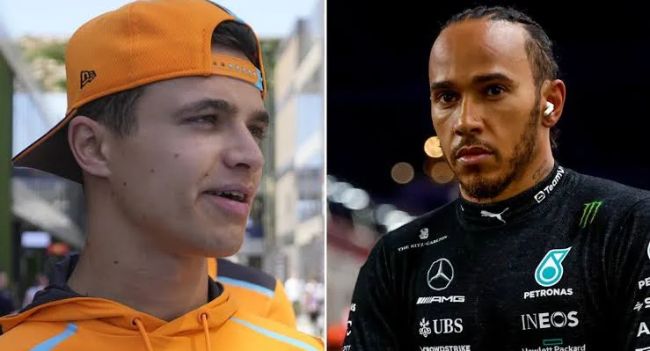
LEWIS HAMILTON ‘TAUGHT LANDO NORRIS A LESSON IN HUMILITY’ — MCLAREN STAR SLAMMED OVER SPRINT CRASH AND ‘OBNOXIOUS’ REPORTER EXCHANGE
Lando Norris has come under fire following a turbulent Singapore Grand Prix weekend, with Formula One commentators arguing that Lewis Hamilton showed his rival how to take responsibility when things go wrong.
Although Max Verstappen claimed victory on the streets of Marina Bay, Norris and his McLaren team-mate Oscar Piastri became the centre of attention after their dramatic collision in the Singapore Sprint.
The incident cost McLaren valuable championship points and sparked criticism of Norris’s on-track decision-making. But it was his reaction in the aftermath that drew particularly sharp comments from the Pit Lane Torque panel.
THE MOVE THAT COST McLAREN EIGHT POINTS
Norris was chasing Piastri during the final lap of the Sprint when he attempted to dive up the inside at Turn Five.
Piastri appeared caught off guard, and the two McLaren cars collided before spinning out of contention. Norris eventually finished eighth, while Piastri failed to score, leaving McLaren eight championship points worse off.
The clash also raised questions about the team’s internal “papaya rules”, which are intended to prevent its drivers from making dangerous or damaging moves against one another.
The stewards ultimately decided that neither driver was more at fault than the other. However, Pit Lane Torque panellist Abigail Nicholson argued that the risk was unnecessary, particularly with so little at stake in the Sprint.
“There’s no need for that crash to happen in a sprint race for one point for one person, because it would have got the same amount of points for the team anyway,” she said.

NORRIS’S REPORTER EXCHANGE SPARKS FURTHER BACKLASH
Norris also faced criticism for his response during post-Sprint interviews, particularly an exchange with Dutch broadcaster Viaplay that attracted widespread attention.
Nicholson described his treatment of the reporter as unnecessary and disrespectful, arguing that journalists should be able to question drivers about controversial incidents without being made to feel foolish.
“It was just so unnecessary to be so rude to someone,” she said.
“There is one thing that you can be as a human in this world, and that is kind. Treating someone like that, and just treating them like they’re dumb for just doing their job and rightly, to be honest, questioning him about what he did, because we’ve seen these incidents go so badly wrong and people get really badly hurt.”
Fellow panellist Daniel Moxon, Express Sport‘s Formula One correspondent, agreed that Norris had handled the exchange poorly.
“It was condescending, it was obnoxious… and it didn’t look good for his image,” he said.
Norris later accepted full responsibility for causing the collision, but the panel’s criticism focused on how he initially responded to questions about the incident.
HAMILTON’S RESPONSE OFFERED A DIFFERENT EXAMPLE
Moxon contrasted Norris’s reaction with Hamilton’s handling of a costly tyre-strategy gamble at the same Grand Prix.
The seven-time world champion finished sixth after the decision cost Ferrari the opportunity to secure a double podium. Hamilton apologised over team radio and accepted responsibility for the gamble that failed to deliver the intended result.
Moxon acknowledged that the two incidents were not directly comparable, but said Hamilton’s immediate admission offered a useful example of accountability.
“The incidents weren’t quite the same, but compare it to the way that Lewis reacted to making that mistake with the pit stop,” he said.
“He immediately showed contrition, immediately held his hands up, and he showed humility, took responsibility.”
Moxon argued that Norris could have shown greater humility even if he did not believe he was solely responsible for the Sprint collision.
“The stewards didn’t say it was your fault, but they also didn’t say it was Oscar’s fault, they said it was about 50-50 between them, so you played a role in that incident – take some accountability for the part that you played,” he added.
The debate has left Norris facing scrutiny on two fronts: the decision that ended in a costly collision with his team-mate and the way he handled the questions that followed. While the stewards stopped short of blaming either driver outright, the panel’s message was clear — accepting responsibility can matter just as much as what happens on the track.