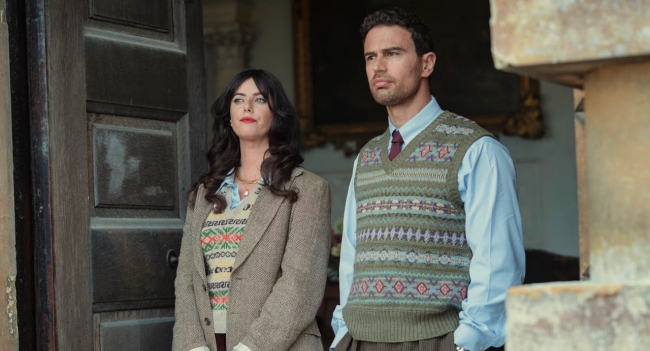


Guy Ritchie’s The Gentlemen returns with a bigger criminal empire, a darker Eddie Horniman, and a much wider world. The problem is that expanding the story also means moving its most compelling partnership to the sidelines.
Season 1 worked because Theo James’ Eddie and Kaya Scodelario’s Susie Glass were so effective together. Their uneasy alliance gradually became the heart of the series as the newly installed Duke of Halstead learned how to survive, and eventually thrive, inside the criminal operation hidden beneath his family estate.
Season 2 changes that formula. Eddie is now comfortable with the criminal life and increasingly hungry for more money, influence, territory, and power. Susie remains an important part of the story, but the season is primarily concerned with Eddie and the consequences of his growing ambition.
That shift gives James considerably more emotional material to work with. Eddie is no longer simply an aristocrat reluctantly dealing with criminals. He is becoming one himself, and the transformation is often fascinating to watch.
Unfortunately, it also leaves Susie and the partnership that made the first season so entertaining with considerably less to do.
Season 2 Turns Eddie’s Ambition Into Its Central Conflict
A year after the events of Season 1, Eddie and Susie have expanded their criminal operation, and Eddie has discovered that his aristocratic status can be just as useful to him as his criminal instincts.
Netflix describes the second season as a deliberate expansion of the series, taking Eddie and Susie beyond England and into the Italian lakes.
Thematically, however, the story remains focused on something much simpler: ambition.
Eddie wants to restore his family’s centuries-old estate to its former glory, but the more power he acquires, the further he moves from the relatively restrained man viewers met in Season 1. His willingness to embrace violence becomes increasingly difficult to separate from his desire to protect what he believes belongs to him.
James is particularly strong in these scenes. Eddie’s confidence has hardened into something more dangerous, and the actor gives the character considerably more emotional depth this time around.
The progression also fits with the character’s development. In Season 1, Eddie initially wanted to escape the criminal operation beneath Halstead Manor. By Season 2, he has accepted the possibilities offered by being both a duke and a criminal.
That is one of the season’s strongest ideas, even when the surrounding story struggles to keep pace with it.
Eddie and Susie Are Better Together


Scodelario remains excellent as Susie. She is stylish, sharp, controlled, and increasingly interested in establishing herself independently from her father, Bobby Glass.
That evolution gives Susie a meaningful arc of her own. She begins questioning whether she needs to continue operating under Bobby’s influence and becomes more willing to make decisions without his approval. Her partnership with Eddie is changing at the same time, and she is starting to recognize that the steady, calculating man she once knew is becoming considerably more volatile.
The difficulty is that the season separates Eddie and Susie for too much of the running time.
There is no requirement for the two characters to become romantically involved. Their strongest connection has always worked perfectly well as a complicated friendship and professional partnership. What matters is the chemistry between them, and Season 2 doesn’t give that dynamic enough room.
Instead, both characters are given new romantic complications. Eddie becomes involved with the Italian Countess Bella, played by Benedetta Porcaroli, while Susie becomes entangled with someone from her past.
Bella is elegant, wealthy, and seemingly unfazed by Eddie’s increasing appetite for violence. But the relationship never develops the same spark as Eddie’s scenes with Susie. The romance becomes increasingly important to Eddie’s story during the second half of the season without giving viewers much reason to become invested in it.
The contrast is especially noticeable because James and Scodelario remain so naturally compelling whenever they share the screen.
The Italian Detour Doesn’t Quite Pay Off
The expansion from the English countryside to Italy sounds perfectly suited to Ritchie’s style. There are grand locations, luxury properties, beautiful scenery, and plenty of opportunities for Eddie to look the part of an aristocratic criminal.
And visually, the season makes the most of it.
The Italian lakes provide an attractive backdrop, including lavish palazzos and stylish sequences featuring Theo James on million-dollar speedboats. Yet much of the Italian material feels strangely hollow.


Even the presence of a CGI tiger cannot consistently inject the energy the storyline needs.
The problem is less the location itself than the decision to expand the story so far beyond the environment where The Gentlemen is at its most comfortable. Halstead Manor and the wealthiest corners of London remain the natural territory for Eddie’s particular brand of aristocratic criminality.
The new Italian crime world also struggles to produce a figure as memorable as Giancarlo Esposito’s billionaire American from Season 1.
Esposito returns as well, although his role is more limited this time. He still brings the same precision and charisma to his scenes, particularly when delivering grand comparisons that elevate Eddie’s ego to increasingly ridiculous heights, invoking figures such as kings, the ancient Greeks, and even Jesus Christ.
But the character largely feels like a supporting player in a season that is trying to build a much larger criminal world around Eddie.
The Season Has a Serious Pacing Problem
Eight episodes may sound modest, but Season 2 frequently feels as though it has too much story in some places and not enough in others.
Eddie’s plans continue to spiral out of control, much as they did in Season 1. The difference is that the detours aren’t consistently as entertaining.
One episode sends Eddie on a lengthy side adventure involving a Bishop’s greedy, inexperienced son and the search for a priceless falcon. The premise has the eccentricity expected from The Gentlemen, but the episode drifts rather than building momentum. More importantly, the detour does little to advance Eddie’s larger ambitions.
Other parts of the season have the opposite problem. Major developments arrive quickly, leaving little time for relationships and conflicts to gain real weight.
That imbalance becomes increasingly noticeable as the season progresses.
Ritchie’s filmmaking remains energetic and unmistakable. The slick editing, sudden bursts of violence, eccentric characters, sharp dialogue, and elaborate criminal schemes are all still present. But the first season’s chaotic humor gave those ingredients an extra lift, and Season 2 doesn’t always find an equivalent.
Daniel Ings’ Freddy, in particular, is badly missed. The wonderfully dysfunctional older brother brought a chaotic comic energy to Season 1, but his presence is significantly reduced here.
The Supporting Characters Become the Season’s Biggest Strength


Ironically, the forced distance between Eddie and Susie gives several returning characters an opportunity to become much more important.
One of the season’s strongest episodes barely features either lead. Instead, the focus shifts to gamekeeper Geoff, played by Vinnie Jones, Eddie’s mother Lady Sabrina, played by Joely Richardson, his sister Charly, played by Jasmine Blackborow, and Charly’s husband Nanny, played by Benjamin Clementine.
The result is a much more intimate story built around tension rather than spectacle.
Jones is particularly effective. Geoff has always been a loyal and dependable figure around Eddie, but Season 2 reveals a softer side of him. His affection for Charly, her baby boy Tarquin, and Lady Sabrina gives the character a warmth that contrasts nicely with the violence surrounding him.
His scenes with Richardson are also among the season’s most convincing relationship material. The chemistry between Geoff and Sabrina is surprisingly strong, and their lingering glances have considerably more emotional weight than either of the season’s central romantic subplots.
The supporting cast also benefits from having more room to develop.
Charly, who felt largely peripheral in Season 1, has a much stronger presence this time. She has more agency and a clearer role within the family’s increasingly complicated situation.
Lady Sabrina remains one of the family’s most important but underused figures. She is attempting to hold the Hornimans together while dealing with Freddy’s absence, Eddie’s increasingly dangerous ambitions, and her own feelings for Geoff.
That makes her more important to Eddie’s journey than her limited screen time might initially suggest.
The Finale Makes Season 3 More Interesting
The season’s reliance on revenge as a driving force can feel repetitive, but the finale introduces a potentially much more interesting direction.
Lady Sabrina plays a direct role in one of Eddie’s most important moments, helping establish a new dynamic that could significantly reshape the story going forward.
And that may be the strange success of The Gentlemen Season 2.
Even when the season feels uneven, Ritchie and co-writer Matthew Read leave enough unresolved to make the next chapter genuinely appealing.
The series has already been renewed for a third season, and Season 2 clearly functions as a bridge toward what comes next.
That setup works because Eddie has changed. The reluctant aristocrat who stumbled into the criminal world in Season 1 has become increasingly comfortable with power, violence, and ambition. Susie, meanwhile, is beginning to imagine a future in which she has greater control over her own life and business.
Those developments could make for a fascinating third season if the series brings its central partnership back into sharper focus.
Verdict: Entertaining, Stylish, but Less Complete Than Season 1
The Gentlemen Season 2 still has plenty to recommend. Guy Ritchie’s visual style remains intact, Theo James gives Eddie a richer and more complicated performance, and several supporting characters finally receive the attention they deserved.
But the decision to pull Eddie and Susie apart comes at a cost.
Their partnership was the engine of Season 1, and the second season never quite finds an equally compelling replacement. The Italian storyline stretches the series beyond its most effective setting, some plotlines move too slowly while others move too quickly, and the new romances don’t match the chemistry of the show’s central duo.
The result is an entertaining eight-episode crime drama that often looks fantastic and occasionally delivers genuinely excellent character work, but rarely feels as complete as its predecessor.
Season 2 ultimately feels less like a fully satisfying chapter and more like an ambitious transition toward the already-commissioned third season.
Still, the setup works. By the finale, Eddie’s transformation and Susie’s growing independence make the future of their uneasy alliance difficult to ignore.
And that may be Ritchie’s most reliable trick: even when the current story doesn’t completely land, he leaves the next one looking hard to resist.
The Gentlemen Season 2 is streaming now on Netflix.