Down Cemetery Road: Emma Thompson and Ruth Wilson Shine in a Light Conspiracy Thriller
A house explodes in the quiet suburbs of south Oxford. Soon afterward, a child disappears. For Sarah Trafford, an art conservator with no obvious connection to either event, the mystery becomes impossible to ignore. Determined to find out what happened, she turns to private investigator Zoë Boehm.
What begins as an unusual case quickly takes Sarah and Zoë far beyond the familiar territory of credit checks and unfaithful spouses. Before long, they are caught up in a conspiracy involving the British government, secret military experiments and the deliberate maiming of its own soldiers.
That is the premise of Down Cemetery Road, Mick Herron’s 2003 debut novel, now adapted by Apple TV into an eight-part series. It is the second Herron book series to receive an Apple adaptation, following the fifth season of the acclaimed Slow Horses, his darkly comic spy drama about MI5 outsiders struggling against bureaucracy and corruption.
The similarities between the two series are immediately apparent. Both feature some of Britain’s most respected actors and use institutional failure as a source of intrigue. This time, however, Herron’s target is the UK government rather than MI5.
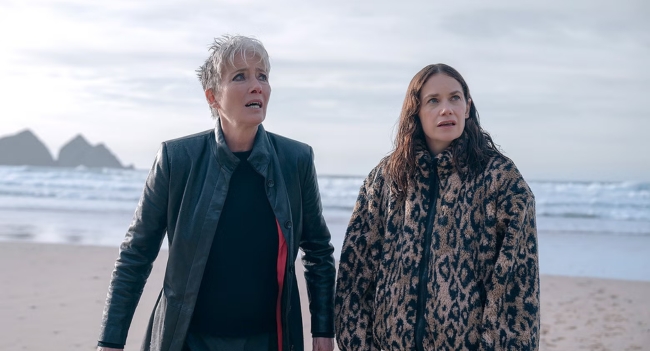
Ruth Wilson plays Sarah Trafford, while Emma Thompson takes the role of Zoë Boehm. Together, they give the series much of its energy and charm.
A conspiracy that works better as a plot device
Sarah and Zoë eventually uncover evidence suggesting that the UK government deliberately injured its own soldiers while conducting illicit chemical weapons tests in the field. Herron’s novel places those experiments during the Gulf War; the television adaptation moves them to Afghanistan.
It is a disturbing premise, but the series does not explore it with the depth that might be expected from such serious material. On screen, even more clearly than in the novel, the military conspiracy functions largely as an Alfred Hitchcock-style MacGuffin: the mystery that sets the story in motion rather than an idea the drama examines at length.
As a political conspiracy thriller, Down Cemetery Road therefore falls short of landmark British series such as Edge of Darkness (1985), with its investigation into the secret expansion of nuclear power, or State of Play (2003), which examined corrupt connections between politicians and the oil industry.
The politics may be relatively thin, but the series still succeeds as entertainment. Its pleasures come from the performances, atmosphere and increasingly elaborate action sequences.
A cast full of familiar faces
Part of the fun is spotting established British actors in supporting roles.
Mark Benton, who plays a private investigator in the long-running series Shakespeare & Hathaway, appears here as an Oxford academic. In one memorable scene, he raises himself briefly from behind his wineglass to recall Sarah as an exceptionally gifted student who had memorised the entirety of T. S. Eliot’s The Waste Land, footnotes included.
Sara Kestelman, whose career is rooted particularly strongly in theatre, brings warmth and sadness to the role of a bereaved mother.
Gary Lewis, remembered as the initially hostile father in Billy Elliot, is equally memorable as a Scottish skipper. He regards Zoë and Sarah with suspicion, seeing them as more English outsiders determined to tell “humble Highlanders” how things should be done.
Yet the series belongs to Emma Thompson and Ruth Wilson.
Emma Thompson and Ruth Wilson at the centre
Zoë Boehm has considerably more screen time in the adaptation than she does in Herron’s novel, where the character does not appear until the second half.
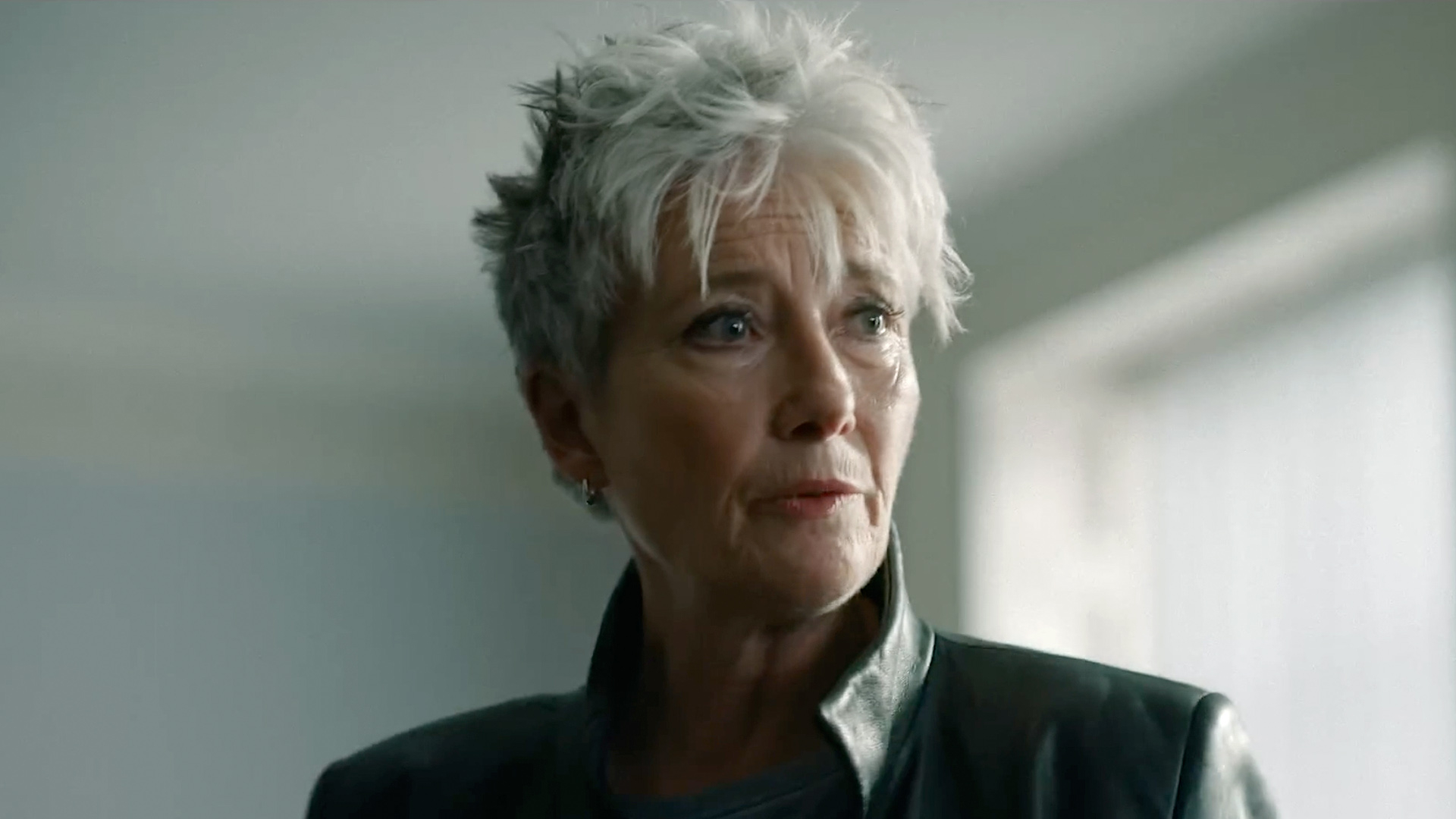
Thompson clearly relishes the opportunity. The role allows her to move well away from the restrained upper-class characters that have shaped much of her screen image in films including Sense and Sensibility, Howards End and The Remains of the Day.
As Zoë, she is sharper, rougher and considerably less interested in politeness. Her punkish silver hair matches her abrasive wit, particularly when she refers to collecting her husband from “the fuck-up creche”.
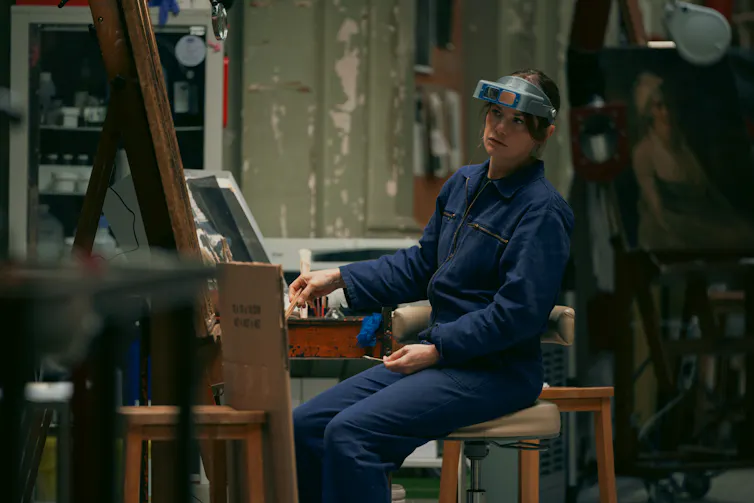
Wilson gives Sarah a different kind of intensity. As she has throughout her career in film, television and theatre, she makes the character feel intelligent, observant and deeply curious.
The series establishes Sarah’s alertness almost immediately. We first see her examining a painting through the magnifying glasses she uses in her work as an art conservator. She is someone accustomed to looking closely at details that other people miss.
The difficulty is that the adaptation gives her relatively little opportunity to examine herself with the same attention.
That lack of interiority extends beyond Sarah.

Characters become thinner as the action grows
Herron’s novel spends more time inside the minds of its characters, including Amos Crane, the frightening government operative. In the book, Crane is not simply a ruthless figure. He is frustrated by the bureaucratic restrictions surrounding his work and has his own complicated relationship with the system he serves.
Fehinti Balogun plays Crane in the television version as something much closer to a machine. He is presented as a seemingly emotionless killer, with only brief glimpses of vulnerability, including his mourning for his brother and an unexpectedly strange moment when he laughs at an episode of the BBC sitcom Keeping Up Appearances.
The result is an adaptation that sacrifices some of the novel’s psychological depth in exchange for a much more action-heavy story.
Morwenna Banks and her fellow screenwriters add fights and chase sequences that are absent from Herron’s book. These changes give the series a stronger sense of momentum and spectacle.
One of the most effective set pieces comes aboard a speeding train. With the characters unable to simply get off, the sequence draws on the classic suspense possibilities of films such as The Lady Vanishes and Murder on the Orient Express.
The show also finds unexpected ways to make ordinary moments visually striking.
A particularly memorable example involves Zoë eating an enormous meringue. When it breaks apart into a shower of sugary fragments, the effect becomes a miniature disaster, echoing the much larger explosion that opens the series.
When the comedy works, and when it doesn’t
Not every attempt at comic relief is equally successful.
The repeated exchanges between civil servant mandarin C., played by Darren Boyd, and his hapless subordinate Hamza Malik, played by Adeel Akhtar, are intended to provide a lighter counterpoint to the thriller. Instead, their scenes gradually become irritating.
They also contribute to a sense that the adaptation occasionally indulges in its own cleverness rather than serving the story.
Elsewhere, however, the series shows considerable care in its use of sound and music.
Mozart’s Requiem accompanies the action as it reaches a deadly climax, while Dizzy Gillespie’s bebop jazz underscores the narrative confusion at the end of the opening episode.
The music chosen to close individual episodes is similarly deliberate. P.J. Harvey’s Big Exit and Björk’s Bachelorette are among the songs used, each providing an appropriately pointed final note.
The closing credits eventually bring Billie Holiday’s I’ll Be Seeing You.
That choice carries an obvious suggestion of what might come next. Herron has already written three more novels featuring Zoë Boehm, so the question remains whether viewers will, in fact, be seeing her again.
For all its limitations as a political thriller, Down Cemetery Road makes a persuasive case for itself as stylish, entertaining television. The conspiracy may be more of a narrative engine than a subject for serious political examination, but Emma Thompson and Ruth Wilson give the series a compelling centre, while its supporting cast, action sequences, music and occasional flashes of dark humour keep the story moving.