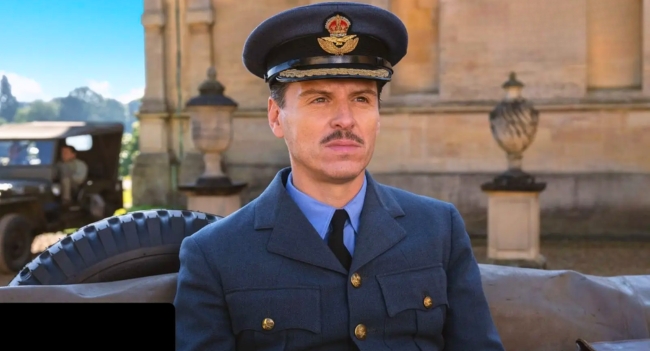
Andrew Scott delivers a gripping performance in Pressure, the WWII drama that turns a weather forecast into a matter of life and death


A single weather forecast could determine whether thousands of Allied troops lived or died. That extraordinary dilemma sits at the heart of Anthony Maras’ Pressure, a tense World War II drama about the little-known meteorologist whose advice helped shape the timing of D-Day.
The film focuses on Captain James Stagg, played by Andrew Scott, who was tasked with advising General Dwight D. Eisenhower on whether the weather would allow the Allied invasion of Normandy to go ahead.
The stakes could hardly have been higher.
During his inauguration in 1961, John F. Kennedy reportedly asked outgoing president Dwight D. Eisenhower what had given the Allies their crucial advantage over the Nazis on D-Day. Eisenhower’s answer was simple: better meteorologists.
That exchange appears during the closing credits of Pressure, underlining just how important the film’s seemingly unlikely subject really was.
A forecast that could change the course of the war
The story unfolds in June 1944, concentrating on the tense 72 hours leading up to the planned Allied invasion.
Stagg is summoned from London, leaving behind his heavily pregnant wife, and sent to Eisenhower’s headquarters at Southwick House in Hampshire. His responsibility is to produce a reliable forecast for the planned invasion on Monday, 5 June.
Today, checking the weather for the coming days takes little more than opening an app. In 1944, forecasting conditions several days ahead was a vastly more uncertain task, particularly with the unpredictable weather systems moving across Northern Europe.
Stagg is therefore placed in an impossible position. Military leaders need an answer, but the science cannot provide the certainty they want.
“I’ll do my best,” Stagg tells Eisenhower.
The response is blunt: Eisenhower does not want Stagg’s best effort. He wants certainty.
Eisenhower’s impatience is understandable. He is still carrying the weight of Operation Tiger, the disastrous rehearsal for D-Day two months earlier that cost more than 700 lives. With the real invasion approaching, another mistake could have catastrophic consequences.
And that is where the film’s title becomes particularly apt.
Andrew Scott is the film’s greatest strength


Scott gives Stagg an intensity that immediately makes the character compelling.
His version of the meteorologist is direct, serious and often blunt, but beneath that reserved exterior is a man acutely aware of what his calculations could mean. Every forecast carries the possibility of sending thousands of men into dangerous conditions, and Scott communicates that burden without needing to overplay it.
The pressure comes from all sides.
Stagg soon finds himself at odds with Irving Krick, the confident American meteorologist played by Chris Messina. Krick takes a more optimistic view of the coming weather, drawing on historical climate data to argue that the storm will pass in time.
Stagg is far less convinced.
Their disagreement becomes one of the film’s central sources of tension, as the two men repeatedly challenge each other’s interpretation of the available information.
At the same time, Stagg has to deal with Eisenhower, who needs a definitive answer, and British General Bernard Montgomery, who is eager to proceed with the invasion despite the uncertain conditions.
Brendan Fraser brings another dimension to Eisenhower


Brendan Fraser plays Eisenhower as a formidable military leader carrying his own doubts and anxieties.
His Eisenhower is under immense pressure to make the right decision, knowing that the lives of thousands of soldiers depend on him. Fraser brings considerable presence to the role, particularly during a rousing pre-battle speech that provides one of the film’s most stirring moments.
That speech lands because the film has spent so much time establishing the consequences of the decision facing Eisenhower.
The drama is not built around a conventional battlefield hero. Instead, it places scientists, strategists and senior commanders in a room and asks them to make an almost impossible choice with incomplete information.
A strong supporting cast
Kerry Condon provides a welcome change of tone as Kay Summersby, Eisenhower’s secretary. Her performance adds warmth to an otherwise tense environment and gives the film a human connection amid the military planning.
Damian Lewis, meanwhile, makes a memorable impression as British Field Marshal Bernard Montgomery.


Lewis’ Montgomery is bullish and determined, with little apparent appetite for allowing worsening weather to derail the invasion plans.
That puts further pressure on Stagg, whose increasingly cautious forecasts threaten to delay an operation that military leaders have spent months preparing.
The film’s central group consequently becomes a fascinating clash of personalities and priorities. Stagg is concerned with what the evidence says. Krick believes the historical data supports a more optimistic forecast. Eisenhower needs to make the final call, while Montgomery is keen to move forward.
Every disagreement matters because the consequences extend far beyond the walls of Southwick House.
Making meteorology genuinely tense
The most surprising achievement of Pressure is how effectively it turns weather forecasting into drama.
Much of the film takes place away from the battlefield. There are maps, calculations, discussions and repeated arguments over what the changing conditions could mean for the invasion.
Yet the tension rarely disappears.
For much of its 100-minute running time, the film remains inside this pressure cooker, following Stagg and the other decision-makers as they try to determine whether the storm will prevent the Allies from launching the invasion as planned.
There are moments when the repeated exchanges between Stagg, Krick and Eisenhower begin to feel familiar. The same fundamental disagreement returns several times, with Stagg warning against excessive confidence while others push for a more optimistic assessment.
Even so, the underlying stakes keep the drama moving.
The audience knows what is at stake, and the film makes clear that something as apparently mundane as a weather forecast can become a military decision with consequences on an enormous scale.
A different perspective on D-Day
Pressure is at its most interesting when it moves away from the familiar images of soldiers and battles and concentrates on the people making decisions behind the scenes.
D-Day is usually remembered through the invasion itself: the beaches, the troops, the fighting and the enormous military operation.
Anthony Maras instead turns his attention to one of the less celebrated elements of the planning process.
Stagg’s forecasts become the centre of the story, giving the film an unusual perspective on one of the most consequential moments of the Second World War.
That approach also gives Andrew Scott plenty of room to shine. His performance captures a man who understands the seriousness of his responsibility without presenting himself as a conventional hero.
The drama comes from watching him stand by his professional judgment when powerful people around him want a different answer.
A gripping drama built on a deceptively simple question
The brilliance of the premise is its simplicity: will the weather allow D-Day to go ahead?
From that question, Pressure builds a story about responsibility, uncertainty and the consequences of making a decision when certainty is impossible.
The film does occasionally settle into a repetitive rhythm as the central characters debate the forecast from different angles. But the performances, particularly from Andrew Scott and Brendan Fraser, keep those confrontations compelling.
Scott gives the film its emotional centre, while Fraser provides a powerful counterweight as a commander forced to make an historic decision.
Together, they turn a story about meteorological charts and military forecasts into a tense human drama.
Pressure also serves as a reminder that history is shaped by people whose names are often less familiar than those of the generals and politicians who ultimately receive the credit.
In this case, one of those people was James Stagg, a meteorologist asked to predict something no one could know with absolute certainty.
His answer could determine the fate of an invasion.
And that makes Pressure an unexpectedly gripping war film.
Pressure arrives in UK cinemas on 9 September.