Sense and Sensibility Review: A Bittersweet Austen Adaptation for a New Generation
Daisy Edgar-Jones and Esmé Creed-Miles step into roles made famous by Emma Thompson and Kate Winslet, but Georgia Oakley’s new adaptation finds a distinctly darker, more elemental mood of its own.
Jane Austen’s Sense and Sensibility has long existed beyond the status of an ordinary novel. It has become something closer to a cultural standard, a story repeatedly revisited by new generations and filmmakers who preserve certain familiar notes while changing others.
That makes any new adaptation a difficult proposition. For many viewers, Ang Lee’s 1995 film, written by and starring Emma Thompson, remains the defining cinematic version. With Thompson, Kate Winslet, Alan Rickman and Hugh Grant among its cast, that production established an enormously difficult benchmark.
Thirty-one years later, director Georgia Oakley and screenwriter Diana Reid take another turn at Austen’s story. Their version does not attempt to compete directly with Lee’s film. Instead, it strips away much of the whimsy and irony associated with recent Austen adaptations and discovers something more solemn, physical and occasionally primal in the Dashwood sisters’ predicament.
The result is not necessarily definitive. It is, however, a thoughtful reinterpretation that gives a familiar story a different rhythm and atmosphere.

A Wilder Dashwood World
Oakley’s Sense and Sensibility approaches the Dashwood sisters with remarkable seriousness.
Rather than leaning heavily into Austen’s comedy or turning the romance into a dreamy period fantasy, the film adopts an understated naturalism. The cultivated world of Georgian society is repeatedly placed against a landscape that feels untamed and almost primordial.
Production designer Francesca Di Mottola’s pastoral environments become an important part of that contrast. Nature seems to press constantly against the rigid social rules surrounding the sisters, particularly Marianne, whose emotional impulses are increasingly difficult to contain.
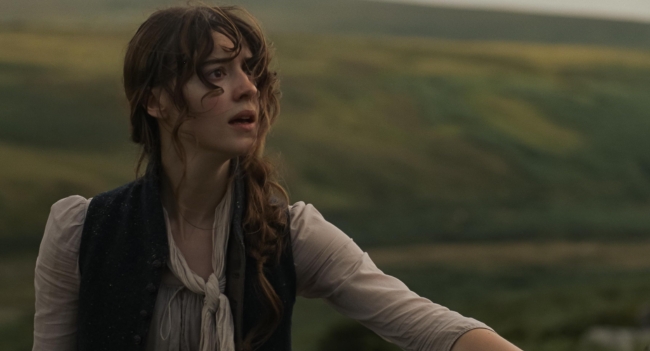
That tension is established almost immediately through Esmé Creed-Miles’ Marianne. A newcomer to the screen, Creed-Miles is introduced running through a forest, practically barefoot and looking more at home in the wilderness than in the restrictive social world into which she has been born.
There is nothing especially bedraggled about her appearance. Instead, Marianne feels untamed. Creed-Miles’ wide, determined eyes communicate an anger and vitality that make this version of the character feel unusually physical.
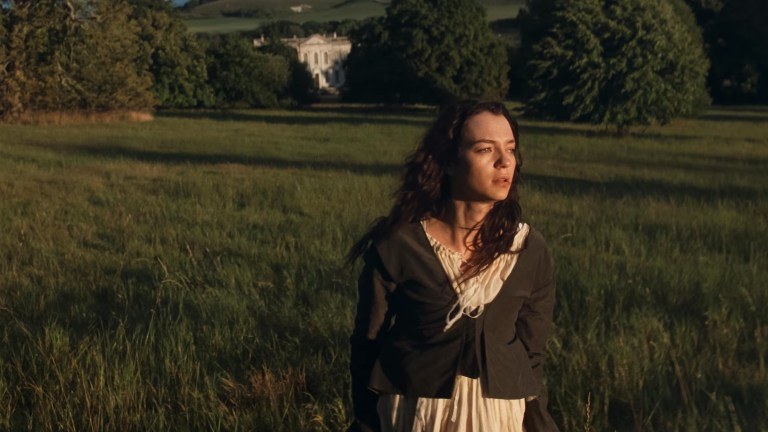
The film’s visual language reinforces that impression. Norland Park, the Dashwoods’ lost home, seems perpetually immersed in a golden, sunset-like glow. Its grounds are thick with grass, creating an almost dreamlike setting in which the sisters’ suppressed desires seem ready to break through the surface.
The effect is picturesque, but there is melancholy beneath it. The beauty of the setting only emphasizes how constrained the Dashwoods have become.
The Dashwoods and the Marriage System
The basic circumstances remain familiar.
After their father dies, Elinor, Marianne and their younger sister Margaret are left vulnerable when their half-brother John inherits the family estate. John’s wife, Fanny, persuades him to abandon the idea of providing meaningful financial support for his sisters.
Suddenly, the Dashwood women are forced out into a society where their previous wealth offers little protection. Without independent means of earning an income, marriage becomes one of the few avenues available to women in their position.
Daisy Edgar-Jones plays Elinor, the responsible daughter who understands the realities of their situation and is prepared to suppress her own desires for the sake of her family. Marianne, played by Creed-Miles, responds very differently. She is romantic, impulsive and unwilling to disguise what she feels.
Their contrasting temperaments lead them toward two very different men.
Edward Ferrars, played by George MacKay, is shy, gentle and considerably more reserved. His personality appeals to Elinor.
John Willoughby, portrayed by Frank Dillane, is far more confident and openly roguish. His boldness immediately captures Marianne’s attention.
Neither man proves to be exactly what the sisters initially believe.
Their romantic complications are further entangled by Colonel Brandon, played by Herbert Nordrum, a mysterious and brooding figure whose presence gradually becomes central to the story.
For anyone familiar with Austen, these elements will be immediately recognizable. What distinguishes the new film is the emphasis Oakley and Reid place on them.

Marianne Becomes the Film’s Emotional Center
Creed-Miles gives the film its most striking performance.
This Marianne has not been modernized in an obvious attempt to make her more contemporary. She remains recognizably Austen’s heroine. Yet Creed-Miles brings a sharper sense of frustration and anger to the character, allowing the audience to feel just how deeply Marianne resents the circumstances imposed upon her.
That makes her emotional journey one of the film’s strongest elements.
Edgar-Jones, meanwhile, gives Elinor an appropriately restrained and wounded quality. She is the sister who sees the danger in Willoughby more clearly and understands that personal happiness may have to be sacrificed for family duty.
Yet the Elinor-Edward romance feels comparatively familiar. MacKay’s Edward is suitably bashful and gentle, and Edgar-Jones handles Elinor’s anguish well, but their relationship rarely carries the same intensity as Marianne’s experience.
That imbalance ultimately works in the film’s favor because Sense and Sensibility becomes less interested in treating its romances as the entire point of the story.

Sisterhood Matters More Than Romance
The most affecting relationship in this adaptation is the one between Elinor and Marianne.
The film understands that the sisters are not simply two women waiting to find suitable husbands. They are each other’s emotional support in a society that leaves them remarkably few alternatives.
Their bond becomes the foundation of the story.
The romances sometimes feel as though they are fulfilling familiar Austen expectations, but the sisters’ willingness to absorb one another’s pain gives the movie its strongest emotional charge. They experience grief, disappointment and happiness together, carrying each other through circumstances that could easily divide them.
That emphasis gives the film its bittersweet quality.
It also allows the filmmakers to make some surprisingly subtle departures from the best-known version of the story. Some sequences that have become especially familiar to audiences since the 1995 film are handled differently or omitted. Without revealing too much, the confrontation between Fanny and Lucy Steele does not appear onscreen in the expected form, while the famous double-wedding sequence is also absent.
Those decisions suggest that Oakley and Reid are less interested in reproducing the moments Austen adaptations have turned into cultural shorthand.
Instead, they are looking for a different emotional center.
A Different Kind of Austen Adaptation
That approach separates this film from several recent Austen adaptations.
Where some productions have emphasized Austen’s dry social comedy and others have amplified the romance into something closer to a period fantasy, Oakley’s film feels deliberately autumnal. Fallen leaves replace snow in an almost storybook landscape, while the characters appear trapped by social expectations as tightly as they are by their formal clothing.
There is an almost adolescent quality to that tension. The sisters are surrounded by beauty, but they have very little control over their futures.
The film’s naturalistic style also makes the social restrictions of the period feel unusually tangible. The world outside the drawing room is wild and expansive, yet the women themselves have very limited freedom within it.
That contrast becomes one of the adaptation’s most memorable ideas.
Familiar Characters, Unexpected Choices
The film also finds room for lighter touches.
Fiona Shaw’s Mrs. Jennings is a particular delight and frequently threatens to steal the scene. Her energy provides welcome relief from the otherwise restrained atmosphere.
The complicated relationship between Willoughby and Colonel Brandon also receives an unexpectedly playful and wry resolution. It is one of the moments where the adaptation allows itself to depart from the solemnity that dominates much of the film.
Those choices help keep the movie from becoming too austere.
Still, its greatest strength remains its focus on Elinor and Marianne themselves. The men may determine much of the plot, but the sisters provide its emotional foundation.
A New Sense and Sensibility
This 2026 Sense and Sensibility is unlikely to erase the memory of the 1995 adaptation for audiences who grew up with Ang Lee’s film. That earlier version has had three decades to become part of the cultural landscape.
Oakley’s film does not need to displace it.
Instead, it offers another way into Austen’s story, one that may resonate particularly strongly with viewers encountering the Dashwoods for the first time rather than returning to characters they have known since the 1990s.
The performances are appealing, the cinematography is consistently beautiful, and the atmosphere is unusually delicate. Most importantly, the film finds genuine emotion in the relationship between two sisters trying to survive a world that gives them very little control over their own lives.
Whether this version will still be discussed three decades from now is impossible to know. What is clear is that it has found a distinct voice within a story that has been adapted many times before.
For a new generation meeting Elinor, Marianne and Margaret without the weight of earlier versions, this may become their Sense and Sensibility.
The film opens in the UK on September 25, 2026, and in the U.S. on October 16, 2026. Focus Features lists it as a romance and drama directed by Georgia Oakley and written by Diana Reid, with Daisy Edgar-Jones and Esmé Creed-Miles leading the cast.
Official Trailer
The official trailer was released by Universal Pictures UK on June 25, 2026.