We Live in Time Review: Florence Pugh and Andrew Garfield Make This Romance Hard to Resist

John Crowley has a particular gift for making intimate love stories feel larger than life. His 2015 Oscar-nominated Brooklyn transformed a seemingly simple romantic decision into something that could determine the course of an entire life. His 2019 adaptation of The Goldfinch, despite its flaws, was similarly interested in the enormous consequences of love and loss.
With We Live in Time, Crowley takes that same sensibility and applies it to a relationship that feels both deeply personal and remarkably expansive. The story itself is straightforward: two people meet, fall in love, build a family, and face a devastating challenge together. What makes the film special is the way Crowley and writer Nick Payne turn those familiar elements into a moving portrait of what it really means to share a life with another person.
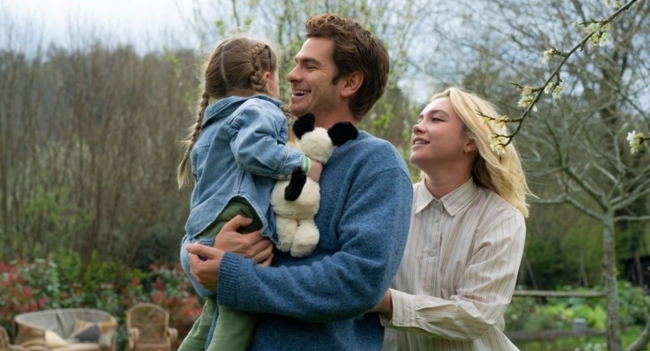
At the center of it all are Florence Pugh and Andrew Garfield, whose chemistry gives the film its emotional pulse. We Live in Time understands that giving yourself completely to another person can be one of life’s greatest risks, and it explores that vulnerability with warmth, humor, and genuine heartbreak.
A Love Story Told Across Three Different Moments
We Live in Time introduces Almut and Tobias through a relationship that already feels lived-in. Almut, an ambitious and accomplished chef, wakes Tobias to show him something she has created. She is excited to share something she loves, while Tobias immediately responds to her presence with a smile.
It is a small domestic moment, but it establishes almost everything that matters about their relationship.
From there, Payne’s screenplay moves freely through time. We see Almut and Tobias as they first meet, as they experience pregnancy and parenthood, and as they confront Almut’s cancer diagnosis. Rather than telling their story chronologically, the film moves between these three periods, gradually building a picture of an entire relationship.

The structure could easily have become confusing or overly clever. Instead, Crowley uses it to reveal how Almut and Tobias change over time. Each jump backward or forward adds another layer to moments we’ve already seen, allowing seemingly ordinary conversations to take on new meaning.
One of the best examples comes early in their relationship. Tobias brings up the possibility of having a child, while Almut isn’t convinced that motherhood is something she wants. His approach irritates her, and the conversation becomes their first major disagreement.
The audience, however, already knows that they eventually have a child together.
That knowledge changes the way we view the argument. We are watching a disagreement between two people who will eventually build a family, even though they don’t yet know exactly where their relationship is headed.
Later, Tobias faces another important conversation with Almut. This time, he understands that simply speaking off the cuff won’t be enough. He carefully prepares himself, makes plans, and takes extensive notes because he has learned how much these conversations matter to her.
It’s a modest detail, but it captures the film’s larger idea beautifully. We aren’t simply watching two people fall in love. We’re watching them learn how to love each other.
The unconventional structure allows those changes to emerge naturally. In a more traditional romance, some of these developments might have felt obvious. Here, the shifting timeline gives them an emotional resonance that grows as the film progresses.
Florence Pugh and Andrew Garfield Carry the Film

The film’s unusual structure works because Pugh and Garfield make Almut and Tobias feel like a genuine couple rather than characters moving through a series of dramatic plot points.
We don’t spend much time exploring who either person was before their relationship. Almut has already established herself as a successful chef, while Tobias has come out of a previous relationship and is in the process of finalizing his divorce when they meet. Their first encounter is memorable in its own right: Almut accidentally hits Tobias with her car.
But We Live in Time isn’t especially interested in their lives before they found each other. Its focus is what happens once they do.
That decision gives the relationship a sense of completeness. Their individual histories matter, but the film is primarily concerned with the life they create together and the people they become because of it.
The opening scenes make that dynamic particularly clear. Almut moves through her garden collecting ingredients and preparing an unexpected dish while Tobias is still asleep. Cooking is central to who she is, and her excitement comes from being able to share that passion with him. Tobias, meanwhile, finds meaning in supporting Almut and standing beside her as she pursues what matters to her.
Pugh and Garfield sell all of this effortlessly.
Their chemistry is immediate, but the performances go beyond attraction. They understand how to play the quieter rhythms of a long-term relationship: the teasing, the awkward conversations, the shared jokes, the affection, and the moments when one person knows exactly what the other needs.


Both actors are Academy Award nominees, and their experience makes a significant difference. Pugh has previously shown her talent for romance and emotional drama in films including Little Women, A Good Person, and Don’t Worry Darling. Garfield has also explored romance at various points throughout his career.
Yet We Live in Time gives them unusual room to simply inhabit a relationship.
They can be funny, awkward, sexy, affectionate, frightened, and vulnerable without the film constantly forcing them toward a dramatic emotional payoff. Their performances make Almut and Tobias feel like two people who genuinely enjoy being around each other, which makes everything that follows considerably more affecting.
John Crowley Makes an Ordinary Life Feel Grand


The strongest aspect of We Live in Time may be the way it treats love as something much bigger than romance.
Almut and Tobias are attracted to each other, and the film certainly gives them plenty of playful and intimate moments. But their relationship becomes most compelling when it shows them functioning as best friends and partners.
When circumstances become frightening and uncertain, Tobias has a practical way of approaching difficult conversations. He tries to give Almut something solid to hold on to when everything around them feels unstable.
Almut, meanwhile, has to confront a different kind of conflict. She has spent much of her life being independent and pursuing her own ambitions. Becoming part of a partnership means figuring out how to maintain that independence while also making room for another person.
Neither character has all the answers. That’s part of what makes their relationship convincing.
They compensate for each other’s weaknesses, challenge each other’s assumptions, and gradually learn how to navigate the complicated space between individual ambition and a shared life. Pugh and Garfield make that balance feel natural rather than neatly resolved.
A Romance About Time, Not Just Loss
The film could easily have become an overly sentimental cancer drama. The audience knows from relatively early on that Almut and Tobias are facing something terrible, and the story gives us plenty of reasons to expect heartbreak.
Crowley wisely takes a different approach.
Rather than constantly pushing the audience toward tears, We Live in Time concentrates on what Almut and Tobias do with the time available to them. The looming tragedy is important, but it isn’t the whole story.
When Almut is deciding how she wants to approach treatment, she expresses a preference for having six great months together, filled with memories and meaningful experiences, rather than spending a year enduring suffering that could ultimately lead to her death.
That decision captures the film’s central idea.
Life is measured not only by how much time we have, but by how we choose to spend it and who we spend it with.


This is where Crowley’s approach recalls Brooklyn and The Goldfinch. Once again, he is interested in the way love can change the course of a person’s life. The difference here is that the film is particularly interested in the value of the moments that make up that life.
That keeps We Live in Time from becoming a conventional tearjerker.
Even when the story moves into its darkest territory, there is still room for humor, surprise, tenderness, and simple happiness. The film understands that a relationship isn’t defined only by the hardest moments. It is also made up of breakfasts, jokes, arguments, celebrations, ambitions, mistakes, and all the ordinary experiences that become precious because they are shared.
We Live in Time Celebrates the Life Two People Build Together

Knowing where We Live in Time is heading doesn’t diminish its emotional impact. If anything, the film’s nonlinear structure allows the joy of Almut and Tobias’s relationship to sit alongside the knowledge of what they may eventually lose.
That’s why the movie feels less like a story about mourning and more like a celebration of having loved someone deeply.
Crowley isn’t asking the audience to focus solely on the tragedy ahead. He is asking us to appreciate the life these two people create together, and the ways that life changes them.
Pugh and Garfield are the key to making that idea work. Their performances give the relationship humor, sexuality, warmth, frustration, tenderness, and genuine affection. They make it easy to believe that Almut and Tobias aren’t simply destined romantic partners, but two people who have chosen each other again and again.
In the end, We Live in Time is a romance about the value of shared moments and the people who give those moments meaning. It recognizes how fragile a life can be while refusing to let that fragility overwhelm the happiness within it.
With Florence Pugh and Andrew Garfield at its center, the film becomes a remarkably affecting portrait of love, partnership, family, and the limited time we have to experience all of it.
John Crowley has once again found a way to make a deeply personal love story feel enormous. And this time, he does it by reminding us that a life well shared can be extraordinary precisely because it is made from ordinary moments.