Netflix’s Best Drama of All Time Is a Seven-Season Series Worth Rewatching
Before Netflix became synonymous with streaming, the company built its business around DVDs delivered through the mail. Its transformation into a streaming platform changed how audiences consumed television, eventually making original series a central part of the service.
Over the years, Netflix has produced plenty of acclaimed shows, from Stranger Things and The Crown to Mindhunter. But few have demonstrated the platform’s ability to balance drama, comedy, social commentary, and an enormous ensemble cast quite like Orange Is the New Black.
Created by Jenji Kohan and debuting in 2013, the series initially appears to be a story about one privileged woman entering prison. Over seven seasons, however, that premise expands into something much broader. Piper Chapman remains important, but the women surrounding her gradually become the emotional center of the show.
That evolution is a major reason Orange Is the New Black remains so compelling. Netflix currently lists all seven seasons, while Rotten Tomatoes records strong critical scores across much of the series, including a 95% score for Season 1 and 98% for Season 7.

Piper Chapman Is the Audience’s Way Into Litchfield
At the beginning, Taylor Schilling’s Piper Chapman is the obvious protagonist.
Piper comes from a comfortable background and has a fiancé, Larry, played by Jason Biggs. Before prison, her biggest concerns seem relatively ordinary. She runs a business making bath soaps and is preparing for a future that looks nothing like life behind bars.
That changes when her past catches up with her.
Years earlier, Piper had been involved with her former girlfriend Alex, played by Laura Prepon, and had carried drug money for her. That decision eventually leads to a conviction for money laundering and a 15-month prison sentence.
The story draws inspiration from Piper Kerman’s memoir Orange Is the New Black: My Year in a Women’s Prison, giving the series a foundation in a real-life account. Netflix similarly describes the show as the story of a privileged New Yorker whose past crime ultimately sends her to a women’s prison.
Piper enters Litchfield frightened and completely unprepared for what awaits her.
The danger comes from virtually every direction. Fellow inmates such as the formidable Russian prison boss Red, played by Kate Mulgrew, and the volatile Tiffany, played by Taryn Manning, make it clear that Piper cannot simply remain the person she was outside the prison walls.
The guards present another threat. George, played by Pablo Schreiber, becomes particularly feared because of the way he uses his authority against inmates who have little power to resist him.
Piper therefore has to learn quickly. Prison forces her to adapt, become tougher, and reconsider the assumptions she brought with her.
But that is only the beginning of what makes the series work.

The Show Gradually Becomes About Everyone
One of the smartest decisions Orange Is the New Black makes is refusing to remain solely Piper’s story.
Her perspective gives viewers an accessible entry point into Litchfield, but the series increasingly shifts attention toward the women around her. Flashbacks reveal the lives they had before prison, showing how different circumstances brought them to the same place.
Those stories give the characters depth that a conventional prison drama might never reach.
The series can be bleak and frightening, but it also has an unusual sense of humor. Comedy frequently appears in uncomfortable situations, while twists and personal conflicts keep the story moving. Outside the prison, Piper’s family and fiancé have to navigate life without her, adding another dimension to her sentence.
Inside Litchfield, meanwhile, Piper’s own transformation becomes increasingly intertwined with the lives of the women around her.
That is where the ensemble becomes the real strength of the series.
An Ensemble That Keeps the Story Fresh
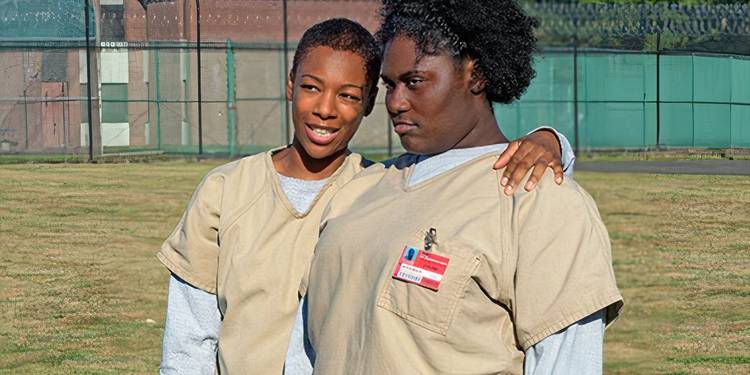
Litchfield is constantly changing. Inmates arrive, relationships shift, people leave, and new personalities enter the story. That allows Orange Is the New Black to reinvent its focus without abandoning its central setting.
Each season can therefore feel different while remaining recognizably part of the same series.
The women also refuse to fit neatly into traditional hero and villain categories. Characters who initially seem easy to dismiss often receive backstories that complicate the audience’s perception of them.
Tiffany, known as Pennsatucky, is a particularly good example. She can initially appear to be a straightforward antagonist, yet the series gradually gives viewers reasons to understand and even sympathize with her.
Suzanne, played by Uzo Aduba, is another standout. Known inside the prison by the nickname Crazy Eyes, Suzanne becomes one of the show’s most carefully developed characters. Aduba’s performance earned her two Emmy Awards for the role.
Red, meanwhile, is introduced as a powerful figure among the inmates, but her influence and position change over time. Her story explores what happens when someone accustomed to authority begins to lose her grip on it.
Natasha Lyonne’s Nicky initially projects confidence and indifference. Beneath that attitude, however, is a much more complicated character, and the series takes the time to explore what lies beneath her bravado.
Then there is Poussey, played by Samira Wiley. She initially provides much of the show’s lighter comic energy, making the eventual tragedy surrounding her character all the more devastating.
These are only a handful of the women who populate the series. The enormous ensemble allows the writers to continually introduce new conflicts, relationships, and perspectives.
More Than a Prison Drama

The range of the series is another reason it stands apart.
Orange Is the New Black can function as a prison thriller, a dark comedy, and an emotional character drama, sometimes within the same episode. It also uses its prison setting to examine the treatment of incarcerated people and the broader prison-industrial complex.
The guards are similarly presented with varying degrees of humanity. John Bennett, played by Matt McGorry, is a notable example of a guard who does not fit the series’ darker pattern. Others are portrayed as far more difficult to redeem.
The show also refuses to treat imprisonment as the entirety of these women’s identities.
Its flashbacks repeatedly take viewers beyond Litchfield, revealing the relationships, mistakes, circumstances, and experiences that shaped each inmate before she arrived. As a result, the audience is encouraged to see the women as complete people rather than simply prisoners.
That approach also keeps the drama from becoming predictable. A character who initially appears to have a clearly defined role can change dramatically once the audience learns more about her past.

Why Orange Is the New Black Still Works
What began as Piper Chapman’s story ultimately becomes a much larger portrait of the women living inside Litchfield.
That expansion is what gives the seven-season series its longevity. The cast changes, the relationships evolve, and the focus shifts, but the show continually finds new ways to create tension within the same environment.
It can be funny without losing sight of its darker subject matter. It can be brutal without stripping its characters of compassion. And it can tell stories about the prison system while still giving individual characters room to surprise the audience.
The result is a series capable of making viewers laugh one moment and breaking their hearts the next.
Netflix lists all seven seasons of Orange Is the New Black, making the complete series available for a full rewatch.
Watch the Official Season 7 Trailer
The final season arrived on July 26, 2019, bringing the seven-season story to its conclusion.
For anyone looking for a long-running Netflix series that combines drama, comedy, compelling characters, and difficult subject matter, Orange Is the New Black remains an unusually rich binge. Its greatest strength is ultimately the same one that allowed it to last seven seasons: once Piper opens the door to Litchfield, there are dozens of other stories worth staying for.