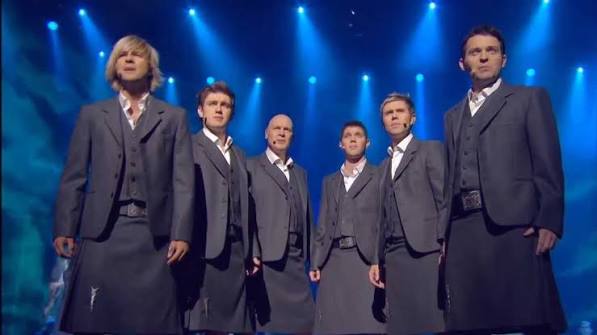
“The Power of Restraint”: How Celtic Thunder Turned Irish Air “Lagan Love” into an Unforgettable Masterclass in Vocal Harmony
Some musical performances demand attention through sheer volume, grand pyrotechnics, and arena-sized climaxes. Others take the opposite path—quieting an entire room until rapt silence is the only natural response. Celtic Thunder’s interpretation of the century-old Irish ballad “Lagan Love” (frequently titled “My Lagan Love”) achieves that rare intimacy, relying entirely on the pure resonance of blended male voices rather than elaborate stagecraft.
By stripping away theatrical excess and letting traditional Irish phrasing breathe, the international vocal ensemble transforms an ancient piece of folklore into an immediate, haunting meditation on romance, vulnerability, and surrender.
The Art of Understatement: Why Restraint Drives the Performance
Rather than inflating the arrangement into a standard pop-opera crescendo, Celtic Thunder approaches “Lagan Love” with deliberate dynamic patience:
-
Space to Breathe: The arrangement refuses to rush. Notes are sustained with gentle control, allowing acoustic decay and natural room reverb to frame each vocal entrance.
-
Absence of Clutter: Without excessive vibrato, sudden key changes, or showy vocal runs, the melody retains its clean, traditional Irish modal identity.
-
Balancing Solos and Choral Depth: Solo phrases step forward with delicate clarity, only to dissolve smoothly back into warm, four- and five-part chordal beds. No individual singer jostles for primacy; each vocal line serves the emotional core of the lyric.
-
Intimacy on a Grand Stage: Though crafted for large concert halls and televised specials, the performance preserves the feel of a quiet fireside session in rural Ireland.
A Century of Heartache: The Origins of “My Lagan Love”
To understand why the performance carries such atmospheric weight, one must look to the song’s rich historical roots in Ulster folklore:
-
Origins in Donegal: The haunting melody was collected from the oral tradition in northern County Donegal at the turn of the 20th century by composer and collector Herbert Hughes.
-
The Belfast Connection: English lyrics were penned by celebrated Belfast poet Joseph Campbell (writing under the Gaelic pen name Seosamh MacCathmhaoil). The ballad was officially published in the landmark 1904 anthology Songs of Uladh (Songs of Ulster).
-
Poetic Imagery and Vulnerability: The text paints an evocative portrait of dusk descending over the River Lagan, where the narrator watches a beloved woman against the twilight. Yet beneath the romantic pastoral imagery lies an undercurrent of helplessness. The narrator is not merely infatuated; he is trapped by desire, yielding his autonomy to an all-consuming devotion.
Harmonization as Storytelling: Voices Merging into One
For decades, Celtic Thunder has balanced traditional Gaelic songcraft with accessible global stage appeal. In “Lagan Love,” their ensemble mechanics reach a creative peak:
-
Organic Layering: Rather than using backing harmonies as a static musical cushion, the group treats harmony as the primary vehicle of the narrative. Chords swell and recede in tandem with the lyrical tension.
-
A Cohesive Choral Identity: At multiple intervals, the distinct vocal timbres within the group fuse so cleanly that the ensemble sounds like a single, multi-octave instrument echoing across the hall.
-
Preserving Irish Heritage: By honoring the cadence and melancholic phrasing of the original air, the group demonstrates their longstanding ability to bring archival Celtic folk music to modern global audiences without diluting its cultural soul.
The Lingering Spell
In a modern entertainment landscape where live vocal showcases often favor bombast and high-decibel belts, Celtic Thunder’s rendition of “Lagan Love” stands apart for its quiet conviction. The performance makes its deepest mark through what it leaves out—the delicate pauses between measures, the unforced breath control, and the shared understanding that classic folk poetry needs no modern polish to move an audience. When the final sustained chord gently evaporates, it leaves behind the kind of reverent stillness that only occurs when an entire room is reluctant to break the spell.