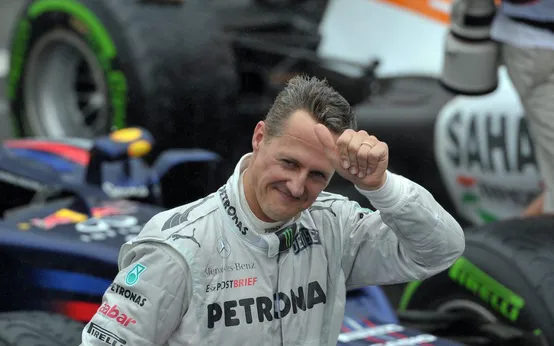
“I’d Rather Not”: Former F1 Chief Richard Hopkins Urges Respect for Michael Schumacher’s Privacy Amid Health Concerns

Almost thirteen years after Michael Schumacher suffered catastrophic head injuries in a December 2013 skiing accident in the French Alps, the Formula One legend remains entirely shielded from the public eye. While millions of motorsport fans continue to hold out hope for a public reappearance, former Red Bull head of operations Richard Hopkins has voiced a heartfelt plea: fans and peers should only wish to see the seven-time world champion if he is genuinely doing well.
“I’d Love to See Michael, but Only if He’s Okay”

Hopkins, who formed a close paddock friendship with Schumacher during his earlier days working as a mechanic at McLaren, spoke candidly to iPredicta about the enduring curiosity surrounding the German icon’s condition.
For Hopkins, the desire to see Schumacher again must come second to dignity and well-being:
“I hope we see him again. I’d love to. But only if that’s right. I don’t think anybody wants to see Michael in a situation we don’t want to see Michael in, or Michael doesn’t want us to see him in.“So I’d love to see Michael, but I’d love to see Michael okay. I think ‘okay’ is the right word to use. But equally, at the same time, if he’s not okay, I’d rather not.”
Hopkins underscored that while he cherishes memories of catching up over coffee with the racing hero, public exposure in an incapacitated state would run contrary to everything Schumacher stood for.
Defending Corinna’s Protective Wall

Since the accident, Schumacher’s wife, Corinna, has maintained a fiercely guarded circle of privacy around their home, allowing only a small handful of trusted associates—such as former Ferrari team boss Jean Todt—to visit.
Hopkins believes Corinna’s protective stance is aimed at preserving her husband’s dignity as the pinnacle of elite athletic strength:
“I don’t know what Corinna thinks. I don’t know what her thoughts on this are, but maybe it’s in some ways aligned to that, in as far as it’s Michael.“He was the ultimate in strength, and I think she’s protecting him more than maybe protecting herself and the family and everything else. I’d love to see Michael and have a chat with him, and have a coffee with Michael, rather than see him in a not-okay situation. So you’ve got to respect that.”
Breaking the “Robot” Myth

Reflecting on the portrayal of Schumacher in recent retrospective documentaries—such as projects chronicling his fiercely contested 1994 world championship with Benetton following Ayrton Senna’s tragic death at Imola—Hopkins addressed the perception that the German was an unfeeling, calculated competitor:
“Schumacher was a very emotional guy, wore his heart on his sleeve, as far as occasions where he got emotionally angry, I suppose. Not necessarily emotionally sad.“I’m sure there were other occasions when he did. The guy wasn’t completely made of steel; he wasn’t a bloody robot. He was a human being at the end of the day. So I’m sure behind closed doors a lot of what we saw was a bit of an act, dare I say, but I think that was all for his reasoning.”
Hopkins’ remarks serve as a poignant reminder to the F1 community: while the longing to see Formula One’s greatest champion return to public life is understandable, honoring the family’s boundary and protecting his dignity remains paramount.