The Savage Frontier: Dissecting the True History, Strategic Battles, and Tragic Atrocities Behind Netflix’s American Primeval

Helmed by director Pete Berg and penned by The Revenant screenwriter Mark L. Smith, Netflix’s limited drama American Primeval strips away the nostalgic veneer of the classic American Western to depict the unforgiving realities of the 1850s western expansion. Rather than reducing the era to a binary conflict between heroic settlers and lawless outlaws, the six-episode series chronicles a multi-sided geopolitical crisis involving Mormon pioneers, the United States military, independent frontiersmen, and sovereign Indigenous nations fighting for territorial survival.
While fictional travelers Sara Rowell (Betty Gilpin) and her young son Devin (Preston Mota) anchor the narrative thread, the story is grounded in documented 19th-century history, notably the infamous Mountain Meadows Massacre and the struggle over Fort Bridger.
Dramatis Personae: Real Pioneers, Religious Leaders, and Historical Composites

| Character | Historical Counterpart / Inspiration | Narrative Role & Historical Reality |
| Jim Bridger | Jim Bridger (Frontiersman, Scout, and Trapper) | Historical Figure. Originally established his trading post in 1843 along the Oregon and California Trails. In the series—set decades after his youth—he navigates volatile territorial pressures between federal authorities and the Latter-day Saints. |
| Brigham Young | Brigham Young (2nd President of the LDS Church) | Historical Figure. Led early Mormon pioneers to the Great Salt Lake Valley after Joseph Smith’s death. He mobilized the Nauvoo Legion militia to protect his isolated community against anticipated federal military campaigns. |
| Bill Hickman | William A. Hickman (Frontiersman, Lawman, Enforcer) | Historical Figure. An enforcer within the Nauvoo Legion whose career reflected the complex intersection of pioneer justice, state-building, and religious militia authority. |
| Winter Bird | Fictionalized composite of Indigenous war chiefs | Composite. Created to depict Shoshone sovereignty and defense of native territories, drawing inspiration from accounts of a real-life chief who had multiple wives. |
| Wolsey | Frontier militia figures | Composite. Modeled after individuals prosecuted or executed in the fallout of the Utah conflicts, echoing the fate of figures like John D. Lee following the Mountain Meadows trials. |
| Abish | Frontier captive narratives | Composite. Played by Saura Lightfoot-Leon, she represents young Mormon women who found themselves displaced into Native communities, adapting to survival outside the rigid structures of the church settlements. |
The Catalyst: Re-enacting the Mountain Meadows Massacre

The narrative engine of American Primeval kicks into gear with a visceral depiction of the Mountain Meadows Massacre, one of the most polarizing and violent episodes of frontier history.
-
The Reality of 1857: In September 1857, amid rising panic that federal regiments were marching to seize control of the Utah Territory (the onset of the Utah War), an emigrant wagon train known as the Baker–Fancher party crossed through southern Utah on their way from Arkansas to California. Members of the local Mormon militia, aided by regional Southern Paiutes, laid siege to the emigrants. After a days-long standoff, the militia approached under a white flag of truce, disarmed the travelers with a promise of safe escort, and proceeded to execute over 120 men, women, and older children, sparing only 17 infants and toddlers.
-
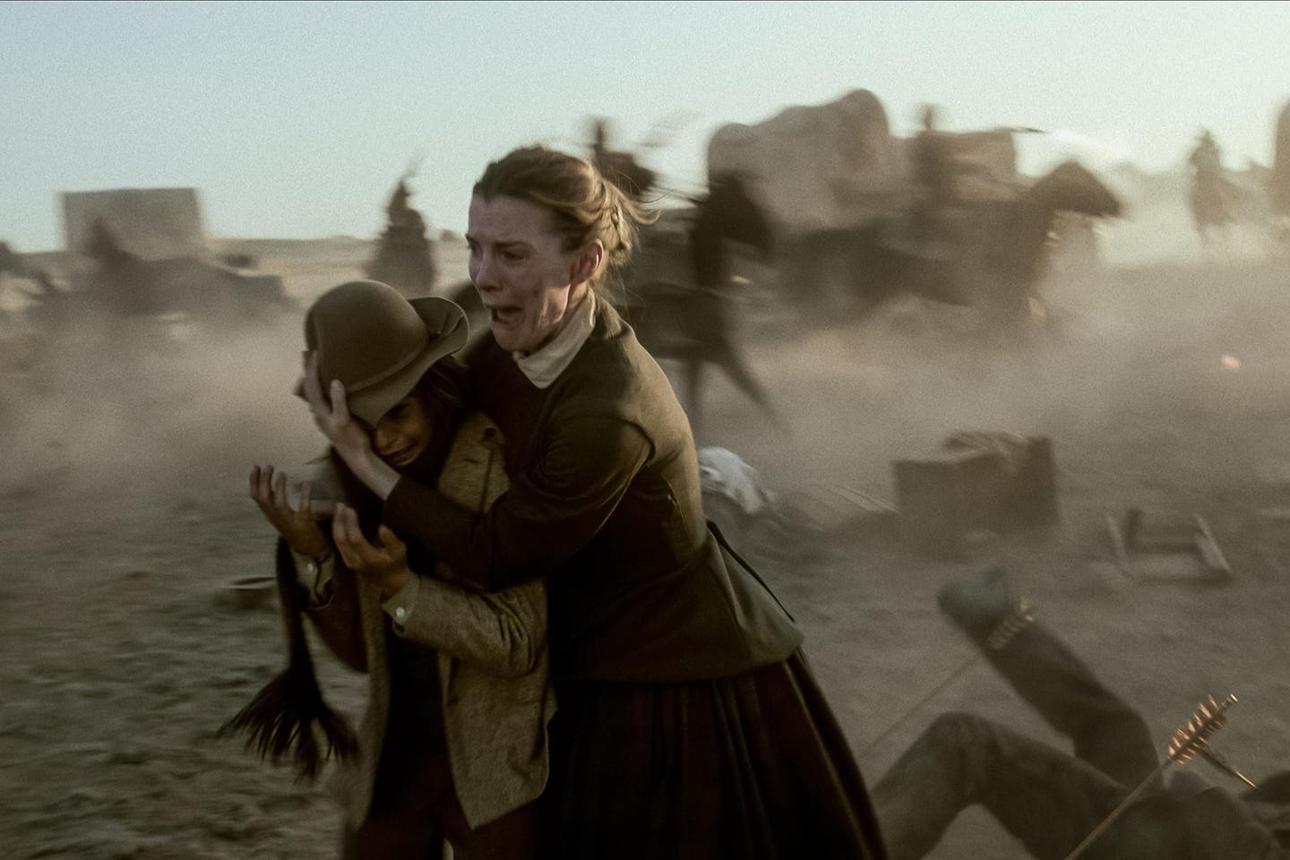
A Visceral Six-Minute Sequence: Berg’s team spent four months choreographing the opening attack, utilizing over 280 performers to stage an unbroken, six-minute tracking shot that follows Sara and Devin as arrows and gunfire dismantle the wagon train, capturing the raw panic of the ambush from ground level.
-
Academic Grounding: The production consulted with leading scholars, including historian Richard E. Turley Jr. (co-author of Vengeance Is Mine: The Mountain Meadows Massacre and Its Aftermath), touring the physical historical site in Utah to ensure the dramatic rendering reflected the terror and paranoia of the time.
The Battle for Fort Bridger: A Tactical Frontier Flashpoint

Serving as the series’ physical crossroads, Fort Bridger was meticulously reconstructed on location in New Mexico:
-
Hub of Survival: Unlike primitive frontier stereotypes, Fort Bridger was an expansive trading community that featured stores, medical practitioners, a dentist, and repair services for westbound wagon trains.
-
The Sale and Scorched-Earth Retreat: In Episode 6, Jim Bridger surrenders control of the fort to Brigham Young. Historically, Mormon authorities acquired the post primarily to deny incoming federal forces a fortified staging point and winter garrison during the Utah Expedition. As US troops under Albert Sidney Johnston advanced, the Mormon militia put the fort to the torch, leaving federal soldiers to winter in tents amidst the smoldering ruins.
-
Period-Accurate Practical Sets: Builders used hand tools and natural timbers up to 80 feet tall to duplicate authentic 1850s log construction techniques without modern precision. To capture the destruction authentically, the production burned down roughly half of the physical New Mexico set during filming.
Cultural Authenticity: Working with Sovereign Native Nations
To steer clear of Hollywood’s long-standing cinematic caricatures, the production engaged Indigenous cultural consultant and project advisor Julie O’Keefe.
-
Collaborative Stewardship: Experts, artisans, and language speakers from the Shoshone, Southern Paiute, and Ute tribes were embedded within production departments.
-
Material Culture: Working alongside production designer Renée Read and costume designer Virginia Johnson, native craftspeople utilized period-accurate brain-tanned buffalo and elk hides, glass trade beads, and heritage broadcloth blankets to recreate authentic frontier encampments and attire.
Confronting History Beyond the Western Myth
Both Mark L. Smith and executive producer Newman highlighted the influence of Howard Zinn’s A People’s History of the United States, deliberately crafting American Primeval as an antidote to romanticized frontier legends. By portraying every faction—from emigrants and Native bands to miners, soldiers, and religious settlers—as driven by desperate resource competition and existential dread, the limited series presents a sobering examination of the high human toll of territorial conquest.
All six episodes of American Primeval are streaming on Netflix.