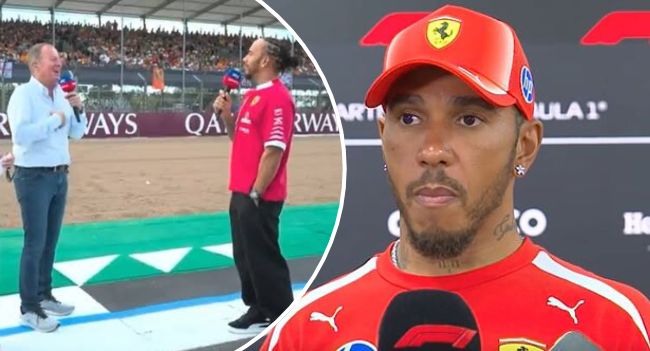
MARTIN BRUNDLE DELIVERS BLUNT VERDICT ON LEWIS HAMILTON’S FERRARI BLUNDER — THE STRATEGY CALL THAT COST HIM A PODIUM

Lewis Hamilton’s Singapore Grand Prix mistake has prompted a pointed assessment from Martin Brundle, who believes the incident exposed a fundamental problem with trying to manage modern Formula One strategy from behind the wheel.
The Ferrari driver looked on course for a strong result at the Marina Bay Circuit, with team-mate Charles Leclerc running second behind Max Verstappen and Hamilton holding third. With overtaking notoriously difficult around Singapore, Ferrari appeared well placed to secure a double podium — provided both cars made the right strategic calls.
But the race took a costly turn when a virtual safety car created an opportunity to pit.
HAMILTON IGNORES FERRARI’S EXPECTED STRATEGY

Ferrari called both drivers in for fresh tyres, and Leclerc followed the instruction. Hamilton, however, stayed out, opting for a one-stop strategy that required him to complete 44 laps on the same tyres.
The decision proved disastrous. Hamilton’s ageing soft tyres rapidly lost grip, leaving him vulnerable as rivals closed in. After briefly staying ahead of Leclerc, he was passed by his team-mate, Kimi Antonelli and Lando Norris, before Oscar Piastri overtook him on the penultimate lap.
Hamilton ultimately finished sixth, a result that fell short of what Ferrari’s pace had appeared to promise.
BRUNDLE’S WARNING ABOUT MODERN F1
Writing in his Sky Sports column after witnessing the race from the commentary box, Brundle argued that the incident highlighted the difficulty of combining driving with complex strategic decision-making.
“After the race, it emerged that switching to a one-stop strategy, which required him to complete 44 laps on the same tyres, had been Hamilton’s own decision. He apologised to the team for the call,” Brundle wrote.
“It is difficult to run a modern F1 car and manage the team’s strategy from behind the wheel, and the incident was telling. Ferrari had seemingly expected Hamilton to pit under the VSC.”

Brundle’s assessment centred on the challenge of making high-stakes tactical decisions while simultaneously controlling a Formula One car at racing speed. Ferrari appeared to have expected Hamilton to pit, but his decision to pursue an alternative plan left him exposed in the closing stages.
HAMILTON ACCEPTS RESPONSIBILITY
Hamilton did not attempt to shift the blame after the race. He apologised to Ferrari over team radio before returning to the pit lane and later reiterated his regret in a message to his 44 million Instagram followers.
“Yesterday wasn’t the result we were looking for, and that’s on me. At a track that’s difficult to overtake you need to try something different, and I chose a strategy that ultimately didn’t deliver,” he wrote.
“It’s a painful lesson to learn, but I take full responsibility for the decisions I made. In this sport, not every call will work out. It’s about accepting when you get it wrong and how you move forward. I’m grateful to the team for the work they put in every weekend.”

Despite the disappointment, Hamilton insisted that sixth place did not tell the full story of Ferrari’s performance.
“P6 doesn’t reflect the pace we had in the car, and despite the result there are positives to take away. Massive thanks to the fans in Singapore for the energy. I’ll continue to put the work in and come back fighting at the next race.”
Hamilton’s own explanation echoed the central lesson in Brundle’s analysis: trying an alternative strategy can offer a potential advantage, but the consequences can be severe when the decision fails to account for how quickly tyre performance deteriorates.
For Ferrari, the Singapore race became a missed opportunity. For Hamilton, it was a costly reminder that a split-second strategic gamble can undo an otherwise competitive weekend.