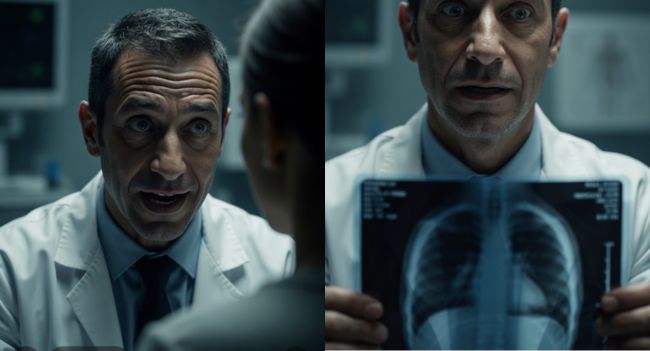
“I took her to the doctor behind his back.”

That was the moment everything changed.
Because the second the doctor looked at the scan…
his expression disappeared.
The reassuring smile.
The calm professional face.
Everything vanished.
He stared at the screen for several seconds longer than he should have.
Then he looked at my daughter.
Then at me.
And when he finally spoke, his voice dropped into a whisper.
“There’s something inside her.”
I remember the exact way those words sounded.
Not loud.
Not dramatic.
Almost careful.
Like he was afraid that saying them too quickly would make them more real.
And I felt the entire room tilt beneath my feet.
Because deep down…
I already knew something was wrong.
I just didn’t know how wrong.
For weeks, I had watched Maya disappear little by little.
Not physically.
Not all at once.
But in small pieces.
The kind of changes other people miss because they happen quietly.
The kind of changes a mother notices because she knows her child better than anyone.
It started with breakfast.
Maya had always been the first person awake in the morning.
She was the girl who used to sing while making cereal, who danced around the kitchen in socks, who complained dramatically if there wasn’t enough syrup for her pancakes.
But suddenly…
food became something she avoided.
She would sit at the kitchen table, take one bite, and quietly push her plate away.
“Not hungry,” she would say.
At first, I believed her.
Teenagers skipped meals.
Teenagers got stressed.
Teenagers changed.
But then I noticed the way she held herself.
The way she pressed one hand against her stomach when she thought nobody was watching.
The way she paused halfway up the stairs because the pain forced her to stop.
Then came the nausea.
It appeared without warning.
One minute she would be talking normally.
The next, she would go silent, cover her mouth, and rush toward the bathroom.
After that came the dizziness.
I saw it happen one morning before school.
Maya was standing in the hallway, one hand holding her backpack strap.
Then suddenly…
she reached for the wall.
Her eyes closed.
Her face went pale.
“Maya?”
She opened her eyes almost immediately.
“I’m fine.”
But she wasn’t.
I knew she wasn’t.
The girl who once spent hours outside kicking a soccer ball against the garage door stopped going outdoors.
The girl who filled her phone with pictures of sunsets, flowers, and random things she found funny stopped taking pictures entirely.
The girl who laughed so loudly during video calls that Robert would shout from the other room telling her to lower her voice…
became so quiet that I started checking on her at night just to make sure she was breathing.
She started wearing oversized hoodies everywhere.
Even inside the house.
The sleeves covered her hands.
The fabric stayed pulled low over her stomach.
And every time I asked why…
she smiled.
That same fake smile teenagers use when they don’t want adults to worry.
“I’m okay, Mom.”
Those words became the biggest lie in our house.
Because she wasn’t okay.
She was fifteen years old.
But lately she looked younger.
Smaller.
Like pain had slowly taken away every piece of confidence she had.
One evening, I watched her sit across from me at dinner.
The kitchen was warm.
The smell of lemon chicken filled the room.
The refrigerator hummed quietly behind us.
Outside, wind pushed against the porch flag Robert had installed last summer.
Everything looked normal.
Except my daughter.
She sat there cutting her food into smaller and smaller pieces.
But she wasn’t eating.
Robert sat at the end of the table, scrolling through his phone.
“She barely ate yesterday,” I said.
He didn’t look up.
“She’ll eat when she’s hungry.”
I stared at him.
“She says her stomach hurts.”
“She always says something hurts.”
Maya’s fork stopped.
Slowly…
she looked down at her plate.
I felt something inside me break.
“This has been going on for weeks,” I said.
That finally made Robert look up.
“She’s exaggerating.”
“She’s losing weight.”
“She’s stressed.”
“She almost fell at school.”
Robert sighed.
Not worried.
Annoyed.
“You keep treating her like she’s fragile.”
I couldn’t believe what I was hearing.
“She’s your daughter.”
“And she’s a teenager.”
His voice stayed calm.
That was always his way.
Robert never needed to yell.
He made everything sound logical.
Reasonable.
He could make cruelty sound like responsibility.
Whenever Maya was sick, he talked about money.
Hospital bills.
Insurance.
Deductibles.
Missed work.
Expenses.
Every symptom became a financial problem instead of a medical one.
Every time Maya said she was hurting…
he acted like she was creating a burden.
And slowly…
she stopped telling us.
That scared me more than the pain itself.
Because children who feel safe ask for help.
Children who feel afraid hide.
Over the next few days, I watched her carefully.
I watched her fall asleep on top of her blankets with her shoes still on.
I watched her wake up confused and exhausted.
I watched her bend down to tie her sneakers…
then freeze halfway because the pain was too much.
And every time she noticed me watching…
she forced a smile.
“Just a cramp.”
But I knew my daughter.
This wasn’t a cramp.
This was fear.
One night, at exactly 2:13 a.m., I woke up.
Not because of a sound.
Because of a feeling.
A mother’s instinct.
Something was wrong.
I sat up and listened.
The house was silent.
Robert was sleeping beside me.
Then I heard it.
A quiet breath from across the hallway.
Thin.
Broken.
Painful.
I got out of bed immediately.
Maya’s bedroom door was slightly open.
Inside, her desk lamp was still on.
The soft yellow light revealed her curled on her side beneath the blanket.
Both arms wrapped tightly around her stomach.
Her knees pulled toward her chest.
Her face buried against a pillow soaked with tears.
“Maya?”
Her eyes opened.
And the expression on her face stopped me.
Not embarrassment.
Not teenage frustration.
Not even fear.
Exhaustion.
“Mom…”
I rushed to her.
“What happened?”
Her voice cracked.
“It hurts.”
“Where?”
She pressed her hand against her stomach.
“Everywhere now.”
Then she looked at me.
And whispered the words I will never forget.
“Please… make it stop hurting.”
That was the moment I stopped being afraid of Robert.
I didn’t care about the argument.
I didn’t care about the accusations.
I didn’t care if he called me irresponsible.
Because my daughter needed help.
And nobody was going to stop me from getting it.
I didn’t wake him.
I didn’t ask permission.
The next afternoon, while Robert was at work…
I picked Maya up from school.
At 1:42 p.m., I signed her out through the front office.
She walked toward me slowly.
One hand pressed beneath her hoodie.
“You told Dad?”
I shook my head.
“No.”
Her eyes widened.
For a second, I saw exactly how much power his anger had over her.
Even when he wasn’t there…
she was still afraid.
I took her hand.
“We’re going anyway.”
And for the first time in weeks…
Maya didn’t argue.
She just nodded.
I drove straight to Riverside Medical Center.
And I had no idea that before the day ended…
a doctor would look at my daughter’s scan…
go completely silent…
and tell me something that would change our family forever.
“There’s something inside her.”
PART 2

The room went silent after Dr. Lawson’s words.
“There is something we need to confirm before I say this out loud.”
I remember staring at him, waiting for the next sentence.
Waiting for him to tell me it was a misunderstanding.
A shadow on the scan.
A mistake.
Anything.
Because sometimes your mind grabs onto the smallest possibility when the truth feels impossible to survive.
Maya looked between us.
Her fingers tightened around mine.
“Mom?”
I forced myself to look at her.
“I’m right here.”
But even saying those words felt different.
Because for the first time all day…
I realized I was scared.
Not the ordinary kind of scared.
Not the kind you feel when your child falls off a bike or gets a bad grade.
This was the fear that settles deep inside your chest.
The fear that whispers:
Something has already changed.
Dr. Lawson pulled the stool closer.
“Maya,” he said gently, “I know this is frightening, but I need you to answer a few more questions.”
She nodded.
“Have you ever had an injury to your stomach area?”
“No.”
“Any surgeries?”
“No.”
“Have you swallowed anything unusual? Any objects? Any medication that wasn’t prescribed for you?”
Maya immediately shook her head.
“No.”
Dr. Lawson looked at me.
“When did the pain begin?”
“About three weeks ago.”
“Has it gotten worse?”
“Yes.”
“How much weight has she lost?”
I hesitated.
“Almost ten pounds.”
The doctor wrote something down.
Then he looked back at the scan.
That pause returned.
The one that made my stomach twist.
“Doctor…”
He looked at me.
“Mrs. Thorne, the ultrasound shows a mass.”
The word landed harder than I expected.
A mass.
A simple medical word.
But to a mother…
it carries a thousand terrifying meanings.
“What kind of mass?”
“We don’t know yet.”
Maya’s face changed.
She was trying so hard not to cry.
“Does that mean cancer?”
The question came from a fifteen-year-old girl sitting on an examination table.
A girl who should have been worrying about homework.
Friends.
A driver’s license.
Not whether her own body was trying to betray her.
Dr. Lawson immediately leaned forward.
“Hey.”
His voice softened.
“Do not jump to the worst conclusion.”
“But it could be?”
He didn’t answer right away.
And that was an answer too.
I squeezed her hand.
“Maya, look at me.”
She did.
“We are going to figure this out.”
She nodded.
But I could see she was trying not to break.
The doctor ordered additional imaging.
Blood tests.
More scans.
The waiting began.
And waiting is one of the cruelest things a parent can experience.
Because when you don’t know what is happening…
your mind creates the answers for you.
Every minute became an hour.
Every hallway sound made me look up.
Every doctor walking past the door made my heart race.
Maya sat quietly on the bed.
She stared at the floor.
Finally, she whispered,
“Dad is going to be so angry.”
I looked at her.
“He should be worried about you.”
She didn’t respond.
That scared me.
Because a child shouldn’t be predicting anger before comfort.
A few minutes later, my phone started vibrating.
Once.
Twice.
Three times.
I didn’t need to check the screen.
I knew.
Robert.
I let it ring.
Then a message appeared.
Where are you?
A second message followed.
Why did you take her somewhere without telling me?
Then another.
Answer me.
Maya saw my face.
“He knows.”
I nodded.
Her shoulders immediately tightened.
Not because she was worried about the doctor.
Not because she was worried about the tests.
Because she was worried about what would happen when we went home.
That broke something inside me.
I had spent so long trying to keep peace in our house that I hadn’t realized peace wasn’t the same thing as safety.
A knock interrupted us.
Dr. Lawson returned.
This time, he wasn’t alone.
A nurse stood behind him carrying another folder.
My heart sank.
“Mrs. Thorne…”
He closed the door.
“We have the additional imaging results.”
Maya reached for my hand again.
I held on.
The doctor sat down.
“The object we saw on the ultrasound is not a tumor.”
For one second…
I forgot how to breathe.
Not a tumor.
The relief came so quickly it almost made me dizzy.
Then I noticed his expression.
He wasn’t relieved.
He was careful.
“What is it?”
Dr. Lawson looked at Maya.
Then back at me.
“The imaging shows a foreign object.”
My mind struggled to understand.
“A foreign object?”
He nodded.
“Something that should not be inside her body.”
The room became colder.
Maya stared at him.
“What does that mean?”
Dr. Lawson took a breath.
“It means something was placed there.”
My grip on her hand tightened.
“Placed?”
“Yes.”
The word hung in the air.
Not swallowed.
Not accidentally ingested.
Placed.
I felt my entire body go numb.
Because suddenly every strange thing over the past few weeks came rushing back.
The way Maya had become afraid.
The way she hid beneath oversized clothes.
The way she apologized.
The way she looked toward the hallway whenever Robert raised his voice.
I looked at my daughter.
“Maya…”
Her eyes filled with tears.
“I didn’t tell you because Dad said you would make everything worse.”
My heart stopped.
“What did Dad say?”
She looked down.
“He said nobody would believe me.”
The door suddenly opened.
A nurse stepped inside.
“Mrs. Thorne?”
I turned.
“Yes?”
“There is someone at the front desk asking for Maya.”
My stomach dropped.
“Who?”
The nurse hesitated.
Then answered:
“Her father.”
The hallway suddenly felt miles away.
Robert was here.
And somehow…
he knew exactly where we were.
I looked at Maya.
The color had drained from her face.
“No.”
It was barely a whisper.
But I heard it.
“What is it, sweetheart?”
She shook her head.
“He’s going to be angry.”
I stood up slowly.
“No.”
This time my voice was different.
Stronger.
“He’s not coming in here to scare you.”
I looked at the nurse.
“Please do not let him enter this room without my permission.”
The nurse nodded.
But before she could leave…
my phone lit up again.
A new message.
From Robert.
I opened it.
And read the words that made my blood run cold.
You had no right to take my daughter.
A second message appeared.
Bring her home before you make this worse.
I stared at the screen.
Because for the first time…
I wasn’t reading the words of a worried father.
I was reading the words of someone who was afraid.
Afraid of what Maya might say.
Afraid of what the doctors might discover.
Afraid that the truth was no longer something he could control.
And then Dr. Lawson quietly said the sentence that changed everything.
“Mrs. Thorne… before her father arrives, there is something you need to know.”
He opened the folder.
Inside were the images from the scan.
And beneath them…
was a note from the radiologist.
His face was serious.
“The object inside Maya was not there recently.”
He looked directly at me.
“It appears to have been there for a long time.”
My fingers went cold.
“How long?”
Dr. Lawson looked at Maya.
Then at me.
“Long enough that we need to ask her a very important question.”
The room fell silent.
“What question?”
The doctor lowered his voice.
“We need to know who had access to her when this happened.”