
“The Blue Can – A Soldier’s Promise Beneath the Smoke”
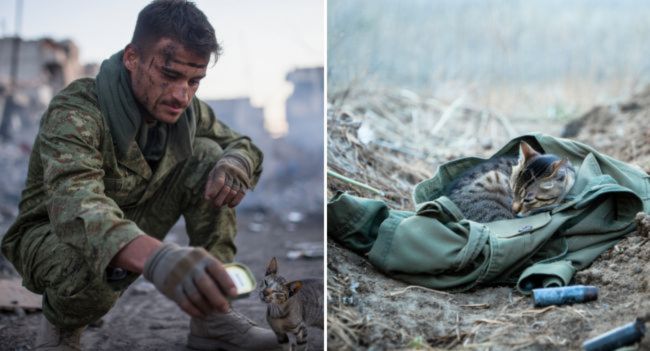
The world only learned about him because of the drone. For weeks, it captured small, silent moments amid chaos — a soldier crouched behind broken walls, whispering to a cat. No one knew his name, but they called him “Blue Can,” after the note he left behind.
The footage was never meant to be seen. It was for intelligence — a watchful eye over a ruined city — yet, between explosions and fire, there was tenderness. The soldier always set aside part of his meal, sometimes just a spoonful of stew, sometimes a crumb of bread. He’d whistle softly, and from behind a shattered door, the cat would appear — a thin gray creature with burnt fur and one torn ear.
In the beginning, it was just survival. But as the days stretched into nights, the two became a kind of story whispered among the soldiers. “He’s feeding that cat again,” someone would say over the radio, half a laugh, half a prayer. In a place where people forgot how to be human, that small act reminded them why they still fought.
They shared more than food. During storms, the soldier tucked the cat into his jacket. The drone’s thermal camera once caught a small heat signature pressed against his heart. He’d pet the animal with hands cracked from frost and gun oil. When artillery fell too close, he’d cover it with his helmet first.
Then came the night of the assault.
The enemy was closing in; everyone knew it. The soldier’s radio went quiet at 0200. Drones recorded only flashes, smoke, then stillness. The next morning, medics found him — motionless in the crater he’d defended alone. His body shielded something inside his jacket.

They found the note first.
“I know they are approaching. I’ll fight for my friend, I’ll do anything to keep him safe. If this takes me, please leave my jacket in my hole, winter is coming and he will come for warmth. P.S. If you can catch him, his favorite food is the blue can.”
The words spread through the camp like a secret hymn. No one could speak after reading it. A corporal went back days later, leaving the jacket just as he asked.
And then — weeks after the soldier’s burial — the drone recorded movement again.
A small figure slipping through the ruins, nose lifted, cautious but determined. It was the cat. It circled the old trench, meowed once, and crawled into the jacket.
For a moment, the camera shook, as if the operator had forgotten to breathe. The gray shape curled into the fabric and didn’t move again until sunrise. When the morning light touched the hole, it looked almost peaceful — like a promise kept beyond death.
Later, someone brought a small crate of rations and quietly left a few of the blue cans beside the trench.
They said the cat still roams the outskirts, always near that same patch of earth. And when the wind blows through the ruins, the torn fabric of an old jacket flutters faintly — as if something, or someone, is still guarding it.
Because in the end, it wasn’t just a soldier and his cat.
It was proof that even in war — where humanity burns slow and bright — love, in its simplest form, can survive the fire.