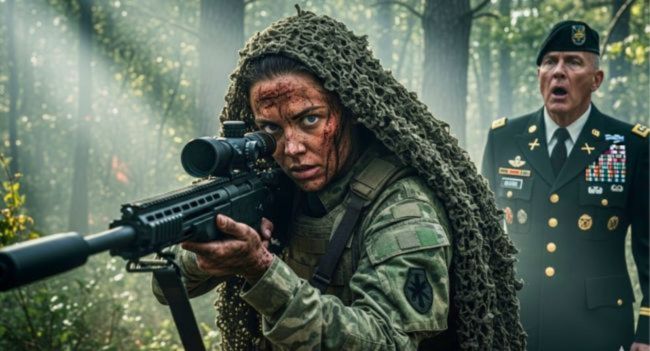
Command Said Those Enemy Snipers Were Unstoppable — Then She Eliminated All Six In Eighteen Minutes
The radio came through like gravel at 08:47: Charlie 6 to any unit. Precision fire from multiple positions. Three casualties. We can’t move. Can’t get a fix. They’re invisible.
Captain Morrison’s voice fractured as another round tore through drywall behind him. In the tactical operations center fifteen miles away, Lieutenant Colonel Sarah Chen leaned over the digital map, watching icons blink over a small Syrian border town. Charlie Company was pinned across an intersection—trapped between buildings, bleeding from wounds no one could place. Heat maps, thermal feeds, and body counts painted a single ugly picture: six snipers, elevated, coordinated, professional.
The intelligence officer scrolled through thermal frames. “Not ISIS,” he said. “Not amateurs. Russian training patterns. Military optics. Interlocking fields of fire.”
Three Marine Scout snipers had been working the area for nearly an hour with no solution. They’d tried every standard detection technique and come up empty; every time they pushed, they were met with accurate suppressive fire and had to displace. Chen looked at the room and found Staff Sergeant Brooklyn Howard at a corner console. Quiet. Focused. Classified attachment. No more than twenty-six, compact, deliberately still—the kind of person who makes observation look like patience, not passivity.
Chen asked the question everyone else had been asking. Brooklyn studied the map for eight seconds and said, flatly, “They’re good. Professional. Textbook multi-sniper overwatch. But not unstoppable.” She rose and walked toward the door. “I can take them. All six. Give me 18 minutes.”
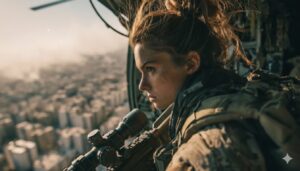
The request sounded like a gamble until Brooklyn listed what she needed: immediate HILO transport to grid November 74, a rifle and optics from the armory, direct comms to Charlie 6. Chen made the call.
Wheels down on a rooftop three blocks from the chokepoint. Brooklyn unpacked a modified M110, fitted the Schmidt and Bender scope, checked the suppressor, and set a drag bag of match-grade rounds beside her. From her vantage she could see the kill zone—open ground flanked by several four- and five-story buildings with rooflines and balconies providing every elevated firing position an enemy sniper would want. The six positions formed a deadly web: primary nodes and backup nodes, overlapping arcs of fire that turned the intersection into a trap.
She didn’t look for flash. She watched for pattern.
Charlie 6 acknowledged overwatch and sent fragmented reports: men pinned in three buildings, seven casualties so far. Brooklyn asked for simple things—mark the general area where each shot came from, use smoke if possible, and, crucially, do not attempt precision engagements unless told. For five minutes she let the enemy give her information. Each shot they took, each displacement, every broken curtain and shattered pane built a mental grid in her head. Where most counter-snipers would lurch to engage on sight, Brooklyn collected data. She let the shooters reveal their doctrine: the way trained teams trade shots, cover for one another, and displace to proximal backups.
Her method was not detection first. It was prediction. Pattern recognition. The enemy’s discipline and reliance on doctrine became a weakness the moment someone understood the doctrine better than they did.
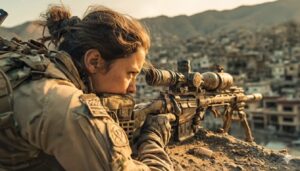
She tested the web. “In sixty seconds I want someone to attempt a crossing from Building Two to Building Three. Not to get hit. To make them reveal coverage.” The Marines argued the ethics of drawing fire, then complied. A man sprinted, dove for cover, and two distinct shots answered—northeast and southeast. Brooklyn saw the shrub of shattered glass where a window had been intact a minute earlier. She marked it. She didn’t shoot.
Minutes turned into a map. Positions that fired consistently revealed primaries. Silent positions that remained steady in the background suggested backups. She ranged the distances: 680 meters northeast, 720 northwest, 640 east, 710 southeast, 695 south, 750 west. Each range, each building silhouette, each curtain moved into place like a chessboard.
She initiated the first phase: create controlled noise. “Suppressive fire on the northeast, third floor,” she told Charlie 6. The idea was not to kill but to coax attention and discipline the enemy into a predictable posture. Under the smoke and the crack of return fire, she watched a shadow crouch. She fired once, suppressor whispering through the scope. The target collapsed. One down.
Brooklyn moved through her mental list and removed options rather than chasing visuals. Her shots were surgical, chosen when the enemy’s expected behavior made them vulnerable—when they looked for targets, when they shifted to check a sector, when they prioritized the battle over their own concealment. Two more shots, then another. Ten minutes in, half were gone. Each kill changed the dynamics: radio silence, increased caution, slower movement. But her approach anticipated that too—she planned for defensive changes and for eventual exfiltration attempts, covering both likely behaviors.
When the fifth target tried to leave via a hallway and stairwell, she tracked movement through windows and ended the escape. The last shooter was the real test: the longest-range, the most patient, the one who had not fired since the first round went down. He’d stayed hidden, waiting for a mistake. Brooklyn did something counterintuitive—she forced him to look where she wanted. A Marine ran across the smoke-choked intersection, bait and nothing more. The last sniper reacted the way a hunter would: search for the counter-sniper. He exposed his glass, the sun catching glint off a scope on a fourth-floor shutter. Seventy-five hundred meters, an upward angle, eight miles per hour left-to-right wind—she accounted for everything, exhaled at the right moment, and squeezed. The window shattered; a rifle clattered to the street.
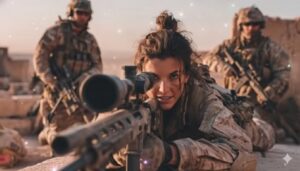
Eighteen minutes and twelve seconds after her boots touched the rooftop, Brooklyn called Charlie 6. “All enemy snipers neutralized. You’re clear to move.” A Marine cautiously crossed. No shots. Captain Morrison’s voice came back, flat with disbelief: “How many did you get?” “All six, confirmed.”
The after-action showed something the initial doctrine hadn’t anticipated: six disciplined, trained snipers undone not by superior firepower but by someone thinking like them and one step ahead. Brooklyn had not merely scored hits. She had turned their doctrine into a trap. She’d used suppression, controlled provocation, geography, and a granular understanding of how trained snipers make decisions under pressure.
Weeks later she briefed thirty senior sniper instructors, scout snipers, SEALs and Rangers. Her lesson was simple and brutal: when your opponent follows doctrine, doctrine becomes predictable. Detecting snipers is valuable. So is optics and acoustics. But against organized sniper teams, detection alone buys time for them to react. Prediction buys victory. She taught them to map fields of fire, think in overlapping arcs, anticipate displacement ranges, and control the tempo so the enemy reveals their decision tree.
Brooklyn would later be credited, quietly, in classified circles. The Syrian operation became a case study at advanced sniper courses: pattern-based counter-sniper methodology, taught next to SOTIC’s existing curriculum. Her file—redacted for public consumption—listed thirty-some confirmed high-value eliminations and an uncanny ability instructors described as thinking like the enemy.
She didn’t want medals. The public never knew her name. For her, the operation was proof of a belief drilled into her by a father with Delta experience: the most dangerous opponent is not always the best shooter. It’s the one who can predict what you’ll do next and position themselves where you cannot respond.
Command had called the six snipers “unstoppable.” For one quiet operator on a rooftop, they were merely trained to behave in certain ways—and once those patterns were understood, predictable became fatal.
Eighteen minutes. Six confirmed. A doctrine rewritten in silence and smoke. The rest became required study.