
John Lennon Walked Into A Monday Night Football Game Completely Confused — Six Years Later, The Same Booth Would Announce His Death

John Lennon wasn’t supposed to be at the Los Angeles Memorial Coliseum that night.
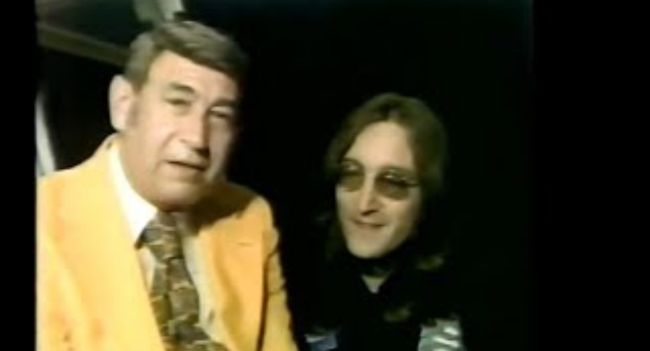
He certainly wasn’t supposed to end up inside the Monday Night Football commentary booth, trying to understand why players kept disappearing from the field and casually discussing whether The Beatles might reunite.
But on December 9, 1974, that is exactly what happened.
The resulting interview with Howard Cosell was funny, spontaneous and wonderfully strange.
Then, almost exactly six years later, an extraordinary coincidence gave the footage a heartbreaking significance.
Cosell would be sitting in that same Monday Night Football booth when he told millions of Americans that John Lennon had been shot and killed.
Lennon Hadn’t Even Planned To Attend The Game

Lennon’s appearance began with a chance encounter earlier that day.
Frank Gifford bumped into the former Beatle at the Beverly Wilshire Hotel and offered him tickets to that night’s game between the Los Angeles Rams and Washington Redskins.
Gifford apparently wasn’t expecting Lennon to take him up on the offer.
But he did.
Lennon arrived at the Los Angeles Memorial Coliseum, joining a crowd of around 87,000 people for one of America’s biggest sporting spectacles.
The stadium was also packed with famous faces.
California governor Ronald Reagan, who would later become US president, was among those attending.
And in one of the evening’s more unlikely encounters, Reagan reportedly found himself explaining American football to Lennon.
The British rock star apparently needed the help.
American Football Left Lennon Completely Baffled
Lennon understood enormous crowds.
He understood screaming fans.
He understood what it was like to stand at the center of a spectacle.
Yet even somebody who had lived through Beatlemania seemed astonished by what he saw inside the Coliseum.
Eventually Lennon was invited into ABC’s commentary booth to speak with Cosell, whom he had previously met during an extended radio interview.
Cosell asked Lennon for his initial reaction to the game.
“It’s an amazing event and sight,” Lennon replied.
Then he made a comparison only a Beatle could probably make.
“It makes rock concerts look like tea parties.”
Understanding the actual game was another matter.
‘Why Half The Team Was Off And Half The Team Was On’
Lennon had been attempting to follow the action, but one basic feature of American football had him puzzled.
He couldn’t understand why the players kept changing.
Lennon told Cosell he was confused about “why half the team was off and half the team was on.”
Cosell tried putting the sport into more familiar terms, asking Lennon to compare American football with soccer and rugby.
Lennon decided rugby was probably the closest comparison.
There was, however, something he thought American football was missing.
A proper rugby scrum.
Lennon joked about the point where “both teams really punch each other.”
For a few minutes, one of the most famous musicians alive was simply another foreign visitor trying to work out the rules of an unfamiliar American sport.
Then Cosell asked the inevitable question.
Could The Beatles Actually Get Back Together?

By December 1974, Lennon had undoubtedly heard variations of the reunion question countless times.
The Beatles had officially broken apart years earlier, but public fascination with the possibility of John Lennon, Paul McCartney, George Harrison and Ringo Starr sharing a stage again had never disappeared.
Cosell brought it up.
Would The Beatles ever reunite?
Lennon’s answer left the door tantalizingly open.
“You never know,” he said. “It’s always in the wind.”
Then Lennon looked around at the enormous stadium.
If a Beatles reunion could resemble the spectacle surrounding him that night, he suggested, “It might be worth doing.”
For anyone hoping for the four Beatles to reunite, it was a tantalizing comment.
But that reunion never came.
A Funny Interview Acquired A Heartbreaking Meaning
Viewed on its own, the 1974 footage is an amusing piece of pop-culture history.
John Lennon turns up unexpectedly at an NFL game, encounters Ronald Reagan, admits he doesn’t understand the sport and gets asked about putting The Beatles back together.
But the date makes the footage difficult to watch without thinking about what happened next.
Almost exactly six years later, on December 8, 1980, Lennon was shot outside the Dakota in New York.
That night, Monday Night Football was once again being broadcast to millions of Americans.
Howard Cosell was once again in the commentary booth.
And Frank Gifford was there with him.
Then news of Lennon’s shooting reached ABC.
Cosell Wasn’t Sure Whether To Announce It
The broadcasters faced an extraordinary decision.
They had learned that Lennon had been shot, and the information was devastating.
But they were in the middle of broadcasting a football game.
According to the account, Cosell initially questioned whether they should interrupt the sporting coverage to tell viewers.
Gifford believed they had no choice.
The news was simply too important.
Cosell ultimately delivered the announcement during the broadcast, meaning millions of viewers learned about Lennon’s death while watching Monday Night Football.
The connection was almost impossible to imagine.
Six years earlier, Cosell had stood beside Lennon in the booth while the musician laughed about football, rock concerts and the possibility of a Beatles reunion.
Now Cosell was telling America that Lennon was dead.
The Same Voices, Six Years Apart
That coincidence transformed an otherwise lighthearted television appearance into something much more poignant.
In 1974, Lennon was 34 years old and looking out over an enormous stadium.
He was joking about a sport he didn’t understand.
He was still being asked about The Beatles.
And when Cosell raised the possibility of a reunion, Lennon could still answer: “You never know.”
Everything remained possible.
Six years later, it wasn’t.
The broadcaster who had once interviewed him amid the noise of an NFL crowd was suddenly responsible for delivering news that would shock the world.
Lennon Was Simply Having Fun
Knowing the ending makes it tempting to watch every surviving Lennon appearance from those final years through the lens of tragedy.
But that isn’t what makes the football footage so appealing.
Its charm comes from how ordinary Lennon seems despite the extraordinary circumstances.
He isn’t performing.
He isn’t delivering a carefully rehearsed statement.
He isn’t trying to promote anything.
He is simply at a football game he hadn’t expected to attend, surrounded by tens of thousands of people, trying unsuccessfully to understand why the teams keep changing players.
Even the Beatles question produces a relaxed answer rather than some grand declaration.
“You never know.”
For one night in Los Angeles, that was enough.
A Strange Little Moment Frozen In Time
There is a remarkable symmetry between those two December nights.
December 9, 1974: John Lennon sits beside Howard Cosell during Monday Night Football, laughs about American football and imagines what a Beatles reunion inside a stadium like that might look like.
December 8, 1980: Cosell sits behind a microphone during another Monday Night Football broadcast and announces that Lennon has been killed.
Nothing about the first encounter could have prepared anyone for the second.
And that is why the old footage feels so different now.
Lennon looks around the Coliseum and has absolutely no idea what is happening on the football field.
More importantly, he has no idea what lies six years ahead.
For those few minutes, he’s simply John Lennon — amused, confused and still able to say that when it came to The Beatles, anything might happen.