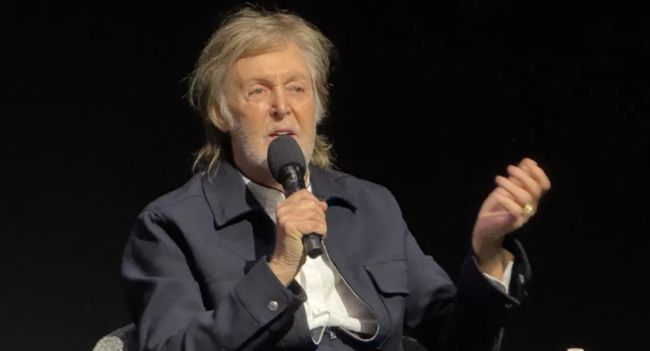
Paul McCartney Says Losing The Beatles Felt Like Being ‘Sacked’ — and Reveals How Fear, Linda and Harsh Critics Pushed Him to Start Again With Wings

Paul McCartney had already reached a level of success most musicians could never imagine when The Beatles came to an end.
But instead of feeling liberated, he suddenly found himself confronting a frightening question.
What was he supposed to do next?
Speaking after a Los Angeles screening of Morgan Neville’s documentary Man on the Run, McCartney admitted that losing the only professional life he’d really known left him feeling almost as though he’d been fired.
“The Beatles break up, that’s been your only job you’ve ever had, and then you don’t have it anymore,” he said. “It’s like you got sacked.”
That uncertainty would eventually lead to Wings, but the journey wasn’t an easy reinvention. It involved isolation in Scotland, bruising reviews, tension with John Lennon, a painful legal fight involving his former bandmates and McCartney’s determination to prove that his greatest music wasn’t necessarily behind him.
Being Alone After The Beatles Was Frightening
For years, McCartney had worked inside the structure of a band.

Suddenly, that safety net was gone.
“I think just being on my own was very scary,” he recalled.
One obvious option would have been to recreate the sound that had already made him famous. But McCartney knew that simply assembling musicians and making Beatles-style records would leave him effectively fronting his own Beatles cover band.
He initially resisted even performing the old catalog.
Promoters asked whether he would play Beatles songs, sometimes suggesting that he at least perform “Yesterday.”
McCartney’s answer was no.
That left him with the much harder task of creating something new while the entire world inevitably compared everything he made with what had come before.
Even Paul McCartney Started Believing the Critics
His post-Beatles album Ram, recorded with Linda McCartney, would eventually undergo a major critical reassessment.
At the time, however, the response hurt.
McCartney believed they’d made something special, only to watch critics tear into the record.
The most painful part wasn’t simply reading negative reviews.
He started believing them.
“For years, I thought it wasn’t a very good album,” he admitted.
His perspective changed when one of his nephews unexpectedly told him that Ram was his favorite McCartney album.
McCartney went back to the record himself.
“And I suddenly listened to it and liked it again.”
For an artist who had already helped create some of the most celebrated records in popular music, it was a revealing admission: even Paul McCartney could lose confidence when enough people told him his new work wasn’t good enough.
John Lennon’s Criticism Couldn’t Erase Their Bond

McCartney’s post-Beatles relationship with John Lennon was another complicated part of the period.
The former songwriting partners publicly criticized one another, and their tensions eventually spilled into music.
Yet McCartney’s recollection of Lennon remains deeply affectionate.
“I loved John and love him to this day and always will,” he said.
He remembered looking up to Lennon from the time they were teenagers, describing him as sharp, witty and someone he considered extraordinarily cool.
McCartney could acknowledge that Lennon sometimes behaved badly while still viewing him through the lens of the friend he’d known since he was 15.
“He was a lovely guy,” McCartney said.
He also reflected on the tragedies Lennon experienced while young, including losing his mother Julia, and contrasted that turmoil with his own comparatively secure childhood before his mother died when he was around 14.
The Idea for Wings Came From Watching Johnny Cash
The inspiration for McCartney’s next band arrived from an unexpectedly simple place.
He and Linda were watching Johnny Cash on television.
Cash had assembled a group featuring Carl Perkins and other country musicians, and something clicked.
McCartney turned to Linda.
“Shall we start a band? Do you wanna be in it?”
Linda had no formal musical education, but that didn’t bother him.
As McCartney saw it, The Beatles hadn’t started with formal musical training either. They had learned through doing it.
So he and Linda would do the same.
“We learned together,” he recalled. “We climbed the steps together.”

Linda Took Enormous Criticism for Joining Him
Putting his wife in Wings wasn’t universally welcomed.
Linda faced criticism over her musical experience, while Paul was attacked for putting her in the band at all.
McCartney specifically recalled criticism attributed to Mick Jagger about having his wife in the group.
More than five decades later, McCartney’s reaction remained unmistakably defiant.
He also defended Linda’s contribution as a singer, particularly the distinctive blend created by her voice alongside his and Denny Laine’s.
Wings didn’t begin as a perfectly polished machine.
That, McCartney suggested, was part of the point.
They had to improve together.
Eventually, they did.
McCartney Realized Wings Could Never Be Completely Equal
There was another lesson waiting for him.
McCartney initially wanted Wings to function as a real band rather than simply a vehicle built around a former Beatle.
But true equality proved difficult.
“I was, like, a Beatle, and they weren’t,” he joked.
Eventually, he accepted that he needed to take control when something wasn’t working.
“I had to be the boss,” he said.
McCartney recalled experiencing something similar during The Beatles, when his enthusiasm for pushing the group into projects could occasionally make him worry that he was becoming too controlling.
When he deliberately backed away, however, things could stall.
He remembered Ringo Starr effectively encouraging him to resume driving the process.
That experience followed him into Wings.
McCartney ultimately concluded that writing, producing and directing the music wasn’t necessarily about dominating the people around him.
It was simply the role he was best equipped to play.
Wings Became His Way of Starting Again

Man on the Run follows McCartney across roughly the decade after The Beatles, using archival material rather than conventional present-day talking-head interviews.
Neville explained that the approach was intended to make audiences experience events as though they were unfolding in real time rather than constantly cutting between the young McCartney and his older self remembering what happened.
McCartney strongly approved of that choice, joking about how strange it can feel when documentaries repeatedly cut between youthful archival footage and an artist decades later.
More importantly, the film reframes Wings as something bigger than a collection of post-Beatles hits.
It was McCartney rebuilding himself.
There were critical failures, arguments, lineup changes and extraordinary successes. There was also the challenge of escaping the shadow of a band so enormous that almost anything following it could look small by comparison.
Yet Wings eventually reached arenas across America, while songs and albums once dismissed became important parts of McCartney’s legacy.
Looking back now, he remembers the period fondly.
For McCartney, Wings wasn’t an effortless second act after The Beatles.
It was the messy answer to the terrifying question of what happens when the greatest chapter of your career ends — and you still aren’t finished making music.