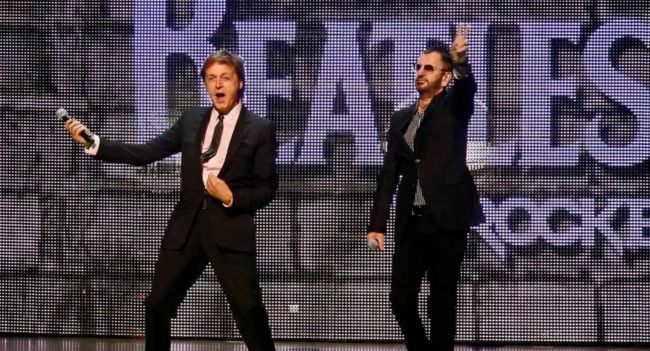
Ringo Starr Says The Beatles ‘Didn’t Get Along’ — But Credits Paul McCartney’s Workaholic Drive for Keeping the Band Making Music

Ringo Starr has never tried to pretend The Beatles were four endlessly harmonious friends.
Looking back on the band’s extraordinary run, the drummer acknowledged that disagreements were a regular part of life inside one of the most successful groups in music history.
“No no, we didn’t get along,” Starr said during an interview with Dan Rather for AXS. “We were four guys. We had rows.”
But for all the tension between Starr, Paul McCartney, George Harrison and John Lennon, he insists one thing rarely changed.
Once the music started, the arguments were put aside.
‘Once the count in, we all gave our best’

Starr explained that even the worst disagreements did not usually interfere with the band’s performances or recording sessions.
The personal friction could be intense, but the four musicians still knew how to work together when it mattered.
“Once the count in, we all gave our best,” he said.
For Starr, that ability to separate personal conflict from the music was a major reason The Beatles were able to accomplish so much in such a short period of time.
The group released 12 studio albums between 1963 and 1970, producing an extraordinary amount of material before their breakup.
And Starr believes one member deserves particular credit for keeping that pace going.
Starr calls McCartney the band’s ‘workaholic’

According to Starr, Paul McCartney was the driving force who repeatedly got the group back into the studio.
“Because of Paul, who was the workaholic of our band, we made a lot more records than John and I would’ve made,” Starr said.
He admitted that he and Lennon were often more inclined to relax.
“We liked to sit around a little more,” he said.
Then McCartney would step in.
“Paul would call, ‘All right lads,’ and we’d go in.”
Decades later, Starr said he still appreciates that persistence.
“We always thank Paul to this day,” he added.
The comment offers a revealing look at McCartney’s role inside the group, not simply as a songwriter and musician, but as someone constantly pushing The Beatles toward the next session, the next song and the next record.
Life outside the band eventually changed everything

Starr suggested that maintaining the same relentless pace became increasingly difficult as the members grew older and developed lives beyond The Beatles.
“Suddenly, we’ve got lives, and I’ve got children,” he explained.
The enormous effort the group had invested in its career began to feel different once family responsibilities and individual interests entered the picture.
That change didn’t erase their musical chemistry, but it added another layer to the tensions already developing within the group.
By the end of the 1960s, the four Beatles were moving in increasingly different directions.
The band’s final years were anything but peaceful

The conflicts that surrounded The Beatles’ breakup have been documented extensively over the decades.
Starr himself has acknowledged that by 1970, he was ready for the band to end.
In the oral-history book All You Need Is Love: The Beatles in Their Own Words, he said he was “pleased” when the breakup finally came after weeks of arguments.
“It was time,” Starr said. “Things only last so long.”
The same book, based on interviews conducted by Peter Brown and author Steven Gaines, also revealed some of the frustration that existed between other members.
George Harrison was particularly blunt when discussing Lennon, describing him in harsh terms and recalling his negativity toward the band.
Those comments reinforced just how complicated the relationships had become behind the scenes.
The music continued to outlast the arguments

Despite all of that tension, The Beatles’ music has endured far beyond the circumstances that eventually pulled the group apart.
Lennon was killed in New York City on December 8, 1980, at age 40.
Harrison died on November 29, 2001, at age 58 after battling cancer.
For decades, McCartney and Starr remained the two surviving Beatles, occasionally returning to the band’s catalogue and legacy together.
Then, decades after the group stopped recording as a four-piece, technology helped make one final Beatles release possible.
‘Now and Then’ gave The Beatles one last song
The group released “Now and Then” in 2023, marking its first new song since “Real Love” in 1996.
The track originated from a Lennon demo recorded during the 1970s.
Using modern audio technology, Lennon’s original vocal was isolated and incorporated alongside contributions from McCartney and Starr, while Harrison’s earlier recordings were also included.
The result gave all four Beatles a presence on one final track.
It was a remarkable closing chapter for a band whose internal relationships had often been far more difficult than their public image suggested.
Four strong personalities, one extraordinary band
Starr’s comments make clear that The Beatles’ chemistry did not depend on constant friendship.
They argued.
They became frustrated with one another.
They developed separate lives and eventually reached a point where the group could no longer continue.
But they also had the ability to walk into a studio after a disagreement and still give everything to the music.
And in Starr’s telling, McCartney deserves a significant share of the credit for making sure they kept showing up.
Without Paul pushing everyone back to work, Starr believes there might have been considerably fewer Beatles records.
The arguments were real.
So was the exhaustion.
But so was the discipline that turned those four often-frustrated musicians into one of the most prolific and influential bands the world has ever seen.