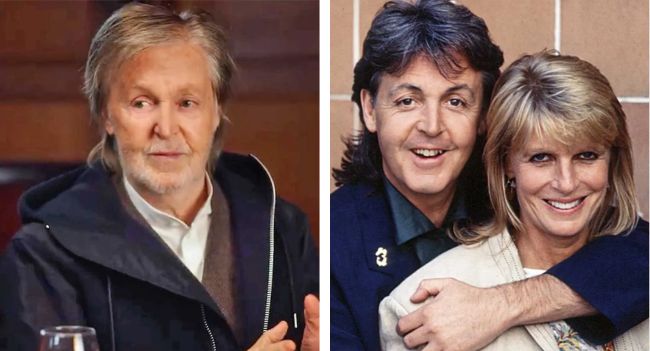
Decades after Linda McCartney’s death, Paul McCartney still carries with him a simple phrase she used whenever life began to feel constrained: “It’s allowed.”
The legendary musician, 83, has offered a rare and personal reflection on how his late wife changed his outlook on life in a new clip from his Words + Music installment with Audible, an expanded companion to his recent documentary Man on the Run.
Looking back on the beginning of their relationship in the 1960s, McCartney described Linda as a “freeing influence” who encouraged him to loosen up, trust his instincts and step beyond the expectations surrounding him.
Linda McCartney Brought a Sense of Freedom Into Paul’s Life
:max_bytes(150000):strip_icc():focal(746x255:748x257):format(webp)/Paul-McCartney-Linda-Eastman-031826-3913a0b65fb34aa48d1d3dd3e7864a8f.jpg)
Linda had grown up in an affluent part of New York, and McCartney said there had been expectations about the kind of conventional life she might eventually lead.
But that future did not appeal to her.
“She had grown up in a posh bit of New York. She was on track to become the sort of company wife. But she didn’t like that. She liked rock ‘n’ roll,” McCartney recalled.
That independent streak was already evident when she was young.
“She would do things like sneak out of the house late at night and drive into New York with a boyfriend,” he continued. “So there was a lot of freedom in her thinking. So I think that really was good for me.”
When Linda met McCartney, she was divorced and raising her 7-year-old daughter, Heather. The couple married in 1969 and later welcomed three children together: Mary, now 56, Stella, 54, and James, 54.
Their marriage lasted until Linda died from breast cancer in 1998 at the age of 56.
The Two Words Paul McCartney Never Forgot
One of Linda’s biggest influences on her husband was teaching him “not to be too uptight.”
McCartney remembered how she would respond whenever he convinced himself that something he wanted to do was somehow off-limits.
“One of my favorite expressions of hers was, you’d be saying, ‘Oh, I’d love to do so and so but I can’t.’ And she’d say, ‘It’s allowed,’” he recalled.
Those two words could immediately change his perspective.
“It’s like all the weight just went off,” McCartney said. “‘It’s allowed.’ Yeah, of course it is!”
Her attitude made a lasting impression on him and encouraged him to move beyond his own comfort zone.
“She didn’t want to do what her family had planned for her, so this madcap idea of having a baby with me, marrying me, and going up to Scotland… it suited her,” McCartney said. “And it suited me.”
Paul and Linda Took a Hands-On Approach to Parenthood
McCartney also reflected on the couple’s family life and how directly involved they were in raising their children.
Despite his enormous success, he said they did not initially think about employing the kind of household help he later realized was available to families who could afford it.
“I mean, I didn’t know… ‘cause stuff I know now, you get nannies and you get housekeepers and you get people to help you if you can afford it. We didn’t know any of that,” he explained.
Instead, McCartney remembers personally helping his children learn basic skills.
“It was me teaching cuh-at…Cat!” he said. “I loved doing that.”
Linda’s Place in Wings Drew Criticism
Linda was already an accomplished photographer when she became part of another major chapter of her husband’s life: Wings, the band McCartney formed following the Beatles.
She played keyboards and provided harmony vocals despite not having been trained as a professional musician.
Her presence in the group attracted considerable criticism at the time, something McCartney revisits in the Prime Video documentary Paul McCartney: Man on the Run.
“She can’t do this, she can’t sing, she can’t play piano, she can’t do anything,” McCartney recalled critics saying. “Oh, they’re crazy man, what’s he got his old lady in the band for? Who the hell is this?”
McCartney saw things differently. He appreciated Linda’s voice and the character of her singing, believing it gave Wings’ music a “special sound.”
Looking Back at a Chapter He Rarely Revisits
McCartney’s Words + Music installment expands on Man on the Run with a three-hour audio experience featuring extended conversations between the musician and director Morgan Neville, along with exclusive musical performances.
For McCartney, participating meant revisiting a period he does not often spend much time examining.
“I don’t normally spend a lot of time looking back but I was flattered when Morgan said he was interested in this period,” McCartney said in a statement.
He acknowledged that Wings had a difficult beginning before eventually finding its footing.
“The first bit of Wings was quite hard work and not very rewarding, but eventually we got some songs under our belts that were hits,” he said.
Neville’s questions ultimately brought memories back to the surface that McCartney said he had not considered for years.
“Morgan got me to think about stuff I hadn’t thought about for a long time,” he added. “He was asking all the right questions and I was happy to be transported back.”
Among those memories is Linda’s enduring influence — and a two-word reminder that helped McCartney approach life with a little more freedom: “It’s allowed.”