Sense and Sensibility Review: A Bold New Austen Adaptation That Doesn’t Always Find Its Edge
Taking on Sense and Sensibility after Ang Lee’s acclaimed 1995 adaptation was always going to be a difficult task. Emma Thompson’s version earned seven Oscar nominations and won Best Adapted Screenplay, making it one of the most celebrated screen interpretations of Jane Austen’s 1811 novel.
Now, three decades later, director Georgia Oakley and screenwriter Diana Reid have returned to the story with a distinctly more contemporary approach. Starring Daisy Edgar-Jones and Esmé Creed-Miles as sisters Elinor and Marianne Dashwood, the new film embraces a more naturalistic, windswept aesthetic and brings a sharper modern energy to Austen’s characters.
The result is visually striking and often engaging, but its attempt to balance traditional period romance with a more unconventional sensibility does not always come together.
The film opened in UK cinemas on September 25, 2026.

The Dashwood Sisters Face A Dramatic Change Of Fortune
At the heart of the story are Elinor and Marianne Dashwood, two sisters whose personalities could hardly be more different.
Elinor, played by Daisy Edgar-Jones, is thoughtful and restrained, while Marianne, portrayed by Esmé Creed-Miles, is far more impulsive and emotionally open. Their contrasting approaches to love give Austen’s story its central tension.
After their father dies, the Dashwood women lose their comfortable position when the family estate passes to their half-brother. His socially ambitious wife persuades him to remove the extended family from the property, forcing the widowed Mrs. Dashwood and her daughters to leave their grand home behind.
They relocate to a modest cottage in Devon, where both sisters begin navigating unfamiliar circumstances while becoming entangled in complicated romantic relationships.
Elinor develops feelings for Edward Ferrars, played by George MacKay, while Marianne becomes involved with John Willoughby, portrayed by Frank Dillane. Colonel Brandon, played by Herbert Nordrum, is also drawn into Marianne’s story.
The film uses these relationships to explore the same tensions at the centre of Austen’s novel: love versus social expectations, emotional openness versus self-control, and the limited choices available to women of the period.

Devon Gives Austen A More Rugged Look
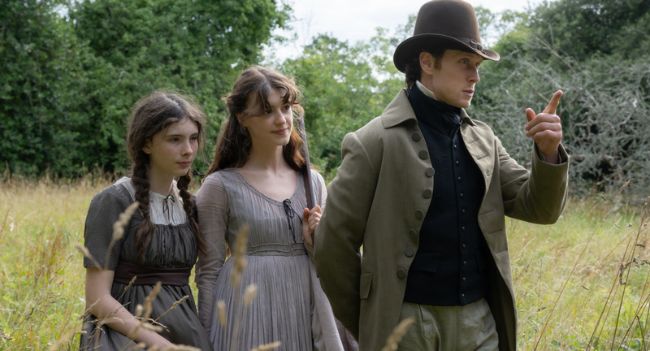
One of the film’s most noticeable departures from the traditional Austen aesthetic is its treatment of the landscape.
Rather than presenting the countryside as a polished, picturesque backdrop, Oakley takes her characters into a much wilder environment. The Devon locations include Princetown, Tavistock, Ashburton, South Brent and Widecombe-in-the-Moor, with rugged moors, beaches and historic towns providing much of the film’s visual identity.
The approach gives the movie a mood that can feel closer to the windswept atmosphere associated with the Brontës than the more refined visual language often used for Austen adaptations.
Other critics have similarly highlighted the film’s naturalistic look. The Independent noted its earthy approach to Austen, while Little White Lies praised the adaptation as a moodier and more naturalistic interpretation of the novel.
The countryside is particularly effective because the film often feels most alive when its characters are outside. By contrast, some of the London sequences are more conventional and restrained.

A More Modern Sense Of Austen
Oakley clearly wants this Sense and Sensibility to feel different from previous adaptations.
The film gives its heroines a more contemporary energy, while several casting choices challenge expectations surrounding Austen’s characters. One of the most notable examples is Eliot Sumner as Mr Palmer, a choice that brings a deliberately unconventional element to the period setting.
The sisters themselves also feel less polished and more physically grounded than the traditional image of Austen heroines. Their emotional lives are placed firmly at the centre of the story, with the relationship between Elinor and Marianne remaining just as important as their individual romances.
That emphasis is consistent with comments surrounding the production. RTÉ, for example, highlighted the importance of sisterhood in the new adaptation, with Edgar-Jones describing the relationship between the women as the film’s true love story.
But the attempt to modernise the material has divided critics.
Some have praised the film for finding a fresh visual and emotional language, while others have argued that it ultimately falls between two approaches: too traditional to feel genuinely radical, yet too deliberately modern for viewers seeking the elegance and wit of the classic adaptations.

Edgar-Jones And Creed-Miles Bring New Energy
The strongest element of the film is arguably the relationship between its two leads.
Daisy Edgar-Jones and Esmé Creed-Miles approach Elinor and Marianne differently, but their performances work together to establish the complicated bond between the sisters.
Edgar-Jones gives Elinor a restrained emotional quality, allowing much of the character’s conflict to remain beneath the surface. Creed-Miles, meanwhile, plays Marianne with considerably more outward intensity.
Their contrasting performances reinforce the central idea behind Austen’s title while making the sisters feel less like familiar literary archetypes and more like individuals struggling to understand what they want.
The supporting cast also has several highlights. Fiona Shaw makes a particularly strong impression as Mrs Jennings, bringing energy, humour and an outspoken quality to a character who can easily become secondary in other versions of the story.
Caitríona Balfe, meanwhile, plays Mrs Dashwood, the sisters’ mother, while the wider cast includes George MacKay, Frank Dillane and Herbert Nordrum.
A Beautiful Film With Divided Reactions

Visually, there is little doubt that Oakley’s adaptation has its own identity.
The film’s natural landscapes, muted period costumes and outdoor photography give it a distinctive atmosphere, while the performances provide an emotional grounding beneath the romantic storyline.
But its reception has been mixed.
Time Out praised the film as a “wild and wonderful” interpretation and gave it four out of five stars, particularly highlighting the chemistry between the Dashwood sisters and Fiona Shaw’s performance.
The Guardian, however, found the adaptation more restrained and austere than the 1995 version, noting that it takes a more reflective approach to Austen’s story.
The Times was considerably less enthusiastic, arguing that the film struggles to establish a sufficiently contemporary identity and describing it as emotionally flat and dramatically uneven.
That split in critical response reflects the central challenge facing this version of Sense and Sensibility: it wants to honour a familiar classic while also convincing audiences that there is something new to discover.
Is This The Next Great Sense and Sensibility?

There is plenty to admire here. Edgar-Jones and Creed-Miles make an effective pair, the Devon locations are striking, and Fiona Shaw brings considerable life to the supporting cast.
Yet the film’s ambition to make Austen feel more modern does not always translate into a consistently compelling experience.
At 131 minutes, the film has room to explore its characters and relationships, but its shifts between intimate romance, traditional period drama and more unconventional storytelling can make the overall tone feel uneven.
Ultimately, this is a Sense and Sensibility that is more interested in emotional rawness and naturalism than polished period elegance. For some viewers, that change in perspective will make Austen’s familiar story feel newly alive. For others, the film may struggle to escape the shadow of the much-loved 1995 adaptation.
Either way, Oakley has created a version with a clear visual personality — even if its attempt to be radically different does not always feel as daring as intended.
Sense and Sensibility is now in UK cinemas.