Netflix’s The Doll Reimagines a Polish Literary Classic — And Viewers Are Already Divided
Netflix’s latest period drama is doing something unusual with one of Poland’s most celebrated novels: instead of attempting a faithful, scene-by-scene adaptation, The Doll turns Bolesław Prus’ classic into a bold six-part drama about obsession, social ambition, class and the struggle for independence.
The Polish-language series arrived on Netflix on September 16, 2026, with Tomasz Schuchardt starring as Stanisław Wokulski and Sandra Drzymalska as Izabela Łęcka. Directed by Paweł Maślona, the series has quickly attracted attention for its distinctive interpretation of the source material. Netflix itself describes it as a modern reinterpretation of Polish literary classic Lalka.
But the response has been far from unanimous. Some viewers and critics have praised its performances, visual style and willingness to reinvent the novel, while others have objected to how dramatically it departs from the original.

A love story shaped by class, money and obsession
At the centre of The Doll is Stanisław Wokulski, a self-made merchant whose ambition extends far beyond his business success.
He wants access to Warsaw’s aristocratic society, and his fascination with Izabela Łęcka becomes inseparable from that ambition. Winning her affection means more than pursuing a romance: for Stanisław, it also represents entry into a social world that has long remained beyond his reach.
Izabela, however, is not simply the distant object of his desire.
The series gives her ambitions and frustrations of her own as she struggles against the limitations imposed by aristocratic society. Her desire to determine her own future becomes an important part of the story, creating a relationship in which love, social status and personal freedom are constantly colliding.
Netflix describes the central relationship as one caught between an enormous class divide, obsession, the desire for freedom and the seductive power of wealth.
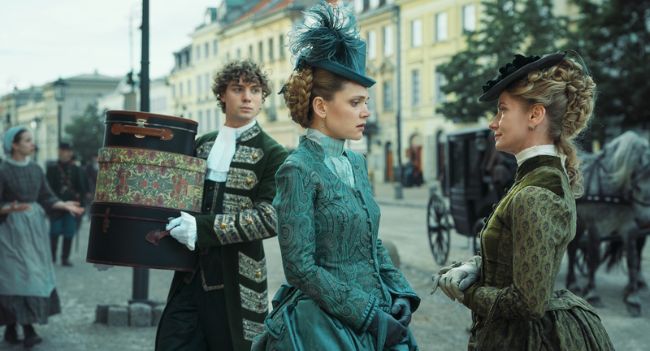
Set in 19th-century Warsaw, the drama also places considerable emphasis on the world surrounding its two leads, from wealthy households and elaborate social gatherings to the lives of people living on the opposite end of the social hierarchy.
This is not a straightforward adaptation of the novel

Prus’ The Doll, or Lalka, is a major work of 19th-century Polish literature. The Netflix series uses its characters and central conflict as a foundation, but the filmmakers have deliberately taken the story in their own direction.
Netflix describes the production as an “authorial” and multi-genre reinterpretation, adding new storylines involving investigations, family secrets and conflicts that expose hidden interests. The creators also move away from romantic idealisation, presenting the characters as people trapped by social structures, ambition and money.
That approach has been one of the most discussed aspects of the series.
Reviews have noted that The Doll should not be approached as a visual reproduction of Prus’ novel. Instead, Maślona uses the familiar characters and social tensions to tell a story designed for a contemporary television audience. Culture.pl similarly described the series as being inspired by Prus rather than functioning as a direct illustration of the original book.
One of the biggest shifts is the treatment of Izabela.
Rather than existing primarily through Wokulski’s perspective, the Netflix version gives her considerably more space as a character with her own desires and frustrations. A review from Upflix highlighted the way the series allows the camera to spend more time on Izabela’s side of the story, turning her from simply the focus of Wokulski’s obsession into someone pushing back against the world around her.
What happens across the six episodes?

The six-episode story follows Stanisław as he returns to Poland after building his fortune and sets his sights on winning Izabela’s hand.
Their relationship becomes increasingly complicated as Izabela begins to recognise how much influence she has over Stanisław and how his ambitions can serve her own interests.
An unexpected victory further raises his profile and brings him closer to the aristocratic world he has been trying to enter.
As the story progresses, however, both characters are forced outside the familiar world of Warsaw.
Stanisław pursues a new business venture, while Izabela finds herself experiencing life on the streets. Their circumstances expose sides of their characters that are difficult to see within the protected world of wealth and status.
By the sixth episode, the truth is finally out in the open, leaving everything Stanisław has spent years pursuing hanging in the balance.
A lavish period drama with a distinctly modern edge

Visually, The Doll leans heavily into its period setting, recreating 19th-century Warsaw through elaborate costumes, interiors and social gatherings.
But the presentation is deliberately contemporary.
Netflix says Maślona brings a dynamic cinematic language to the production, while the series mixes melodramatic tension with humour, mystery and grotesque elements.
That mixture has helped make the series stand out from more traditional costume dramas.
Critics have praised its visual ambition and performances, although some reviews have also noted that the drama can lose momentum at times. Culture.pl, for example, described it as impressive and visually striking while acknowledging that its dramatic drive occasionally falters.
The result is a period drama that looks familiar on the surface but approaches its characters and themes in a distinctly modern way.
The reaction has been anything but quiet

The early response to The Doll has been sharply divided.
Some viewers have praised the atmosphere, performances and costumes, with several saying they became increasingly absorbed after the opening episodes. Others have welcomed the decision to modernise the characters and move away from the structure of the roughly 700-page novel.
There has also been significant criticism.
A Polish audience survey published by WP after analysing nearly 900 comments found that around 73% of commenters expressed negative opinions about the series, while fewer than one in eleven were positive. At the same time, the publication noted that its own reviewer had called the production one of the best Polish series of recent months.
That contrast captures much of the conversation surrounding the show: The Doll has not inspired a single consensus, but it has generated plenty of discussion.
Other Polish reviews have similarly described it as an unusually bold reinterpretation, praising its performances and willingness to challenge expectations while acknowledging that its departures from the source material will not appeal to everyone.
Who stars in The Doll?
The main cast includes:
- Tomasz Schuchardt as Stanisław Wokulski
- Sandra Drzymalska as Izabela Łęcka
- Jacek Braciak as Tomasz Łęcki
- Dariusz Chojnacki as Ignacy Rzecki
- Magdalena Cielecka as Kazimiera Wąsowska
- Mateusz Król as Julian Ochocki
Netflix lists Paweł Maślona as director, with Maślona, Paweł Demirski and Jagoda Dutkiewicz credited as screenwriters.
How to watch The Doll
All six episodes of The Doll are available to stream on Netflix. The series premiered on September 16, 2026, with episodes running for roughly an hour and the finale lasting around 1 hour and 12 minutes.
For viewers expecting a traditional literary adaptation, the series may come as a surprise. But for those willing to see Prus’ characters through a more contemporary lens, The Doll offers a visually ambitious take on a story built around love, wealth, social class and the dangerous distance between what people want and what society allows them to have.