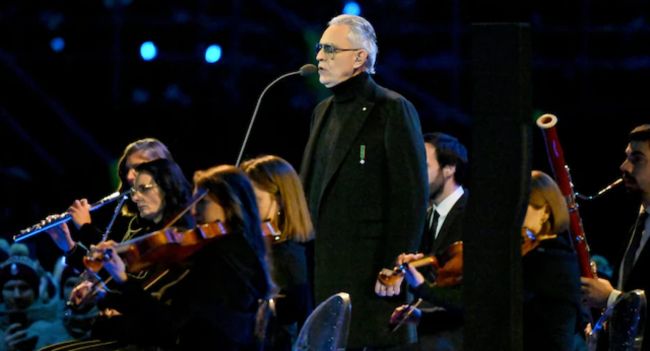
Viewers of the 2026 Winter Olympic Games Opening Ceremony got goosebumps toward the end of the program, and not just from the cold night air. Andrea Bocelli, the best-selling classical singer and one of the most internationally famous Italians, performed an absolutely flawless rendition of “Nessun Dorma,” an aria from the last act of Puccini’s opera Turandot, and it was simply breathtaking. Watch it here.
Twenty years ago, at the end of the 2006 Winter Olympics in Turin, Bocelli performed an original song, “Because We Believe (Ama Credi E Vai).” This time, he opted for an equally stirring song, one that’s famous the world over, even being covered by a puppet turtle.

“Nessun Dorma” translates to “none shall sleep.” In the story, a prince sings the song to the princess he longs for as she and the kingdom stay awake trying to guess his name. The song was one of Luciano Pavarotti’s signature numbers, and after he performed it at the 1990 FIFA World Cup, it became an anthem for soccer games and other large events, like the Olympics!
Andrea Bocelli is honored to perform in Italy for the Olympics once more

“I remember the Torino 2006 (Closing) Ceremony: a packed stadium, an incredibly emotional and affectionate crowd, an atmosphere that only the Olympic Games can create,” Bocelli told Olympics.com ahead of the 2026 ceremony. “When I was young and tried to learn the art of singing from the great singers, I dreamed of one day being able to sing, perhaps in a town square, I did not dare to hope for more. So finding myself on a stage like this was an indescribable emotion and a great honour.”

“I don’t think what matters most is the emotion I can leave behind,” he explained, continuing, “but rather the emotion that the Olympic Games and sport itself can create. Sport in itself embodies extremely important values, values that I believe should take root in the hearts of everyone, young and old alike.”
This year, Bocelli sang as the Olympic torch was brought into San Siro Stadium in Milan. The flame is lit in Olympia, Greece, and travels for months across borders on its way to the Olympic cauldron, passing through many hands and cities.