How All Her Fault Turned Every Parent’s Worst Nightmare Into Riveting Television
Peacock’s All Her Fault begins with a nightmare every parent can instantly understand: You arrive to collect your child from a playdate, only to discover that the child was never there. Then comes the second nightmare. Everyone starts wondering whether you are to blame.
That tension drives the eight-episode domestic thriller, adapted from Andrea Mara’s 2021 novel. But the series goes beyond the question of who abducted five-year-old Milo Irvine. Beneath the mystery, it examines marriage, motherhood, parental responsibility and the quiet resentments created when one person carries more of a family’s invisible workload.
A playdate that never happened
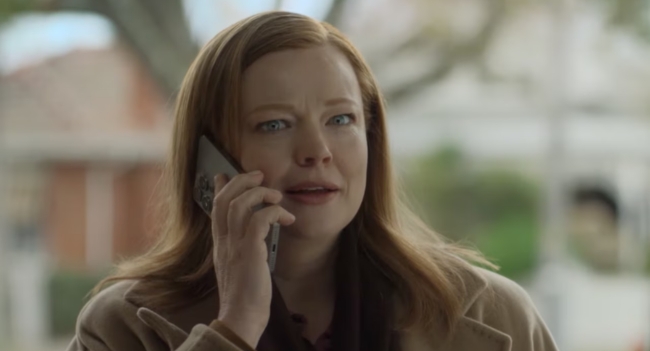
Marissa Irvine, played by Sarah Snook, arrives at a house expecting to pick up her five-year-old son, Milo, played by Duke McCloud. Instead, a stranger answers the door. There is no Milo, no playdate and no obvious explanation for what has happened.
The panic escalates quickly. Phone calls pile up, questions multiply, and Marissa is forced to confront the terrifying possibility that nobody knows where her son is.
Her mistake appears straightforward. She had received a text confirming Milo’s playdate from an unfamiliar number but failed to check that number against the school’s contact list. The series uses that seemingly small oversight to raise a much larger question: How much blame should a parent bear for a mistake made amid the endless logistics of raising a child?
Marissa’s predicament becomes particularly pointed because she and her husband, Peter, both work full time. Yet she is still the parent arranging playdates, volunteering at school, remembering schedules and keeping track of countless details.
That imbalance is central to the series.
Executive producer Megan Gallagher, whose credits include Wolf, was drawn to the idea of women effectively working two full-time jobs: one outside the home and another inside it. The exhaustion, mental load and resentment that can accompany that arrangement became a major part of the show’s foundation.
Gallagher also wanted the series to treat those issues seriously without allowing the social commentary to overwhelm the thriller.

Peter is involved, but not carrying everything
All Her Fault avoids turning the discussion into a simple indictment of men. One of the clearest examples is Detective Alcaras, who was a female Detective McConville in Mara’s novel but is portrayed by Michael Peña, known for Jack Ryan.
The change allowed the series to present a deeply involved father who balances his career with caring for his child, who has special needs.
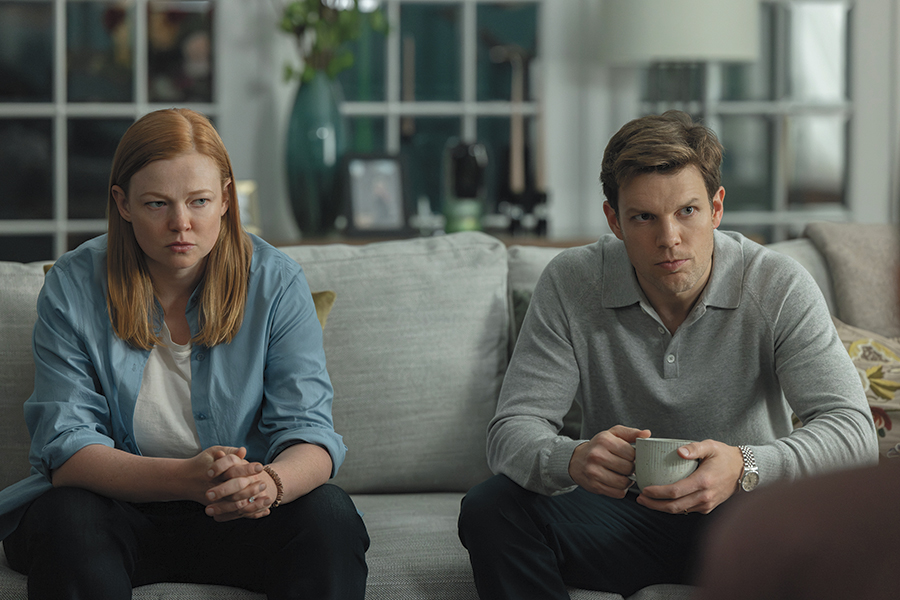
Peter, played by Jake Lacy, is also an attentive father. In fact, his involvement with Milo is so intense that it can verge on control. The problem is that his engagement with his son does not necessarily mean he shares the broader mental responsibility of parenting.
Lacy describes Peter as someone who is able to focus so completely on Milo because Marissa has taken care of everything surrounding that relationship.
The distinction becomes increasingly important as Peter’s story takes some of the series’ most startling turns. Lacy says that playing the character required him to commit fully to Peter’s decisions, even when those decisions became difficult to defend.
That commitment also meant temporarily losing sight of how audiences would see Peter from the outside. Lacy understood why viewers might consider his behavior extreme, even though he had spent the production developing empathy for the character, his suffering and the pain he causes.
There is an element of irony behind the series’ examination of domestic imbalance. Several women involved in the production have partners who stay at home, including Gallagher. Her own husband left his job to become a full-time stay-at-home father, leading to plenty of jokes at home about Gallagher making television about men who do not do enough.
Parenthood changed how Snook and Lacy approached the roles
Both Snook and Lacy are parents themselves, and each believes that experience influenced their performances.
Snook, a three-time Emmy nominee for playing Shiv Roy on HBO’s Succession, won Outstanding Lead Actress in a Drama Series in 2023. During her acceptance speech, she thanked her recently born daughter and credited her with giving her strength for the performance.
For All Her Fault, Snook believes becoming a parent gave her a different understanding of Marissa.
She points to her work in the 2015 Australian limited series The Beautiful Lie, in which she played a woman who leaves her husband and child. At the time, Snook could understand the character’s decision as an actress. Parents watching the series, however, questioned how the character could leave her son.
Snook now sees that experience differently. She believes that if she had been a parent then, she might have approached those choices with a different depth. For Marissa, whose story takes her into increasingly difficult territory, Snook does not think she could have played the role in the same way without being a parent herself.
Lacy, an Emmy nominee for his supporting performance in HBO’s The White Lotus, describes parenthood as similarly transformative. Before having children, he understood intellectually that he would do anything for them. Becoming a father introduced him to a biological attachment he had never experienced before, something he says inevitably informs the choices he makes as an actor, whether consciously or not.
The nightmare hit close to home
The series also affected its cast away from the cameras.
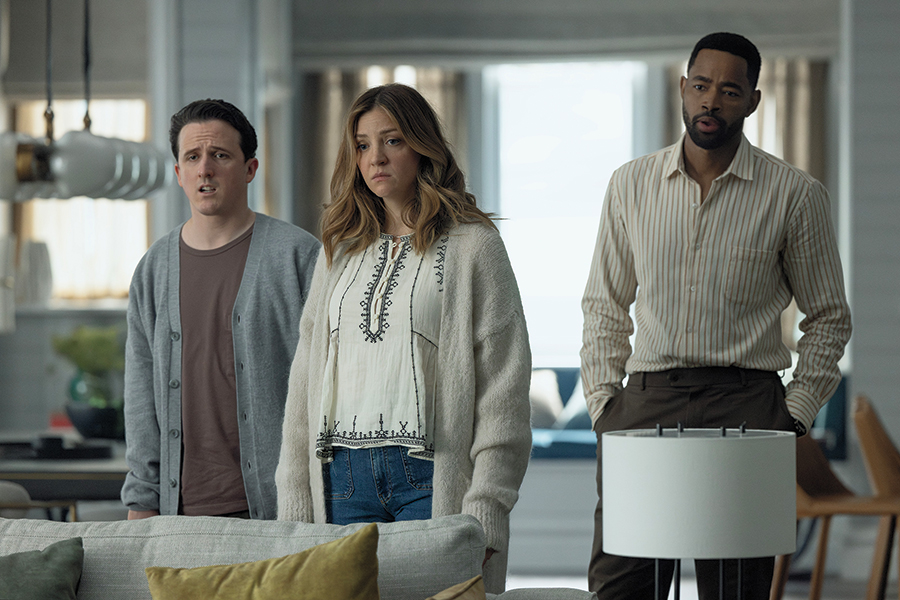
Jay Ellis, who plays Marissa’s friend Colin and stars in Running Point, is a parent, as is Abby Elliott, who plays Peter’s sister, Lia. Ellis says the premise was particularly unsettling because his own child goes on playdates regularly.
Reading the script left him so disturbed that he remembers telling his wife she should never read it.
Elliott describes the experience as similarly nerve-racking. After the first table read, she and Snook hugged and agreed that they needed to go home and hug their children.
Michael Peña says that intensity made humor essential on set. The cast frequently joked around because performing material that required them to explore such dark emotional territory demanded a way to decompress.
When maternal guilt becomes public judgment
The title All Her Fault takes on another meaning as the story unfolds.
Milo’s disappearance quickly becomes a public spectacle. During a press conference, Marissa struggles under reporters’ questions, and public opinion turns against her.
Executive producer Nigel Marchant, a 2011 Emmy winner and five-time nominee for Downton Abbey, points out that the title ultimately applies to several of the women in the story.
Maternal guilt is amplified by the scrutiny Marissa faces. The series explores how quickly a mother can become the presumed person responsible when something goes wrong, even when the circumstances involve an entire family and a much broader network of responsibilities.
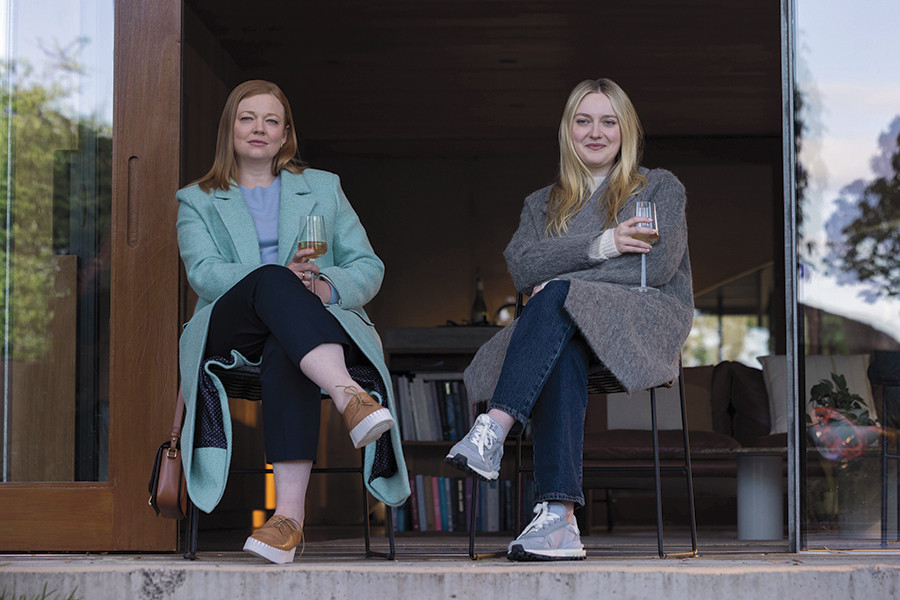
Dakota Fanning’s character, Jenny Kaminski, offers another version of that dynamic. Jenny is a fellow school parent caught in an unequal marriage to Richie, played by Thomas Cocquerel of The Gilded Age.
Richie represents a different kind of parental imbalance. He does the minimum and appears to believe that his contribution should count for much more.
One scene makes the point with mundane precision. Jenny comes home to find that Richie has prepared a sandwich for himself and left the kitchen messy.
Fanning, an Emmy nominee for her supporting role in Netflix’s Ripley, says the scene reflects the way women often notice more of what needs to be done and step in to handle tasks before their partners even recognize them.
A mystery designed to keep expanding
As the investigation continues, suspicion spreads through an increasingly large group of characters.
Even Sophia Lillis, who plays Milo’s nanny Carrie and stars in The Chair Company, was surprised by how many revelations the story contained. Executive producer and director Minkie Spiro had given her the basic outline, but Lillis says she still audibly gasped when she reached the end of the script.
Spiro, who also directed Toxic Town and the first four episodes of All Her Fault, wanted the adaptation to feel larger than a contained domestic mystery.
The goal was to make Milo’s disappearance feel like searching for a needle in a haystack.
That scale was partly achieved through the use of a Volume stage in Melbourne, Australia, where most of the series was filmed. The stage consists of 6,000 screens that allow for 360-degree shooting. Such technology is more commonly associated with science-fiction productions than intimate domestic thrillers.
The production also filmed on location in Chicago, where the story is set, while background footage of Lake Michigan was captured for use on the Volume screens.
For Lillis and Daniel Monks, who plays Peter’s brother Brian and appears in A Knight of the Seven Kingdoms, the result could feel strangely artificial. Monks compared the experience to being inside The Truman Show. When the screens occasionally glitched, the illusion suddenly disappeared and the actors were reminded that the world around them was being created digitally.
Costumes reveal what the characters cannot say
The production’s visual storytelling extended well beyond its technology.
Costume designer Gypsy Taylor, whose credits include Our Flag Means Death, worked with Snook to chart Marissa’s emotional deterioration through her clothing.
Snook wanted Marissa to appear as though she had been physically deflated by the discovery that her son was missing.
Her wardrobe gradually strips away that sense of control. She begins in a beautiful cashmere coat, then loses the coat and is left in a tailored suit jacket. Eventually, even that disappears, leaving her in a silk shirt and making her appear increasingly exposed and vulnerable.
Taylor also gave Marissa a warm color palette designed to encourage viewers to sympathize with her.
Peter’s clothes move in the opposite direction. As the story progresses, his wardrobe becomes sharper and more structured.
Jenny’s clothing communicates something different again. Restrictive turtlenecks and leather jackets make her appear emotionally armored while also suggesting that she feels trapped and suffocated.
Production designer Rob Harris, a three-time Emmy nominee whose credits include The Day of the Jackal, used similar visual techniques in the Irvine home. As the story becomes darker, the home’s color palette gradually grows cooler.
The significance of orange
One of the production’s more subtle motifs is the color orange.
Orange is associated with both Carrie and Milo, who share synesthesia, a condition in which stimulation of one sense can trigger an involuntary experience involving another, such as associating a particular color with a sound.
Harris wanted viewers to sense that the recurring color had significance before understanding exactly why.
At the same time, he cautions against assuming that every visual detail is a clue. The series deliberately contains a large number of red herrings, creating what he describes as a cacophony designed to keep viewers guessing.
Making Australia look like Chicago
Filming primarily in Australia created another unusual challenge: the production had to recreate distinctly American details.
That included everything from left-hand-drive vehicles to oversized refrigerators. Smaller elements mattered, too. Wall plates around electrical outlets, a No Guns sticker in a window and other everyday details helped establish the sense that the characters were living in Chicago.
Even seemingly insignificant objects became part of the illusion. Street signs were changed when necessary, but many of the American details were designed to register almost subliminally rather than calling attention to themselves.
Together, those choices helped maintain the atmosphere the story depends on: viewers should feel that something is wrong without always being able to identify exactly what it is.
Making the twists pay off
Kate Dennis, an Emmy nominee for The Handmaid’s Tale, directed the final four episodes and faced a different challenge from Spiro’s first half of the series.
The opening episodes plant a succession of suspicions and misdirects. The second half has to make those choices pay off while keeping the characters’ emotional journeys consistent.
For Dennis, the difficulty lies in getting all the small moments right. Every reveal has to work alongside the characters’ established emotional arcs, while the audience’s expectations need to be repeatedly challenged.
That careful balance is what allows All Her Fault to function as more than a kidnapping mystery. The disappearance of Milo provides the immediate suspense, but the deeper tension comes from watching a family, and the people surrounding it, confront questions about responsibility, marriage, parenthood and blame.