Emma Thompson’s beloved adaptation casts a long shadow, but perhaps Jane Austen’s darkest novel deserves an even darker retelling…
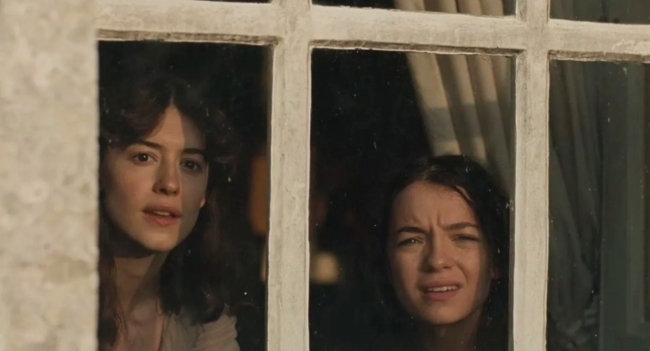
Thirty-one years after Emma Thompson’s Sense And Sensibility swept the Oscars, and more than two centuries after Jane Austen first published the novel, another starry adaptation is on its way. And when I say starry, I mean starry; think George MacKay, Daisy Edgar-Jones, Esmé Creed-Miles, Herbert Nordrum, Caitríona Balfe, Frank Dillane and Fiona Shaw, to name just a few.
Still, there is no point denying that they have an almost impossibly elegant pair of shoes to fill. After all, for many Austen fans, Thompson’s film isn’t simply an adaptation; it’s the adaptation. Kate Winslet’s windswept Marianne Dashwood. Emma Thompson’s quietly devastating Elinor. Hugh Grant somehow making awkwardness the height of romance, as ever and always. Alan Rickman giving us one of cinema’s greatest green flag performances decades before we had the phrase to describe it. Honestly, it is a film I return to every year, as reliable and comforting as a mug of hot chocolate.
And yet, unlike Pride And Prejudice, Sense And Sensibility has never felt like a novel that’s finished revealing itself.
Watch the trailer for the new Sense And Sensibility below.
It’s the Austen book I’ve reread the most, and not because it’s her funniest (that honour belongs elsewhere) or her most romantic (step up to the plate, Mr Darcy!), but because it grows darker every time I return to it. Beneath its drawing rooms and dances lies a story about women trying to build meaningful lives in a world where the odds are forever stacked against them. The Dashwood sisters lose their home because of inheritance law and love is constrained by money, duty and reputation. Happiness isn’t awarded to the deserving, either; instead, it’s painstakingly assembled from compromise, resilience and hope.
Even its great villain feels startlingly modern. George Wickham, of Pride And Prejudice fame, is a charming predator whose true nature is eventually exposed. John Willoughby is something more unsettling: not evil so much as weak. He loves Marianne – perhaps as much as he is capable of loving anyone – but when wealth and security beckon, he chooses them instead. It’s an example of cowardice rather than cruelty, and that somehow makes him feel… well, more recognisable. Perhaps Austen understood long before anyone else that the people who break our hearts are not always monsters. Sometimes they’re just… ordinary people who make very bad decisions.
While Elinor is famously the more sensible (hey, like the name!) of the two, Marianne remains one of Austen’s most fascinating heroines. She believes in ecstatic and all-consuming love, in feeling everything deeply and apologising for none of it. She rejects polite restraint, social performance and sensible marriages. In any other novel, she’d be celebrated as a romantic heroine.
Here, though? She almost dies for it.

For some critics, that’s precisely the point that Austen is trying to make. Indeed, Marianne’s devastating illness has long been read as a kind of correction: a fiery young woman forced back into the boundaries that society expects of her. Read that way, Sense And Sensibility becomes an unexpectedly bleak novel, one in which female passion is something to be disciplined and contained rather than celebrated.
Thompson’s adaptation famously pushed back against that interpretation; rather than punishing Marianne for loving too much, the film offers something infinitely kinder in suggesting that first love isn’t necessarily the greatest love. That surviving heartbreak doesn’t diminish us but expands our capacity to love again. And Winslet’s Marianne doesn’t surrender her spirit; she simply discovers that devotion can arrive in a quieter form… and what a form!
Quite frankly, Rickman’s Colonel Brandon has become something of a patron saint of emotionally mature men. He listens more than he speaks, he offers assistance without expectation, he never pressures the woman of his affections to choose him, and he never asks Marianne, either, to become someone else in order to deserve his affection. Every single rewatch (of which there have been many; I even watched it on my iPad while I was in labour with my daughter) reminds me that Brandon was the greatest: patient enough to love someone through their worst mistake, generous enough not to demand they repay him for it.
Also, the image of him carrying her bridal-style through the rain? It lives rent-free in my head pretty much forever.

If Joe Wright’s Pride And Prejudice became the defining cinematic portrait of yearning (hello? That hand flex?), then Thompson’s Sense And Sensibility taught a generation that romance isn’t only about being chosen, or told that you’re loved. Rather, it’s about being cherished, respected and shown that you are loved through another’s actions and behaviour.
So, what can another adaptation possibly offer? Well, perhaps exactly what Austen adaptations have always offered: another conversation.
Like Greta Gerwig’s Little Women, the new Sense And Sensibility doesn’t need to replace the version many of us already adore; it simply has to ask different questions. Will it lean into the novel’s harsher edges? Will Marianne’s illness feel less like romantic melodrama and more like the terrifying physical cost of grief? Will Colonel Brandon remain the gentle hero Thompson imagined or become the haunted bachelor with a tragic past that becomes the prize of a Marianne who has been broken and all but destroyed by societal demands? The one that… well, the one that Austen wrote?
I hope, if nothing else, it trusts how strange and unsentimental the novel really is, because beneath the cosy cottages and empire-waist gowns is one of Austen’s sharpest observations: life is rarely fair, but happiness remains possible anyway. To me, that feels like exactly the story we need right now.
And if the new film sends me home to rewatch Emma Thompson’s masterpiece once again? Well, perhaps that’s the greatest compliment any adaptation can pay the one that came before it.
Sense And Sensibility will arrive in UK cinemas on 25 September.