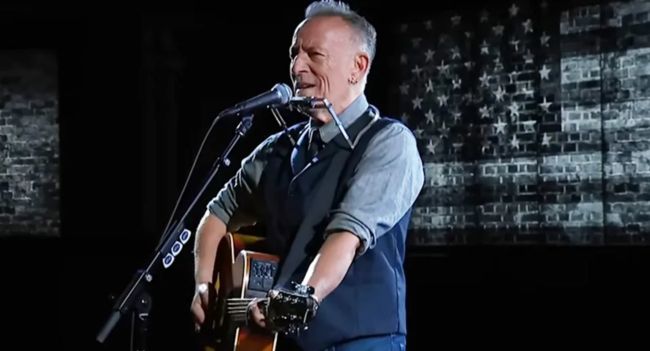
Bruce Springsteen Stood Beside Stephen Colbert on His Second-to-Last Late Show — With a Political Speech and ‘Streets of Minneapolis’ Dedication

Bruce Springsteen arrived at The Late Show during one of the most emotional weeks in Stephen Colbert’s 11-year run.
On Wednesday, May 20, with only one episode remaining before Colbert’s farewell, Springsteen used his appearance to publicly support the outgoing host, criticize the circumstances surrounding the show’s cancellation and perform “Streets of Minneapolis.”
CBS had announced in July 2025 that The Late Show with Stephen Colbert would end in May 2026 and that the franchise itself would be retired. The network said the move was purely financial and unrelated to the show’s content or other matters at Paramount. Critics and some political figures publicly questioned that explanation.
Springsteen made his own view unmistakably clear.
Springsteen Came to Support Colbert
Standing at the microphone, Springsteen said he was there to support Colbert and alleged that the host had lost his program because the President couldn’t tolerate being mocked.
He also criticized Larry and David Ellison, whose family controls Paramount following its combination with Skydance, according to the source article.
Springsteen’s remarks represented his own political interpretation of the show’s ending, not an established explanation for CBS’s decision.
CBS consistently maintained that ending The Late Show was a financial decision made against a difficult economic backdrop for late-night television.
The timing nonetheless fueled debate because Colbert had been a frequent critic of the administration and had recently attacked Paramount’s settlement of the President’s lawsuit concerning a 60 Minutes interview.
Paramount’s $16 Million Settlement Added to the Controversy
Xem bài viết này trên Instagram
Paramount agreed in July 2025 to settle the lawsuit for $16 million, with the money allocated toward the President’s future presidential library and plaintiffs’ fees and costs rather than paid directly to him.
Paramount maintained that the underlying lawsuit was without merit, and the settlement did not include an apology.
The announcement that Colbert’s show would end came later that month.
That sequence led figures including Senator Elizabeth Warren and other critics to raise questions about whether politics had influenced the decision.
CBS denied such a connection.
Springsteen clearly sided with those skeptical of the network’s explanation.
He told Colbert that the people involved had failed to understand what American freedoms were supposed to represent.
Springsteen Dedicated ‘Streets of Minneapolis’ to Colbert
Springsteen followed his remarks with “Streets of Minneapolis,” dedicating the performance to Colbert.
The song was written following federal immigration enforcement operations in Minneapolis and the deaths of Renée Good and Alex Pretti in January, according to the source.
Springsteen had previously debuted the song live in Minneapolis during the Defend Minnesota benefit concert on January 30.
It subsequently reached No. 1 on Billboard’s Digital Song Sales chart dated February 7, despite being available for only two days during that chart’s tracking period.
Springsteen also pledged the recording’s proceeds to the families of Good and Pretti.
Its performance on Colbert’s penultimate broadcast therefore carried an explicitly political message consistent with Springsteen’s public criticism of the administration.
Colbert Had One Show Remaining

The following night, May 21, brought Colbert’s tenure to an end after more than 1,800 episodes and 11 years behind The Late Show desk.
The final weeks had already become a long farewell.
David Letterman returned to the theater he once called home. Tom Hanks, Steven Spielberg and fellow late-night hosts were among those who appeared as the final broadcast approached.
Springsteen joined that procession on the second-to-last night.
And Colbert’s eventual final musical guest carried another extraordinary connection to the Ed Sullivan Theater: Paul McCartney, who had first performed there with The Beatles during their historic American television debut in 1964.
The Boss Chose His Own Way to Say Goodbye

Springsteen could have treated the appearance as a straightforward musical farewell to a longtime television host.
Instead, he used the moment to make his political position clear.
His comments about why The Late Show was ending remain his interpretation; CBS continued to dispute the suggestion that politics or Colbert’s content caused the cancellation.
But there was no ambiguity about why Springsteen himself had shown up.
With Stephen Colbert one night away from leaving the desk he’d occupied for 11 years, Bruce Springsteen stood beside him, publicly offered his support and dedicated one of his most politically charged recent songs to the departing host.