Congratulations!
You've earned 1 point
Paul McCartney Reflects on Starting Over After The Beatles and Building Wings From Scratch
:max_bytes(150000):strip_icc():focal(761x394:763x396):format(webp)/paul-mccartney-and-the-wings-022825-2-0344f0c3cc224533abbe2167bfbbce38.jpg)
Paul McCartney has opened up about the uncertain but ultimately transformative period that followed the breakup of The Beatles, describing the creation of Wings as a personal and creative “rebirth.”
The 83-year-old musician, who published the oral history Wings: The Story of a Band on the Run this year, revisited the early days of his post-Beatles career during the Dec. 19 episode of NPR’s Book of the Day podcast with A Martínez.
Although the end of The Beatles in 1970 was still a “shock,” McCartney recalled entering a period in which he felt creatively freer. By then, the relationships and dynamics between himself, John Lennon, George Harrison and Ringo Starr had been changing.
McCartney said he had hoped the group might strip everything back and rediscover the simplicity of its earliest days.
“I was trying to encourage us to go back and start from square one,” he explained. “But in actual fact, I did that with Wings.”
Wings gave McCartney the chance to begin again
:max_bytes(150000):strip_icc():focal(695x384:697x386):format(webp)/paul-mccartney-and-the-wings-022825-1-475af153825e466b9929ff58f42ac879.jpg)
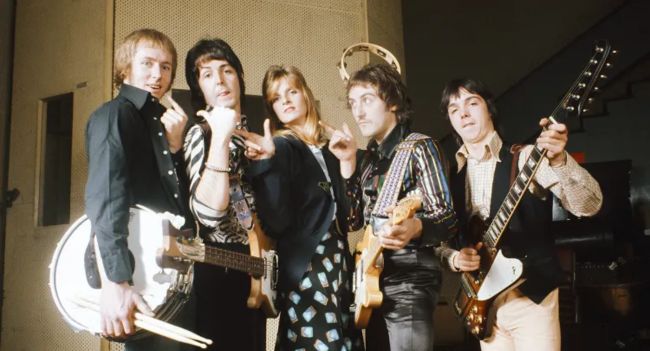
McCartney formed Wings in 1971 alongside his wife, Linda McCartney, and guitarist Denny Laine.
The group’s lineup would change several times over the following decade before Wings eventually disbanded in 1981. During that run, the band sold more than 20 million records worldwide and produced enduring hits including “Band on the Run,” “Silly Love Songs” and “Live and Let Die.”
For McCartney, however, the beginning was about much more than simply forming another successful group.
“It really was like a rebirth,” he said.
One of the most unusual aspects of that fresh start was bringing Linda into the band despite her lack of professional musical experience.
McCartney remembered the pair singing together around their home and becoming increasingly impressed by what he heard.
“We would sing around the house, and I always remember thinking, ‘Wow, she’s really got something. But she’s completely inexperienced,’” he recalled.
Linda sensed that her husband wanted to put together another group. When McCartney eventually asked whether she wanted to join him, her response was characteristically understated.
“She sorta said, ‘Uh, yeah,’” he remembered.
Why McCartney initially refused to perform “Yesterday”
:max_bytes(150000):strip_icc():focal(749x0:751x2):format(webp)/Denny-laine-dead-1-120523-268912273b3f48c4bd00070b61379a34.jpg)
Establishing Wings as an independent band also meant deliberately creating distance from McCartney’s Beatles legacy.
That proved difficult when promoters naturally wanted audiences to hear some of the songs that had already made him one of the world’s biggest musicians.
McCartney recalled being repeatedly asked to perform “Yesterday,” but he and Wings resisted.
“At the time, I thought I’m trying to make a new band here,” he explained. “I’m trying to do this new thing.”
When promoters pleaded with him to play the Beatles classic, his answer remained firm: “No. We’re not doing it.”
The decision was intentional. Rather than relying on Beatles songs to carry their concerts, McCartney wanted Wings to accumulate enough material to stand on its own.
That process took time, but the breakthrough eventually came with the release of Band on the Run in 1973.
By then, McCartney said, Wings finally had songs audiences immediately recognized as belonging to the new band rather than his former one.
A new book revisits Wings’ turbulent journey
Published on Nov. 4, Wings: The Story of a Band on the Run draws on hours of interviews with McCartney, former Wings members and other people connected to the group’s history, including George Martin and Sean Ono Lennon.
The project allowed McCartney to revisit a period filled with experimentation, uncertainty and what he described as “madcap adventures.”
In an earlier statement about the book, McCartney acknowledged that beginning again after The Beatles was far from easy.
“Starting from scratch after The Beatles felt crazy at times,” he said. “There were some very difficult moments, and I often questioned my decision.”
But as Wings developed and found its identity, those doubts gradually began to disappear.
“As we got better,” McCartney recalled, “I thought, ‘Okay, this is really good.’”