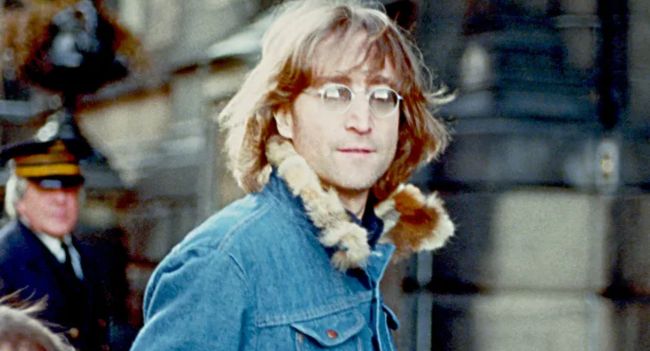
On December 8, 1980, John Lennon sat inside his New York City home and spoke to a group of radio journalists about music, his return to recording and his new album with Yoko Ono.
:max_bytes(150000):strip_icc():focal(791x270:793x272):format(webp)/john-lennon-120325-19e7b22805ec4e1289a835fe48ed83e0.jpg)
Nobody in the room knew they were conducting his final interview.
Just hours later, Lennon would be murdered outside the same Manhattan building.
Now, more than four decades after his death, Steven Soderbergh’s documentary John Lennon: The Last Interview revisits those final hours — including an unnerving encounter involving the journalists as they left the Dakota that takes on a horrifying significance in hindsight.
The interview was supposed to be about John’s comeback
:max_bytes(150000):strip_icc():focal(749x0:751x2):format(webp)/john-lennon-germany-062625-9942699d05a14c7298ec40711d822db4.jpg)
Lennon had recently returned to music after spending years largely away from the recording industry.
Double Fantasy, his album with Ono, had been released only three weeks earlier.
On December 8, San Francisco radio station KFRC sent Dave Sholin, Laurie Kaye and Ron Hummel to interview the former Beatle at the Dakota.
The conversation was intended to focus on the new record and this latest stage of Lennon’s life.
Instead, it became the final interview he would ever give.
Lennon was 40.
The interviewers encountered a disturbing stranger afterward
:max_bytes(150000):strip_icc()/john-lennon-parents-3-32ccc5dd36f444bfbc71d6e7f871a4f2.jpg)
According to The Guardian, something deeply unsettling happened when the KFRC team left the building.
They encountered a man described as a “creepy stalker-fan.”
In an effort to calm him, Kaye reportedly gave him a brand-new copy of Double Fantasy.
The man was Mark David Chapman.
Hours later, he would murder Lennon.
The detail becomes even more disturbing because Chapman had also obtained Lennon’s autograph on a copy of the album that day.
The documentary revisits the circumstances surrounding the encounter as it reconstructs the final interview and the events of December 8.
Lennon and Yoko had already created some of their most famous photographs that day
![John Lennon, The Last Interview' Review: Steven Soderbergh's Immersive Documentary Finds A Lost Future In Lennon's Final Hours [Cannes]](https://cdn.theplaylist.net/wp-content/uploads/2026/05/07115651/JOHN-LENNON-THE-LAST-INTERVIEW-Steven-Soderbergh-1024x576.jpg)
The radio interview was not the only significant event to take place inside the Lennons’ apartment.
Earlier that day, photographer Annie Leibovitz visited Lennon and Ono for a photo shoot.
The resulting images of the couple would become some of the most recognizable photographs ever taken of them.
The timing made them tragically significant.
Within hours, the images and the radio conversation had become documents of Lennon’s final day.
Soderbergh’s film uses previously unseen photographs of Lennon and Ono as it examines that period.
According to Variety, the documentary also incorporates a small number of AI-created fantasy images.
Hours later, Lennon returned to the Dakota
After completing the interview and leaving the apartment later that day, Lennon and Ono eventually returned home.
Lennon was shot outside the Dakota.
According to the account cited by PEOPLE, he was struck twice in the back and twice in the shoulder with a .38-caliber pistol.
New York City medical examiner Dr. Elliot Gross attributed Lennon’s death to “massive hemorrhaging and shock” caused by the gunshot wounds.
The autopsy found that two bullets struck Lennon’s left lung before exiting through his chest.
Another bullet entering through his shoulder struck his left arm bone, while a fourth punctured his left lung and lodged in his neck.
Lennon was only 40 years old.
His killer remained at the scene
Chapman confessed shortly after the shooting.
Decades later, he would speak openly about his motive during parole proceedings.
At a September 2022 parole hearing, Chapman admitted that his desire for notoriety played a central role.
“I knew what I was doing, and I knew it was evil,” he said. “I knew it was wrong, but I wanted the fame so much that I was willing to give everything and take a human life.”
His actions brought a devastating end to a day that had begun with Lennon looking toward the future.
The final interview became far more significant than anyone expected
That is what gives the surviving conversation such haunting historical weight.
The journalists had arrived to discuss a musician beginning another chapter of his career.
Lennon had spent years away from releasing new music before returning with Double Fantasy.
There was no reason for the interviewers to imagine they were recording his final thoughts.
And when they encountered Chapman outside, they could not have known what would happen only hours later.
What had been an ordinary promotional interview became one of the final extensive records of Lennon speaking about his life and work.
Steven Soderbergh returns to those final hours
John Lennon: The Last Interview is directed by Steven Soderbergh and premiered at the 2026 Cannes Film Festival on May 16.
Rather than simply recounting Lennon’s career, the documentary concentrates on that final interview and the circumstances surrounding it.
Previously unseen photographs provide another window into Lennon and Ono’s life, while the testimony and material connected to the KFRC interview bring audiences back to December 8, 1980.
Knowing what happened afterward inevitably changes the way those conversations are heard.
Ordinary remarks become final remarks.
A promotional interview becomes a historical recording.
And a strange encounter outside the Dakota becomes something far darker.
A day that began with plans for the future became Lennon’s last
Lennon left behind Yoko Ono and his two sons, Julian and Sean.
His murder ended a life and career that had already transformed popular music, but the material recorded during his final day preserved an extraordinary snapshot of where he was at 40.
He had made new music.
He was giving interviews again.
He had posed for photographs with his wife.
And he was discussing the future without knowing how little of that day remained.
More than 45 years later, John Lennon: The Last Interview returns to those final hours — when a conversation about a comeback unknowingly became a goodbye.