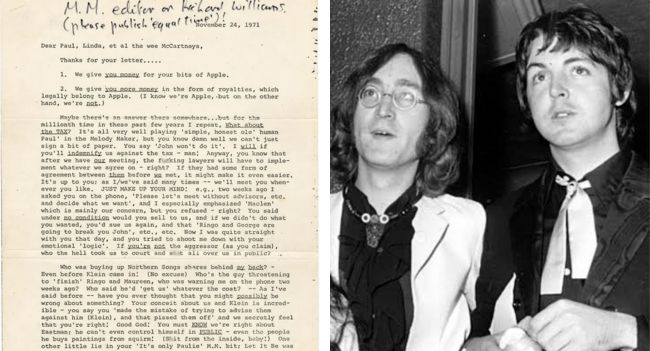
John Lennon’s Furious Three-Page Letter To Paul McCartney Exposed How Bitter The Beatles Breakup Had Become

John Lennon and Paul McCartney had spent years creating some of the most celebrated music in history together. By 1971, their relationship had deteriorated so badly that Lennon poured his anger into a blistering three-page letter to his former songwriting partner.
Written in November 1971, roughly 18 months after The Beatles’ breakup, the typewritten letter confronted McCartney over everything from the band’s legal and financial battles to politics, Yoko Ono and the increasingly public war of words between the two former friends.
Yet amid all the anger, Lennon ended with something surprisingly conciliatory.
There were “no hard feelings,” he insisted, before telling McCartney that if he ever wanted to meet, he only had to call.
Decades later, the extraordinary document was offered at auction with an estimate of up to $40,000.
McCartney’s Interview Sparked Lennon’s Response
Lennon wrote the letter after reading an interview McCartney had given to the British music magazine Melody Maker.
The Beatles had already separated, but the legal and personal consequences of the breakup were still unfolding.
At the centre of the dispute was the group’s business relationship.
McCartney had opposed the appointment of Allen Klein to manage The Beatles’ financial affairs, while Lennon, George Harrison and Ringo Starr supported Klein.
McCartney subsequently took legal action seeking the dissolution of the band’s contractual partnership.
For Lennon, McCartney’s public characterization of the conflict in his Melody Maker interview was difficult to accept.
His response was unmistakably angry.
“It’s all very well playing ‘simple, honest ole’ human Paul’ in Melody Maker,” Lennon wrote, before challenging McCartney over who had actually taken the group to court and attacked the others publicly.
Lennon then delivered another cutting line.
“As I’ve said before – have you ever thought you might possibly be wrong about something?”
The Beatles’ Business War Had Become Deeply Personal
The disagreement over Klein represented much more than a routine business dispute.
By the time The Beatles separated, years of extraordinary success had become tangled with questions about money, management and control.
McCartney believed going to court was necessary to dissolve the partnership.
Lennon clearly saw the situation very differently.
“Your conceit about us and Klein is incredible,” he wrote, defending Harrison and Starr alongside himself.
The letter demonstrated how difficult it had become to separate the financial fight from the damaged friendships underneath it.
Lennon and McCartney had known each other since they were teenagers and had spent years writing songs together as the creative engine behind The Beatles.
Now they were communicating through lawyers, magazine interviews and angry correspondence.
Lennon Also Attacked McCartney Over Politics
Money and management were not Lennon’s only grievances.
He also took aim at McCartney’s attitude toward political songwriting.
Lennon had become increasingly outspoken politically and was a prominent opponent of the Vietnam War. In 1971, he also released Imagine, one of the songs that would become most closely associated with his calls for peace.
McCartney, meanwhile, had criticized the direction of Lennon’s songwriting during his Melody Maker interview, saying there was “too much political stuff.”
Lennon fired back in his letter.
“Your politics are very similar to Mary Whitehouse’s,” he wrote, referring to the British conservative activist.
“Saying nothing is as loud as saying something.”

The remark revealed another growing difference between two musicians whose names had once appeared side by side on some of the world’s most famous songs.
Yoko Ono And Linda McCartney Became Part Of The Argument
The letter also addressed one of the most sensitive areas surrounding The Beatles’ breakup: Lennon and McCartney’s relationships with their wives.
Yoko Ono had faced years of accusations that she had contributed to the band’s collapse, a narrative Lennon strongly resisted.
He was particularly bothered by the suggestion that he and McCartney should meet without Yoko and Paul’s wife, Linda McCartney.
“The bit that really puzzled us was asking to meet WITHOUT LINDA AND YOKO,” Lennon wrote.
He then made his position unmistakable: “I thought you’d have understood by now that I’m JOHNANDYOKO.”

For Lennon, his partnership with Yoko was not something he was prepared to separate from the rest of his life simply to recreate the relationship he once had with McCartney.
By 1971, both men had moved into very different personal and creative lives.
The Letter Captured Their Friendship At One Of Its Lowest Points
The ferocity of Lennon’s words illustrated just how far the relationship had fallen from the years when he and McCartney worked side by side.
Their friendship had begun long before international fame.
They met as teenagers and developed a songwriting partnership that eventually became central to The Beatles.
Together with Harrison and Starr, they experienced a level of global fame almost impossible to separate from their personal lives.
But by the band’s final years, tensions had grown.

After the breakup, those disagreements did not disappear. Instead, some became even more public.
Songs, interviews and statements were interpreted as attacks between the former bandmates, creating an image of Lennon and McCartney as bitter rivals.
The November 1971 letter shows that the anger behind that image was, at least at that moment, very real.
Yet its ending suggests the relationship was never quite as simple as hatred.
Lennon Ended His Attack With An Unexpected Olive Branch

After three pages of grievances, Lennon changed tone.
Despite everything he had written, he told McCartney there were “no hard feelings.”
Then he left the door open.
“I know we basically want the same,” Lennon wrote.
He reminded McCartney of what he had already said by telephone and repeated that the two could meet whenever McCartney wanted.
“All you have to do is call,” Lennon concluded.
It was a striking ending to such an angry document.
Lennon had attacked McCartney’s behavior, challenged his account of the breakup and criticized his politics. Yet he still appeared unwilling to close the friendship completely.
That contradiction would continue to define their relationship.
Their Relationship Eventually Began To Heal
The hostility of the immediate post-Beatles period did not last forever.
During the following years, Lennon and McCartney gradually repaired some of the damage between them.
They never returned to their old songwriting partnership or publicly performed together again, but the bitterness eased.
Their contact became more friendly, and they continued speaking by telephone.
McCartney also visited Lennon in New York.
The last time the two men saw each other was reportedly in 1976, four years before Lennon’s death.
By then, the relationship was far removed from the furious correspondence of 1971.
A $40,000 Piece Of Beatles History
The three-page letter later emerged as a remarkable artifact from one of the most turbulent periods in Beatles history.
It was offered through music memorabilia auction house Gotta Have Rock and Roll with an estimated value reaching $40,000.
At the time of the report, bidding had reached $22,000.
Its significance extends beyond Lennon’s signature or its connection to two famous musicians.
The letter captures Lennon and McCartney while the wounds of The Beatles’ breakup were still raw.
There is anger over money.
There is frustration over politics.
There is resentment involving their wives.
And there is the complicated emotional residue of two people who had spent an extraordinary portion of their lives together before everything fell apart.
Anger Never Completely Erased The Bond
McCartney has spent decades reflecting on the complicated relationship he shared with Lennon.
Their friendship was never a simple story of perfect creative harmony followed by permanent hatred.
They could be extraordinarily close and fiercely competitive.
They could create together and wound each other.
The breakup brought some of their ugliest disagreements into public view, and Lennon’s 1971 letter captured that bitterness with unusual directness.
But even after pages of fury, Lennon could not quite shut the door.
He ended by telling McCartney to call.
Years later, they would find their way back to a friendlier relationship before Lennon’s murder in New York in 1980 made any further reconciliation impossible.
That makes the letter more than an angry relic from The Beatles’ collapse.
It captures Lennon and McCartney somewhere in the difficult middle — no longer the inseparable young songwriting partners they had once been, but not yet ready to completely let each other go.