Lore: A Distinct Coming-of-Age Story in the Ruins of Nazi Germany
Cate Shortland’s Lore approaches the aftermath of the Second World War from a deeply unsettling perspective: not through soldiers or resistance fighters, but through the eyes of children raised to believe in Nazi ideology.
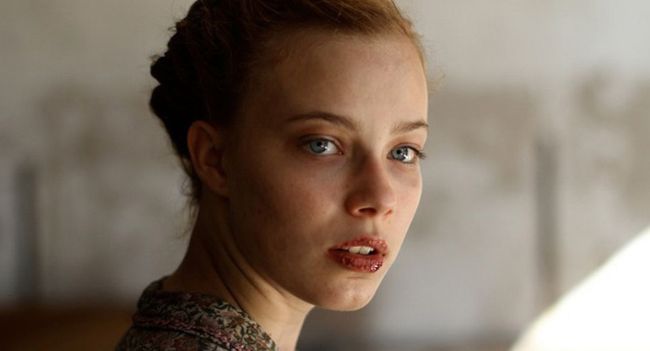
At the centre is Lore, the 14-year-old eldest of five siblings, played with remarkable intensity by Saskia Rosendahl. When her Nazi parents disappear at the end of the war, Lore is suddenly responsible for getting her younger brothers and sisters to their grandmother’s home near Hamburg.
What begins as a journey through a defeated Germany becomes something much more complicated. Lore must find food, shelter and safety while gradually confronting the collapse of everything she was taught to believe — including the idea that the Third Reich would prevail.
Adapted from Rachel Seiffert’s Booker-shortlisted novel The Dark Room, Lore turns a survival story into an unusual coming-of-age drama about indoctrination, trust, sexuality and the painful loss of innocence.

The end of childhood
The film opens in a deceptively peaceful setting.
Lore is taking a bath, while her younger sister Liesel, played by Nele Trebs, plays hopscotch. The children are still living within the protected world created by their parents.
That illusion ends when their father, Vati (Hans-Jochen Wagner), a senior SS officer, suddenly arrives home. He tells his wife, Mutti (Ursina Lardi), that they must leave immediately.
As the family hurriedly prepares to abandon their home, Vati and Mutti burn incriminating documents. They are not simply ordinary German parents caught up in the collapse of the country; they are committed Nazis who have spent years passing those beliefs on to their children.
Soon, however, the protection those beliefs once seemed to provide disappears. Their father is taken into Allied custody, while their mother surrenders herself, leaving Lore and her siblings to fend for themselves.
Lore becomes the leader almost overnight.
With some money and jewellery left behind, she sets out with her siblings on a gruelling 900-kilometre journey to their grandmother in Hamburg. They must cross a Germany fractured by defeat and occupation, where food is scarce and the usual rules of society have largely collapsed.
A world Lore was never prepared to see
The journey is not simply about getting from one place to another.
Lore has been raised to believe that the Nazi worldview is correct. Now she is travelling through the consequences of that very ideology.
Shortland does not make this transformation easy or sentimental. Lore does not suddenly understand everything that has happened, nor does she immediately abandon the beliefs that shaped her childhood.
Instead, the contradictions accumulate around her.
The children encounter hunger, violence, corpses and exploitation. The film refuses to soften the physical reality of a country emerging from war, showing how completely ordinary life has been disrupted.
Even more disturbing is the persistence of Nazi thinking among some of the adults they encounter. The regime has collapsed, but its ideology has not simply vanished. One farm woman mourns Hitler as someone who loved his people, revealing how difficult it can be for individuals to accept that the system they trusted has brought devastation instead of glory.
That tension gives Lore much of its emotional force. The war may be over, but its consequences are only beginning for these children.

Thomas challenges everything she believes
The most complicated relationship in the film begins when Lore encounters Thomas, played by Kai Malina.
Thomas is a young Jewish survivor who has endured the concentration camps and learned how to survive in the chaotic world left behind by the war.
His presence creates an immediate contradiction for Lore.
She is drawn to him, yet her Nazi upbringing has taught her to view Jewish people through the regime’s dehumanising propaganda. Thomas, meanwhile, has his own reasons for remaining emotionally guarded after everything he has experienced.
Their connection therefore never becomes a conventional romance. Attraction, suspicion, fear and inherited hatred exist alongside one another.
Thomas becomes a challenge to Lore’s worldview simply by existing in her life. He forces her to confront a person who does not fit the image she has been taught to believe.
The film is careful not to turn that relationship into an uncomplicated redemption story. Lore’s transformation remains uncertain, and the emotional consequences of everything she encounters continue to follow her.
Cate Shortland keeps the story deeply personal
Shortland, who previously directed Somersault, approaches Lore with the same interest in female adolescence and emotional vulnerability, but places that intimate perspective against one of the darkest periods in European history.
Working with co-writer Robin Mukherjee, she adapted Seiffert’s The Dark Room into a film that relies as much on atmosphere and observation as conventional exposition.
The camera stays close to Lore and the children, often giving the impression that the audience is experiencing the journey from inside her fractured perspective.
Cinematographer Adam Arkapaw, known for Animal Kingdom, plays a major role in creating that effect. His fluid, often handheld photography moves between sweeping natural landscapes and small, tactile details, keeping the film simultaneously beautiful and unnerving.
The result is a Germany that can look almost dreamlike even when the reality beneath those images is horrific.
Beauty against devastation
One of Lore‘s most distinctive qualities is the contrast between its visual beauty and the brutality of its story.
Forests, fields and rural landscapes are filmed with extraordinary sensitivity. Yet the children pass through a world filled with death, deprivation and evidence of what the war has left behind.
The imagery often shifts with Lore’s emotional state, while Max Richter’s score adds another layer of unease. The music can become heavy and ominous before giving way to quieter, more delicate passages.
BFI has highlighted the way Arkapaw’s cinematography and Richter’s score work together to place Lore’s personal awakening against the larger horror surrounding her.
Rather than relying on constant spectacle, Shortland allows the atmosphere to build gradually. The result is closer to a dark fairy tale than a conventional historical war film, with the landscape itself becoming part of the story.
No simple redemption
Perhaps the most challenging aspect of Lore is that it refuses to tell viewers exactly what Lore has learned.
Her beliefs begin to fracture, but the film does not present her as someone who emerges from the journey with a clean understanding of right and wrong.
There is no obvious redemption arc.
Even near the end, Lore’s actions remain morally complicated, and the film deliberately avoids the kind of cathartic conclusion often associated with stories about the Holocaust and Nazi Germany.
That refusal to provide easy closure is part of what makes the film so distinctive. Lore is not simply transformed by witnessing suffering. She is forced to live with the contradictions she has discovered.
When she and her siblings finally reach their grandmother’s home, the apparent return to normality feels deeply uncomfortable. The world has changed irrevocably, even if the adults around her would rather behave as though it has not.
A coming-of-age story unlike most others
At its heart, Lore is still a story about adolescence.
Lore is discovering attraction, sexuality, responsibility and independence at the same time that the ideological world of her childhood is collapsing around her.
That makes Saskia Rosendahl’s performance particularly important. She captures a teenager who is frightened and overwhelmed but also fiercely determined to protect her siblings, while gradually confronting truths she was never prepared to understand.
The performance was widely praised, with critics highlighting Rosendahl’s ability to convey both Lore’s vulnerability and her deeply troubling attachment to the beliefs of her upbringing. Lore currently holds a 94% critics’ score on Rotten Tomatoes.
The film’s emotional power comes from refusing to separate Lore’s personal awakening from the historical catastrophe surrounding her. Her childhood ends not because she is ready to grow up, but because the world she trusted has collapsed.
A haunting portrait of a country trying to move on
Lore is not an easy historical drama, and it was never designed to be.
Its disturbing imagery, deliberately impressionistic storytelling and morally ambiguous protagonist can make it demanding viewing. But those qualities also prevent it from becoming another straightforward account of World War II.
Instead, Shortland focuses on what happens after the fighting stops — when children raised inside an extremist ideology are left to navigate the consequences of a world they were taught to misunderstand.
The result is a stark, visually extraordinary coming-of-age film about survival and the painful process of unlearning.
Lore’s journey may take her across 900 kilometres of post-war Germany, but the more difficult journey happens inside her: from unquestioning belief toward an uncertain awareness of what her family, her country and her childhood have really left behind.